
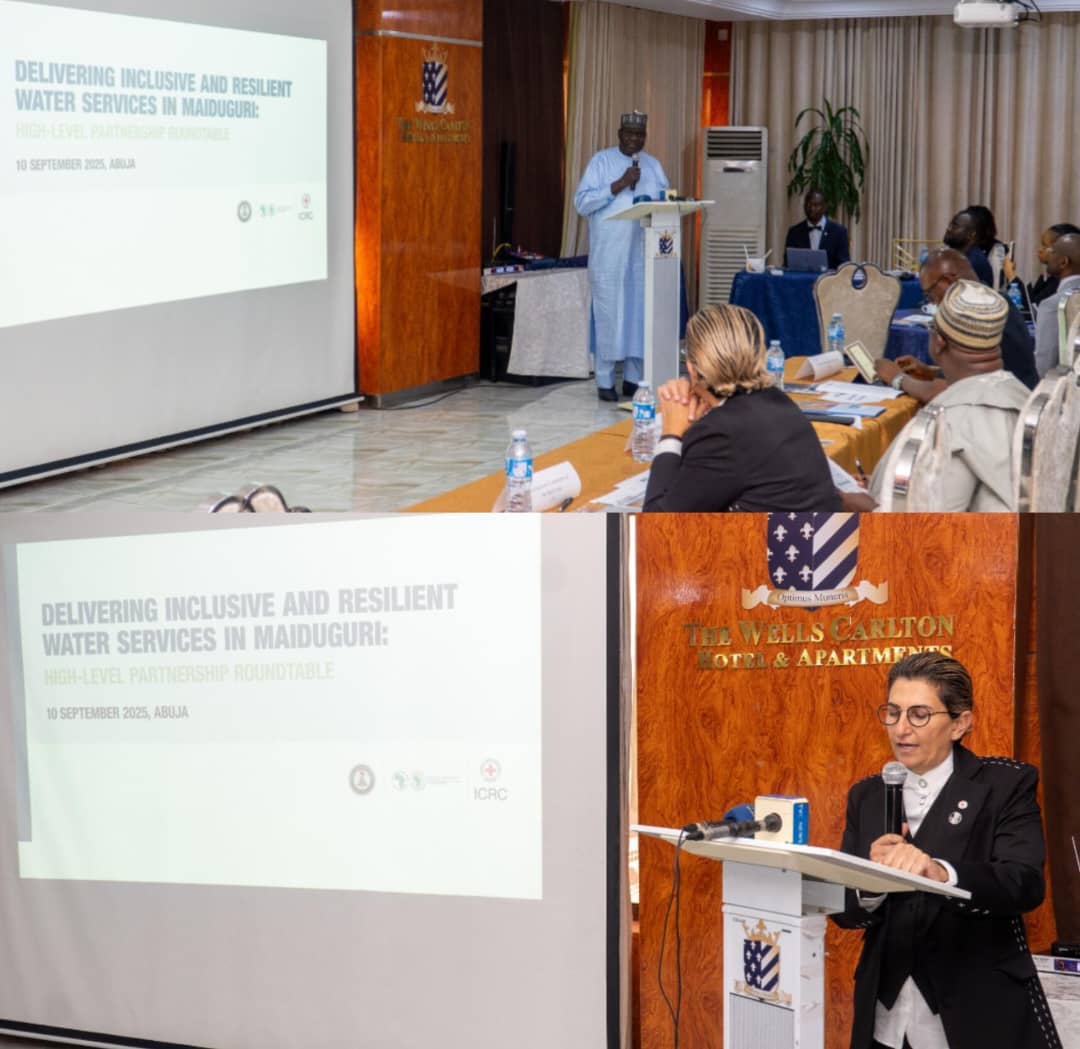
The International Committee of the Red Cross (ICRC), African Development Bank (AfDB) and other humanitarian workers in collaboration with Borno state government has held a high-level partnership roundtable discussion to rehabilitated as well as expand the Maiduguri’s water system so as to meet the growing needs of 2.5 million people estimated to be inhabitants by 2030.
Aliyu Dawobe, the ICRC’s communication officer, Abuja delegation disclosed this in a statement sent to GLOBAL TRACKER on wednesday.
GLOBAL TRACKER recalled that this comes as the state suffers devastating flooding in 2024 caused by the collapse of the Alau Dam, which displaced over 419,000 people and affected more than one million in Maiduguri.
According to the statement, the discussion was co-convened by the ICRC and the AfDB, in partnership with the Ministry of Water Resources and the Borno State government and It brought together about 40 senior government officials, representatives from
humanitarian organizations, the Nigeria Development Partners Group, international financial institutions
and technical experts including the secretary to Borno State Government Malam Bukar Tijani.
“The humanitarian–development link is not just a concept; it is a lifeline. In today’s world of protracted
crises, we must respond to urgent needs while investing in long-term resilience, to enhance the overall impact of humanitarian action and create conditions to prevent conflict and setbacks to development,” said Doris El Doueihy, head of the ICRC delegation in Nigeria.
Since 2009, Maiduguri, the capital of Borno State has been at the epicentre of Boko Haram conflict in northeastern
Nigeria.
The city has experienced rapid urban growth due to displacement and climate shocks. Between 2006 and 2021, its population more than doubled and could surpass 2.5 million by 2030, which would put a strain on limited infrastructure.
Currently, the public water system only partially meets the demand, forcing most households to rely on unsafe, costly, and non-potable private boreholes, especially for women and children who must risk fetching water far from home.
The floods in 2024 further highlighted the water system’s extreme vulnerability to climate change and conflict.
It said the ICRC proposed the water project to the Borno State Ministry of Water Resources, designed and launched it by leveraging its humanitarian mandate, technical expertise and operational access and the project was formally endorsed by the state government
in May 2023.
The ICRC has a longstanding operational presence in Borno State, supporting essential services and
infrastructure. In collaboration with local authorities, it has contributed to the repair and rehabilitation of
boreholes and water systems across displacement camps and hard-to-reach areas.
In Maiduguri, recent
urban water projects have improved access for more than 150,000 residents, with additional expansion underway. These efforts build on a broader strategy to assess essential service gaps, renovate public
infrastructure and promote environmental sustainability in conflict-affected settings.
“Water, resilience and peace are closely connected. Investing in water is central to the African
Development Bank’s Strategy for Addressing Fragility and Building Resilience in Africa,” said Director
General for Nigeria Dr. Abdul Kamara.
“Through initiatives like the Inclusive Basic Service Delivery
Project and strong partnerships with the Nigerian government and institutions like the ICRC, we aim to help northern Nigeria move from recurring humanitarian crises to a future of stability, resilience and
sustainable development.”
The African Development Bank has invested over USD 805 million in water and sanitation projects across Nigeria over the past decade, providing access to safe water and sanitation for at least eight million people.