
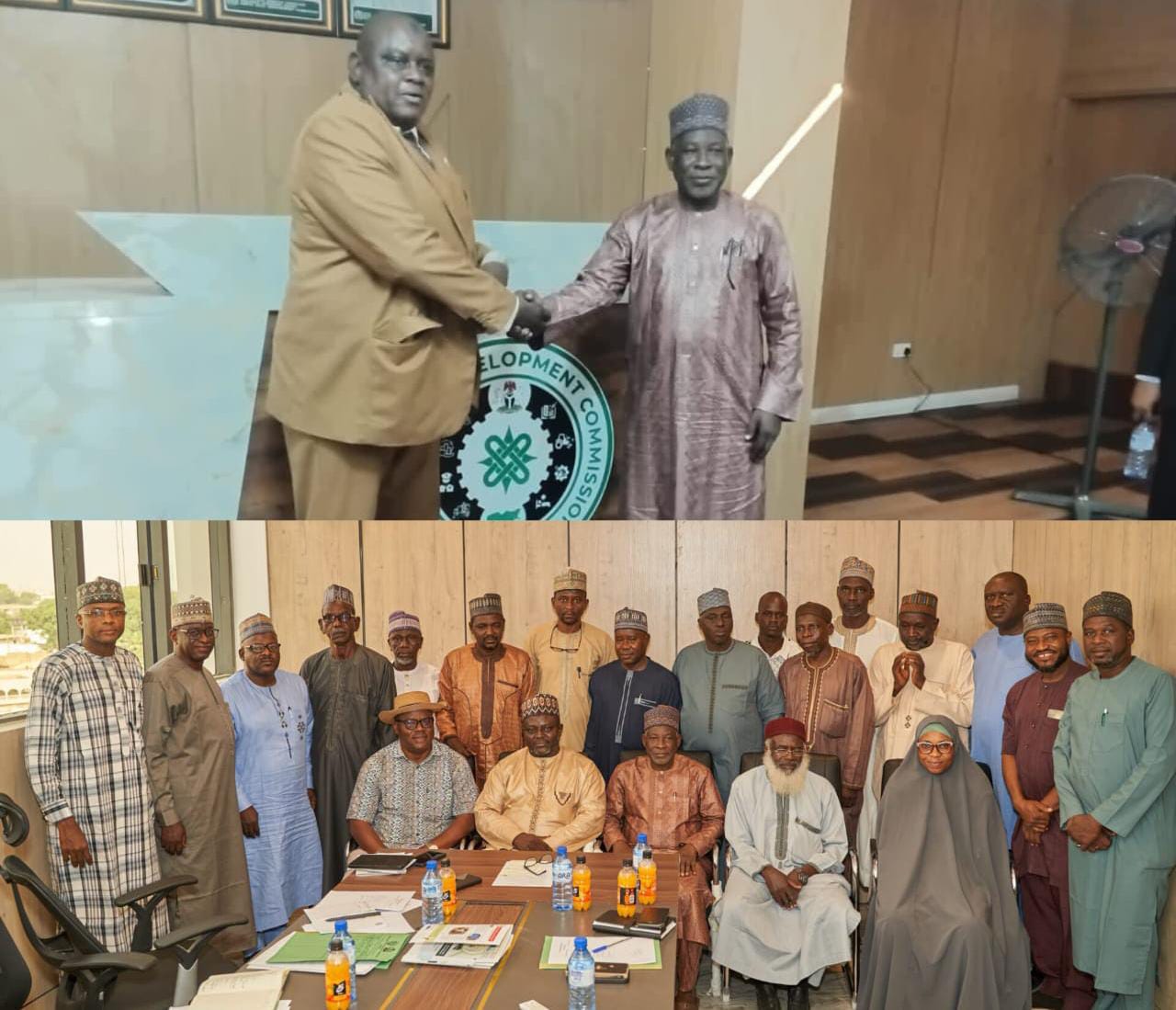
The North-West Development Commission (NWDC) has stepped up efforts to promote transparency in public project execution and accelerate agricultural development across the region through proposed strategic partnerships with the Independent Corrupt Practices and Other Related Offences Commission (ICPC) and leading agricultural research institutions.
The initiatives, announced following separate engagements at the Commission’s headquarters in Kano on Tuesday, aimed at strengthening accountability in development projects while developing practical solutions to food insecurity, low agricultural productivity and rural economic challenges.
This was contained in a statement signed and issued by Abdulrashid Yusuf Safana, Head of Press and Public Relations which was sent to GLOBAL TRACKER in Kano on Wednesday.
READ ALSO: NWDC Seeks Police Partnership, Requests Convoy For North-West Project Monitoring
In its anti-corruption initiative, the NWDC Managing Director and Chief Executive Officer, Professor Shehu Abdullahi Maaji, received the ICPC Resident Anti-Corruption Commissioner for Kano and Jigawa States, Barrister Ahmad Mohammed Wada, who led a delegation on an advocacy visit to the Commission.
Wada said the visit was intended to establish a strategic partnership that would enable both institutions to prevent corrupt practices, particularly in procurement, project implementation and the management of development programmes.
He advocated a formal collaboration framework to ensure strict adherence to due process at every stage of procurement and project execution.
Responding, Maaji welcomed the proposal and commended the ICPC for pursuing corruption prevention through institutional partnerships and advocacy.
The NWDC chief executive said the Commission was committed to transparency, accountability and zero tolerance for corruption, adding that it was willing to collaborate with the anti-graft agency, especially in monitoring projects and commissioning completed interventions.
He explained that involving the ICPC in project implementation would strengthen the credibility of the process and boost public confidence in the Commission’s development activities across the North-West.
Both institutions agreed to develop a formal framework to institutionalized their partnership, although details of its implementation, monitoring arrangements and specific oversight responsibilities are yet to be announced.
In a separate engagement on agricultural development, Maaji convened a strategic meeting with representatives of major agricultural research and development institutions to develop a regional framework for agricultural transformation and food security.
The meeting brought together representatives of the International Institute of Tropical Agriculture (IITA), the International Crops Research Institute for the Semi-Arid Tropics (ICRISAT), HarvestPlus, the Centre for Dryland Agriculture, East-West Knowledge Transfer, Sasakawa Africa Association, the Institute for Agricultural Research and the National Agricultural Extension and Research Liaison Services, alongside researchers and other experts.
According to the Commission, the engagement was designed to harness research, technical expertise and institutional cooperation to modernise agriculture, improve productivity and strengthen food security across the seven North-West states.
Maaji said the region possessed significant agricultural advantages, including extensive arable land, dams with potential for irrigation farming and a strong pool of researchers and other skilled professionals.
He stressed that these resources needed to be effectively harnessed to improve food production, create economic opportunities and support sustainable development.
The NWDC chief executive also underscored the relationship between food security and regional stability, noting that insecurity remained a major challenge that must be addressed alongside agricultural development.
The Commission’s agricultural strategy is expected to focus on modern farming methods, improved irrigation, stronger agricultural value chains and opportunities for young people and women to participate in productive activities.
The meeting resolved that the Commission and participating institutions would jointly develop a practical, research-driven framework to guide agricultural interventions across the region.
Representatives of the participating institutions reportedly pledged technical support and cooperation towards the proposed framework, which is expected to provide a basis for coordinated agricultural development programmes.
The engagements reflect two complementary priorities for the NWDC: ensuring that development projects are implemented transparently and building partnerships capable of delivering measurable improvements in agriculture and livelihoods.
The Commission, established under the NWDC Establishment Act of 2024, covers Kano, Jigawa, Kaduna, Katsina, Kebbi, Sokoto and Zamfara states.
Its mandate includes interventions in agriculture, education, health, security, infrastructure, environmental sustainability, industry, energy, and youth and women development.
With the proposed ICPC collaboration, the Commission is seeking to strengthen accountability in project implementation. Its engagement with agricultural research institutions, meanwhile, is intended to provide the technical foundation for improving farm productivity and regional food security.
The effectiveness of both initiatives will depend on translating the proposed partnerships into clear implementation plans, measurable targets, transparent project monitoring and sustained cooperation with relevant stakeholders.