
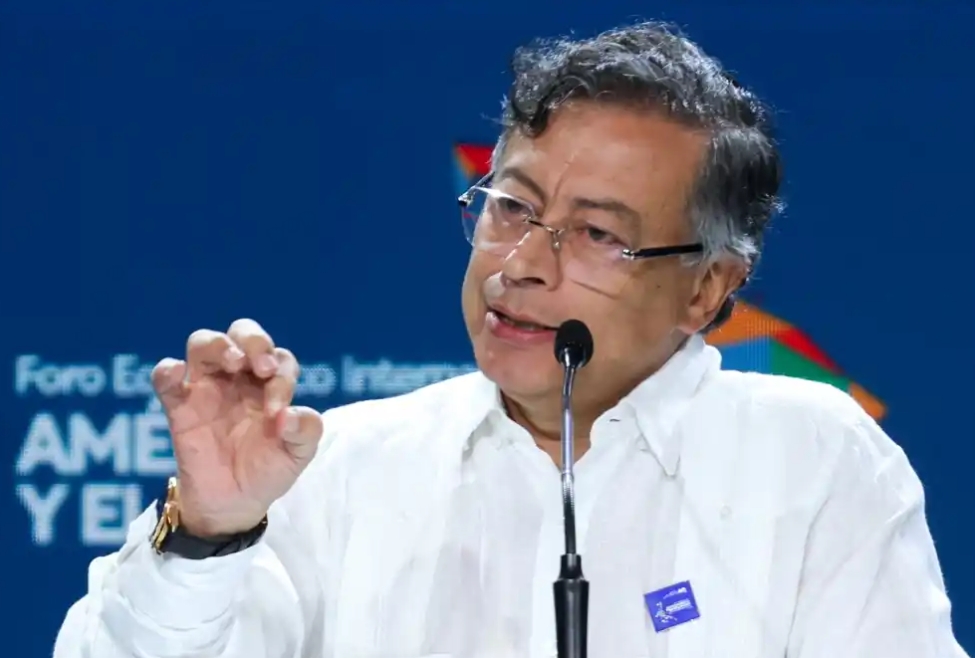
Colombian President Gustavo Petro has declared on Tuesday that he narrowly escaped an assassination attempt, linking the alleged plot to his government’s escalating campaign against drug cartels and armed criminal groups.
Speaking during a nationally televised address, Petro said security intelligence forced his helicopter to alter its landing plans during a recent trip to Colombia’s Caribbean region after authorities received warnings that gunmen were positioned to fire at the aircraft.
“I escaped being killed,” Petro told members of his cabinet. “They were waiting to shoot at the helicopter.”
The president did not publicly name the group allegedly behind the threat but suggested the plot was tied to powerful narcotics trafficking networks angered by intensified state operations.
Colombia’s security forces have launched a series of actions in recent months targeting cocaine production zones, illegal mining operations and the financial structures of criminal organizations.
A Long War Against Cartels
Colombia’s battle with drug cartels dates back more than four decades. In the 1980s and early 1990s, the Medellín and Cali cartels dominated the global cocaine trade, amassing enormous wealth and unleashing terror campaigns that included car bombings, kidnappings and assassinations of politicians, judges and journalists.
The assassination of presidential candidate Luis Carlos Galán in 1989 became one of the most infamous symbols of cartel power.
Although the large, centralized cartels were dismantled, they did not disappear entirely. Instead, they fragmented into smaller, more flexible criminal networks.
Today, cocaine production remains a multibillion-dollar industry, with Colombia still the world’s largest producer of coca leaf and cocaine.
Modern criminal organizations operate differently from their predecessors. Groups such as the Gulf Clan (also known as the Gaitánist Self-Defense Forces of Colombia), along with dissident factions of the former FARC guerrillas and the National Liberation Army (ELN), control strategic territories used for drug cultivation and smuggling routes that run through the Pacific coast, the Caribbean and across land borders into Central America.
These groups are not limited to drug trafficking. They also profit from illegal gold mining, human trafficking, fuel smuggling and extortion schemes that target businesses and rural communities.
Their deep local influence often allows them to intimidate residents and corrupt officials, complicating government efforts to reassert state authority.
Petro’s Strategy and Rising Tensions
Since taking office in 2022, Petro has attempted to balance military pressure with negotiations under his “Total Peace” policy, an ambitious plan aimed at persuading armed groups to disarm in exchange for legal and social guarantees.
While some ceasefires have been announced, several have collapsed amid accusations of continued violence and broken commitments.
At the same time, the administration has intensified seizures of cocaine shipments, targeted financial networks tied to organized crime and promoted crop-substitution programs to encourage farmers to abandon coca cultivation.
Petro has argued that decades of purely militarized anti-drug policy failed to eliminate the trade and instead fueled cycles of bloodshed.
Critics, however, say the security landscape remains volatile. In some regions, attacks on police and soldiers have increased, and armed groups have demonstrated their ability to coordinate strikes against state forces. Analysts warn that pressure on trafficking routes can trigger retaliation from criminal groups seeking to protect profits.
The reported assassination plot has heightened tensions ahead of upcoming elections. While Petro is constitutionally barred from seeking immediate reelection, his political movement remains influential, and his security policies continue to shape national debate.
Defense officials confirmed that investigations into the alleged threat are ongoing and that additional protective measures have been implemented around the president and senior officials.
Colombia’s painful history of cartel violence remains fresh in the national memory. Though no sitting Colombian president has ever been assassinated, political figures have long been targets when confronting organized crime.
For Petro, the warning underscores the risks inherent in challenging entrenched criminal power.
“We will not bow to criminals,” he said. “The state must be stronger than the mafias.”
As authorities investigate the alleged plot, the episode serves as a stark reminder that Colombia’s struggle against drug cartels and armed criminal networks is far from over and that the fight continues to test the resilience of its democracy.