BY: NURADDEEN DANJUMA.
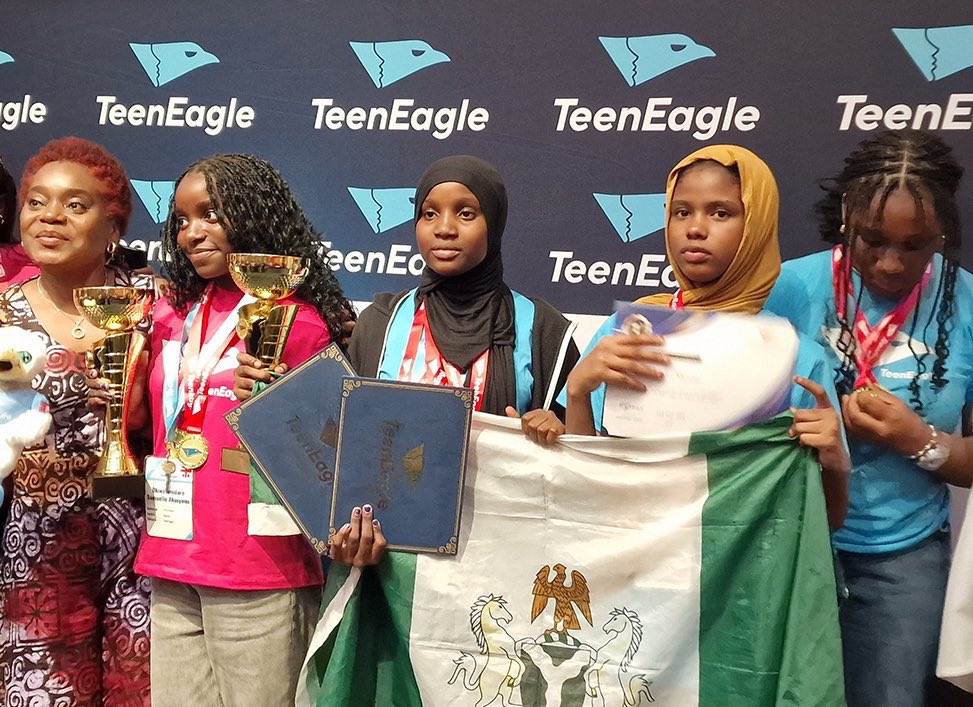
The recent feat by three Nigerian teenage girls: Seventeen-year-old Nafisa Abdullahi Aminu, Fifteen -year-old Rukayya Muhammad Fema, and Hadiza Kashim Kalli who emerged as World Champions in English language communication skills and debate at the 2025 TeenEagle Global Finals in London, is not just a personal victory for the girls, but a moment of national pride.
Competing among 20,000 participants from over 60 countries, they flew Nigeria’s flag high and projected the nation in good light at the global stage.
However, their achievements were met with silence from the Nigerian Presidency, a disappointing and painful contrast to the warm accolades, cash rewards, national awards, and house gifts offered to the national football team, musicians, and other celebrities.
As the saying goes, “All fingers are not equal”, but when it comes to rewarding excellence, the principle of equity must reign supreme. The glaring neglect of these young intellectuals calls into question the government’s value system, especially towards education, the very bedrock of any nation’s development.
The reward system in Nigeria, often skewed in favour of entertainment and sports, sends a dangerous message: that brains matter less than balls, and dancing gets more recognition than debating.
One wonders: what happened to the age-long wisdom in the words of Nelson Mandela, who declared that “Education is the most powerful weapon which you can use to change the world”? Should such a transformative tool not be encouraged, appreciated, and publicly rewarded? These girls, through their brilliance, not only demonstrated that excellence is not limited by geography, gender, or religion , but also shattered stereotypes often associated with the Northern Nigerian girl-child. In their quiet confidence, they taught the world that the North is not just about insurgency and illiteracy but is also home to intellectual giants and bright stars who can compete and win globally.
Unlike the last three weeks, the Nigerian government’s silence is deafening. It sends the unfortunate message that unless one kicks a ball, sings a hit song, or trends on social media, their contributions to national honour and development are invisible. This kind of selective recognition breeds bitterness, mediocrity, and disillusionment among the youth. It also contradicts the principles of justice, fairness, and meritocracy; a pillars upon which any sustainable society must be built.
Worse still is the possibility that these girls are being overlooked because of their region or tribe. Such action, whether deliberate or incidental, echoes the proverbial warning: “ A house divided against itself cannot stand. ” Rewarding some while neglecting others on the basis of identity deepens our national fault lines and undermines unity. Let it be known that excellence has no tribe, and merit knows no race. These girls are not just daughters of the North; they are daughters of Nigeria, and their victory is a victory for us all.
Selective reward breeds complacency and discourages those working hard in silence. If we must progress as a nation, our reward system must be inclusive, merit-based, and blind to ethnic or political bias. As Chief Obafemi Awolowo rightly said, “ The children of the poor you fail to educate today will never let your children sleep in peace tomorrow .” These words should awaken us to the reality that education is not a sector to be sidelined but a lifeline for national development, innovation, and global competitiveness.
Moreover, justice is not only about punishing the guilty, but also about rewarding the righteous. A system that praises footballers with mansions while ignoring brilliant young girls who made the nation proud is a system in moral decay. We cannot continue to exalt entertainers and ignore intellectuals and still expect national transformation. It is akin to watering the leaves while starving the roots.
In conclusion, the Presidency owes these girls and the nation a gesture of appreciation—not just in words but in action. This is not just about three girls; it’s about the future of Nigerian education, about encouraging others to dream big and work hard. If we must build a Nigeria that competes globally, we must reward brains, not just fame.
Let us remember the words of Dr. Martin Luther King Jr.: “Intelligence plus character—that is the goal of true education.” And let us honour those who embody it, wherever they are from.
I rest my case here hoping to hear $100,000 to the proud winners and $100,000 to the teachers each. Yes PBAT has done, and he can do it again.
Nuradeen Danjuma is a lecturer with department of geography, Bayero university Kano and writes from Rijiyar Zaki.