
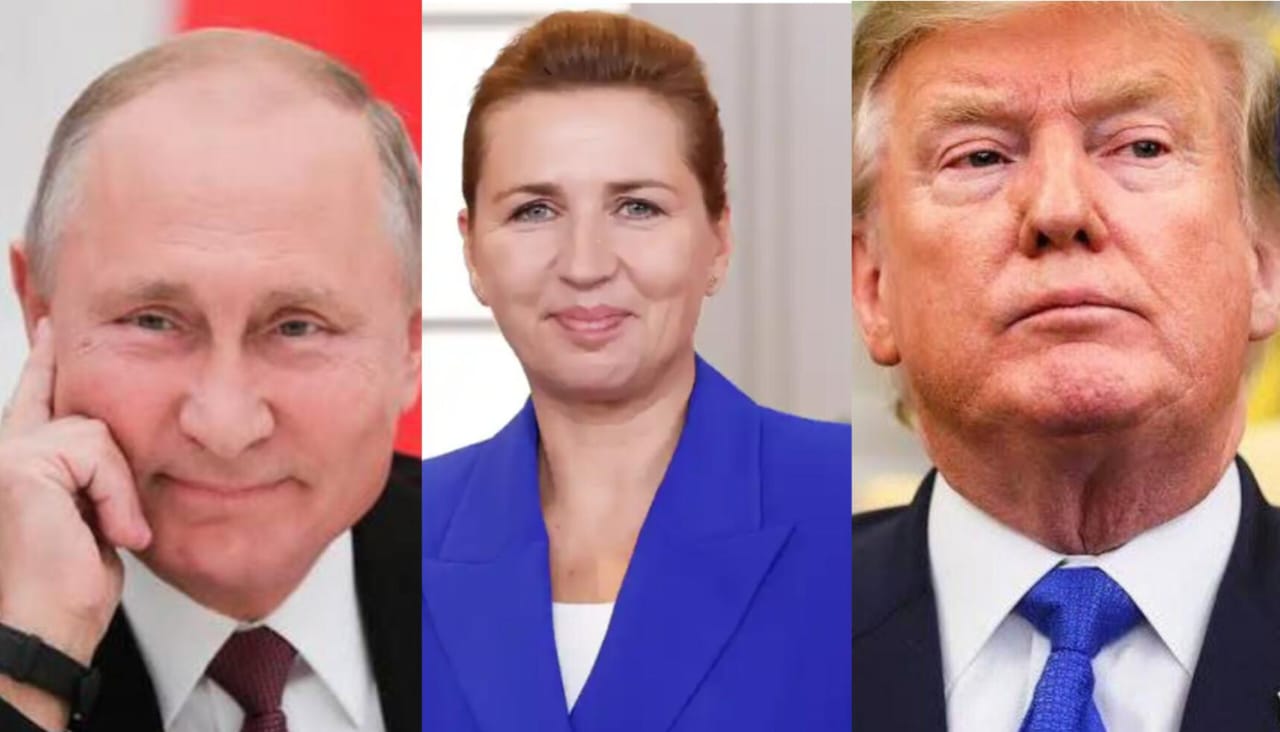
The Russian Federation is likely watching with interest as United States President Donald Trump‘s drive to acquire Greenland widens splits with Europe, potentially weakening North Atlantic Treaty Organization (NATO) and benefiting Moscow.
Trump’s claims on Greenland have sparked concerns about the future of NATO and the potential for increased Russian influence in the Arctic.
Russia has bridled at Trump’s suggestion that Moscow poses a threat to Greenland, while avoiding mentioning his name in its criticism.
READ ALSO: BREAKING: Trump Urges Iranian Protesters to Attack Institutions as Russia Condemned it
GLOBAL TRACKER learned that for Russia, the Greenland debate is less about the Arctic island itself and more about what it represents; a visible strain between the United States and its European allies, particularly Denmark, at a time when NATO cohesion is central to deterrence.
Russia’s Strategic Interest: Division Over Territory
Russian foreign policy toward NATO is built on a consistent objective and prevents the alliance from acting as a unified, effective security bloc.
Moscow understands that NATO’s strength lies not only in military capabilities, but in political solidarity. Any dispute that pits allies against one another is therefore strategically valuable.
From this perspective, a U.S. push to acquire Greenland even rhetorically is advantageous to Russia. It places a NATO member state, Denmark, in direct opposition to another, the United States. Russian reactions have reflected this logic: officials and commentators have mocked European outrage, framed the dispute as proof of American disregard for allies, and highlighted the episode as evidence that NATO’s internal trust is fragile.
Reports say Russia does not need to engineer such disputes to benefit from them, but It simply needs to amplify them.
Greenland and the NATO Security Dilemma
Greenland is already covered by NATO’s collective defense framework, and the United States maintains military facilities there with Denmark’s consent. From NATO’s perspective, this arrangement is stable and sufficient. From Russia’s perspective, however, the controversy surrounding Greenland exposes a deeper vulnerability: NATO’s dependence on political consensus.
Russian officials have simultaneously rejected claims that Moscow intends to seize Greenland while accusing the West of exaggerating Russian threats to justify militarization.
This allows Russia to cast itself as a rational actor while portraying NATO as internally divided and driven by U.S. unilateralism.
The result is a familiar Russian narrative that NATO is not a defensive alliance of equals, but a US’s dominated bloc whose internal contradictions undermine European security.
Why This Matters for NATO
The Greenland episode highlights a broader risk for NATO. Russia’s strategy is not primarily to defeat the alliance in battle, but to undermine its cohesion. If NATO members begin to doubt one another’s intentions or question whether alliance guarantees apply equally deterrence will be weakens.
Also, disputes over sovereignty, decision-making, and U.S. leadership create openings for Russian diplomacy and information campaigns. Even when no policy changes follow, the perception of discord can be enough to serve Moscow’s interests.
At the same time, Russia’s own security posture is shaped by its belief that NATO is hostile and expansionist. This mutual suspicion feeds a cycle in which political disagreements within NATO are interpreted in Moscow as confirmation that the alliance is unstable and therefore vulnerable to pressure.
A Low-Cost, High-Impact Strategy
For Russia, encouraging or exploiting NATO divisions is a low-cost strategy with potentially high returns. It avoids the risks of direct military confrontation while advancing Moscow’s long-standing goal of reducing NATO’s effectiveness as a unified security actor.
Greenland, in this sense, is not an anomaly. It is a case study in how symbolic disputes can become strategic tools, reinforcing Russia’s belief that NATO can be weakened from within.
The Bottom Line
Russia’s reaction to the Greenland controversy underscores a central feature of its foreign policy, while NATO is most dangerous when united, and most manageable when divided. While Moscow may not actively support a takeover of Greenland in concrete terms, it clearly benefits from and encourages the political rifts such a debate creates.
For NATO, the lesson is clear. External threats are amplified when internal unity falters. In an era of heightened confrontation with Russia, even disputes that seem theoretical or symbolic can carry real consequences for alliance security.