
BY: NASIRU MOHAMMED WAZIRI, KANO
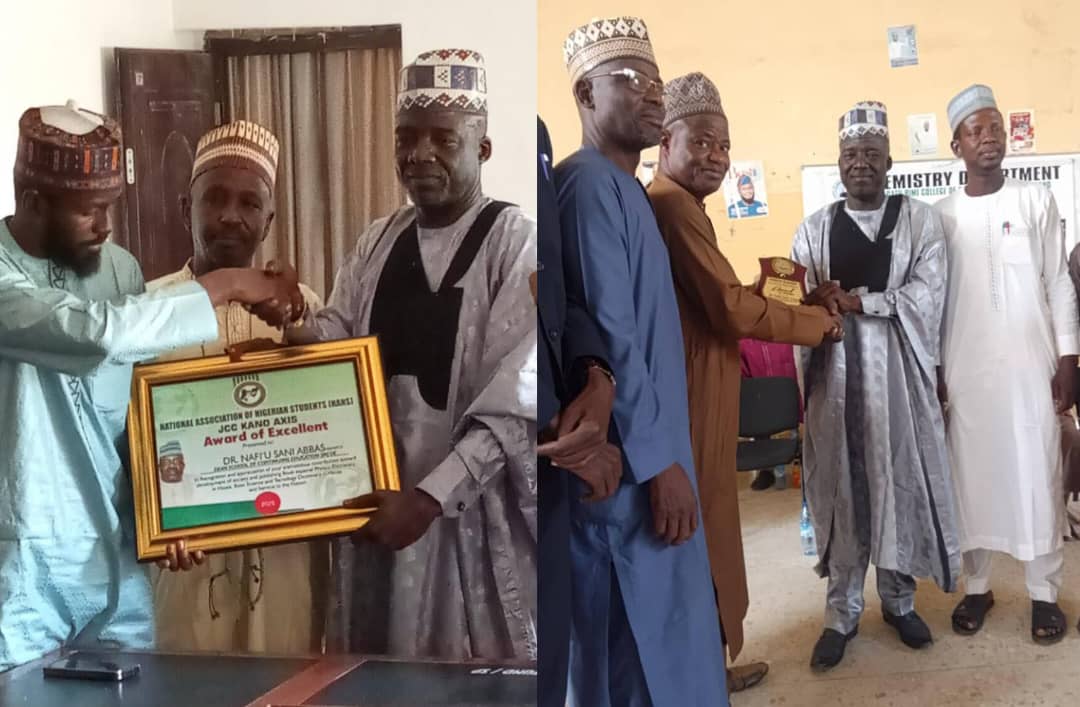
The National Association of Nigerian Students (NANS), Joint Campus Committee (JCC), Kano Axis, has conferred a dual honour on Dr. Nafiu Sani Abbas, recognizing his exceptional contributions to science, technology, and indigenous language development in Nigeria.
At a ceremony held at Sa’adatu Rimi College of Education, Kano, NANS formally acknowledged Dr. Abbas both as Dean, School of Continuing Education, Sa’adatu Rimi College of Education, and as Chief Executive Officer of Jalla Tech Hub, Kano.
The recognition follows his historic breakthrough in producing the first-ever science dictionaries in the Hausa language—a pioneering feat in Nigeria’s educational history.
A Landmark in Indigenous Science Education
Dr. Abbas led the development of two major scientific reference books written fully in Hausa and English.( Bilingual).
1. Physics Dictionary in Hausa
2. Basic Science and Technology Dictionary for Primary Schools (Hausa Edition)
These works represent a monumental stride in promoting scientific literacy among Hausa-speaking learners. For the first time, core scientific concepts have been systematically translated and explained in a widely spoken Nigerian mother tongue, removing learning barriers for millions of pupils across the northern region.
Both dictionaries have been duly certified by the National Educational Research and Development Council (NERDC)—the highest curriculum authority in Nigeria—signifying official acceptance and national educational importance.
A Call for Support, Funding, and National Adoption
The recognition by NANS has reignited calls for greater investment from the Nigerian government, corporate bodies, philanthropists, and the northern elite. Stakeholders argue that Dr. Abbas’s innovation can serve as a blueprint for bridging the gap between modern science and indigenous cultures, especially in rural areas where English-language barriers still hinder STEM education.
Education advocates at the event stressed that mother-tongue scientific resources are critical for strengthening foundational learning, boosting student interest in technology, and expanding Nigeria’s scientific workforce.
“Projects like this require sustainable funding, research grants, and government partnerships,” a NANS representative stated. “If fully supported, Dr. Abbas’s work can transform the future of science education not only in the North, but across Nigeria.”
Strengthening Nigeria’s Scientific Future Through Language
The event concluded with calls for the Federal Ministry of Education, northern governors, tech investors, and wealthy individuals to partner with Dr. Abbas and expand indigenous-language STEM projects, including:
Hausa-language mathematics and chemistry dictionaries
Digital learning platforms for mother-tongue science education
Science terminology development hubs across northern institutions
As the world moves deeper into the knowledge economy, participants emphasized that nations that empower their people through education in their mother tongue are often the ones best positioned for rapid scientific and technological advancement.
Dr. Abbas’s work stands as proof that innovation thrives when local languages and modern science meet—and that Nigeria has the talent needed to lead Africa in indigenous technology development, if only the necessary investment is provided.