
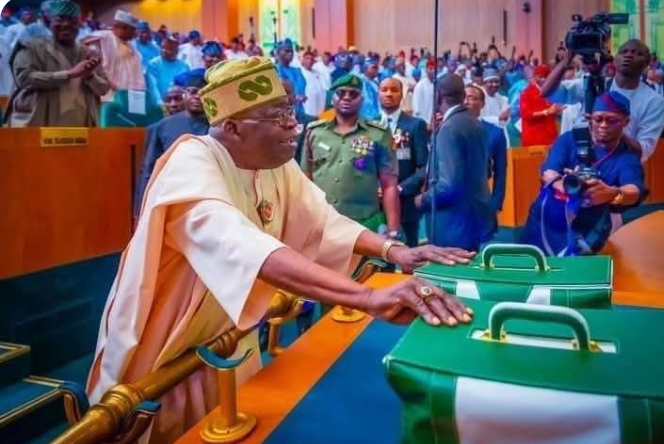
The Nigeria’s President Bola Tinubu on Friday presented a ₦58.47 trillion budget proposal for the 2026 fiscal year to a joint session of the National Assembly, outlining spending priorities across key sectors of the economy.
Under the proposal, capital expenditure is estimated at ₦26.08 trillion, while recurrent (non-debt) expenditure stands at ₦15.25 trillion.
The budget is benchmarked against a crude oil price of $64.85 per barrel.
READ ALSO: Closure, Transfer of Companies Threaten Our Economy — One Kano Agenda Boss
The President said expected total revenue for the 2026 fiscal year is ₦34.33 trillion, while projected total expenditure is ₦58.18 trillion, including ₦15.52 trillion earmarked for debt servicing. This leaves a budget deficit of ₦23.85 trillion, representing 4.28 per cent of the Gross Domestic Product.
According to Tinubu, the proposal is anchored on crude oil production of 1.84 million barrels per day and an exchange rate of ₦1,400 to the US dollar.
A breakdown of sectoral allocations shows that defence and security received the largest share at ₦5.41 trillion, followed by infrastructure with ₦3.56 trillion. Education is allocated ₦3.52 trillion, while the health sector is set to receive ₦2.48 trillion.
Historica Nigeria reports that the budget, titled “Budget of Consolidation, Renewed Resilience and Shared Prosperity,” was described by the President as more than routine fiscal estimates.
Addressing lawmakers, Tinubu said the proposal reflects the administration’s national priorities, reaffirming the government’s commitment to fiscal sustainability, debt transparency, and value-for-money spending.