
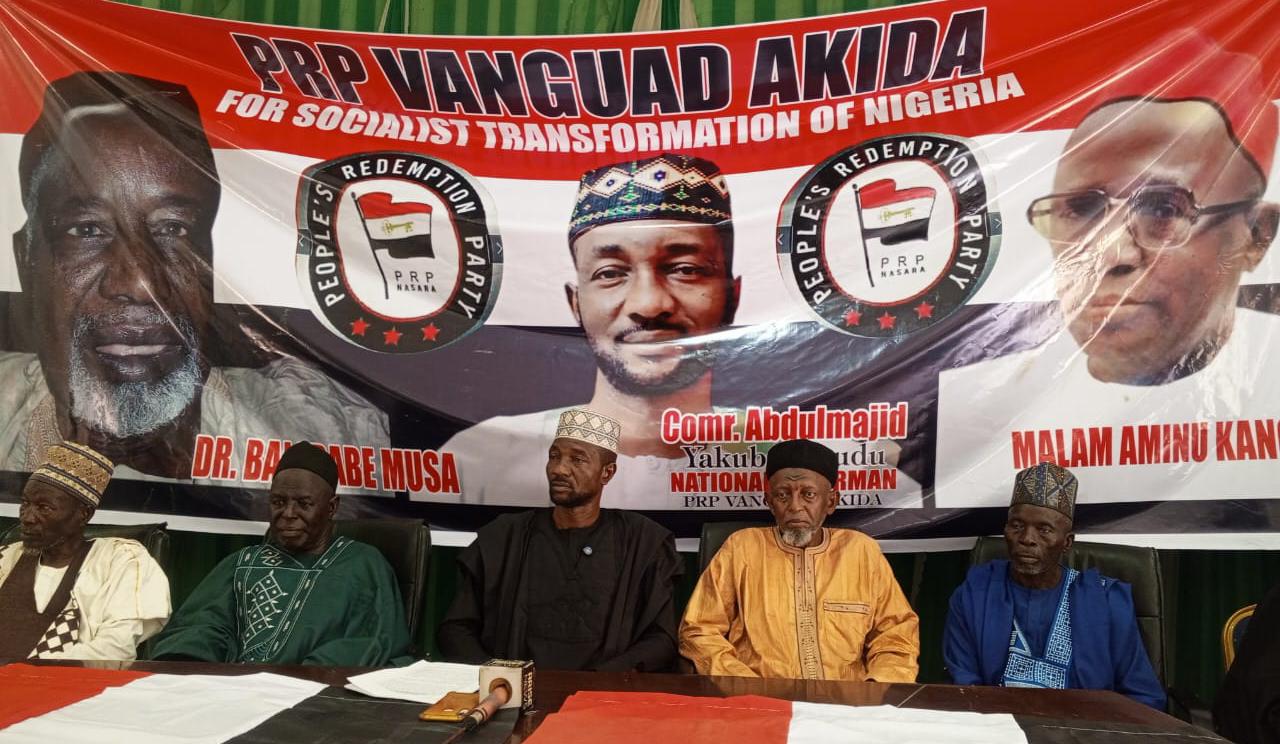
A deepening internal crisis within the People’s Redemption Party (PRP) has taken a sharper political& dimension as Abdulmajid⁹ Yakubu Dauda, a leading figure of the PRP Vanguard (Akida faction), declared that the party “is not for sale to the highest bidder,” warning politicians and interest groups to steer clear of what he described as ongoing attempts to hijack the party’s structure amid active court cases.
Speaking at a press conference held at the Nigeria Union of Journalists (NUJ) Kano State Council, Abdulmajid issued a forceful message to politicians and Nigerians, insisting that the PRP remains a party anchored on ideology, discipline, and constitutional order, not political bargaining or external acquisition.
He accused rival elements within the party of undermining its founding values, particularly targeting claims of leadership legitimacy by Hakeem Baba-Ahmed, whom he alleged was not a registered member of the party but had positioned himself as a central authority within its structure.
READ ALSO: PRP Doubts KANSIEC Will Conduct Free, Fair Election Over Nomination Form Fee, Others
According to him, such actions represent a dangerous distortion of the party’s identity and an affront to its membership base.
“For Dr. Hakeem Baba Ahmed, who was never a member of the party, but who now claims to preside over its affairs, to have indiscriminately invited notorious politicians from crisis-ridden parties to join the PRP, is not just insensitive and disrespectful, but authoritarian and feudal,” he said.
The PRP faction leader also condemned what he described as a “sham convention” allegedly organized by a Kaduna-based group claiming to represent the party.
He said the convention, reportedly held in Abuja, was illegitimate and violated the PRP’s constitution and ideological foundation.
“This is a travesty and a total abuse of the PRP constitution, its heritage, and left-oriented politics,” he stated.
Abdulmajid further broadened his criticism to what he called entrenched political forces, arguing that the PRP cannot be reduced to an instrument of elite bargaining or political convenience. In a strongly worded remark, he rejected any association between his faction and what he termed the political establishment.
“The Kaduna Mafia is not the PRP. It is the enemy of the PRP… it represents the same system of exploitation,” he said, linking broader national political structures to systemic inequality.
Central to his message was a warning against any attempt to “purchase” influence within the party or secure positions through financial or external political leverage.
“Our party is not for sale to the highest bidder or any group whatsoever. Buyer beware. Do not risk your deposit. We are still in court,” he warned.
He emphasized that ongoing legal proceedings over the leadership and structure of the party remain active, cautioning that any political engagement with disputed factions could carry legal and political risks.
The remarks highlight escalating tensions within the PRP, as rival factions continue to contest control of the party’s leadership and ideological direction.
The dispute has exposed deep divisions over identity, governance style, and the future orientation of one of Nigeria’s longstanding political movements, historically associated with the legacy of Balarabe Musa.
The crisis reflects a broader struggle over the soul of the party, with competing groups seeking to define its future in an increasingly fluid political environment.
As court battles continue and rival camps harden their positions, the PRP’s internal struggle appears set to remain a defining political storyline, with implications for both its structure and its relevance in Nigeria’s evolving democratic landscape.