
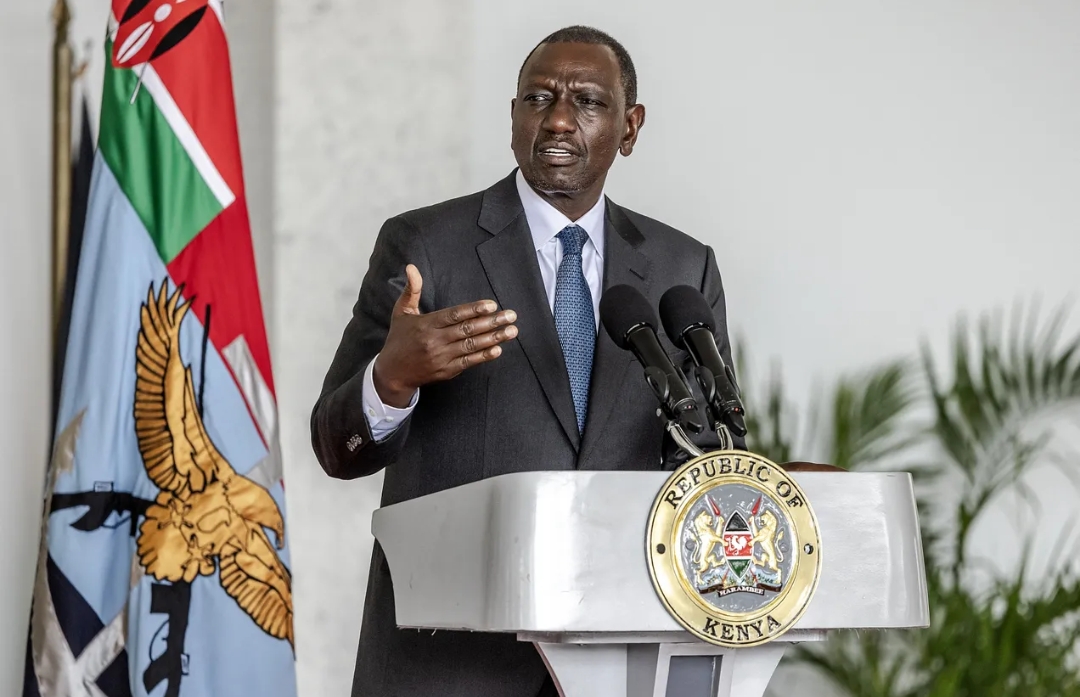
The President of the Republic of Kenya, William Samoei Ruto has delivered one of the strongest critiques yet of the African Union, declaring that the body is “not fit for purpose” at a time when African countries are grappling with mounting security threats, economic pressures, and deepening development challenges.
Ruto’s statement has resonated across the continent, reflecting a growing consensus among policymakers and analysts that Africa’s premier institution is struggling to keep pace with the scale and complexity of modern challenges.
While the African Union was established to promote unity, peace, and prosperity, critics argue that its current structure and operational capacity are increasingly outmatched by unfolding realities.
Across Africa, insecurity continues to intensify, with persistent conflicts, insurgencies, and political instability stretching national governments and exposing the limits of collective response mechanisms.
From the spread of armed groups in the Sahel to protracted crises in other regions, the expectation has been that the AU would provide leadership and coordination. Instead, its interventions are often seen as slow and constrained, shaped by political considerations among member states and limited enforcement capabilities.
The result has been a widening gap between the urgency of security threats and the pace of continental action.
At the same time, economic pressures are mounting. Despite ambitious frameworks such as the African Continental Free Trade Area, intra-African trade remains relatively low, and implementation challenges continue to slow progress.
Infrastructure deficits, fragmented markets, and policy inconsistencies have hindered efforts to unlock the continent’s full economic potential.
Ruto’s remarks underscore a deeper frustration that while Africa has bold economic visions, the institutions responsible for driving integration and execution are not delivering at the required speed or scale.
Development challenges further compound the situation. Africa’s rapidly growing population presents both an opportunity and a risk, as millions of young people enter the workforce each year in search of jobs and stability.
Climate change, food insecurity, and limited access to basic services are placing additional strain on governments. Although long-term frameworks such as Agenda 2063 outline a path toward transformation, progress has been uneven, and the gap between policy ambition and tangible outcomes remains significant.
Seen in this context, Ruto’s declaration is less a rejection of the African Union than a call for urgent reinvention. It reflects a demand for a continental institution that is more decisive in responding to security threats, more effective in driving economic integration, and more accountable in delivering development results.
It also raises critical questions about whether the AU can reform its structures, strengthen its financial independence, and operate with greater efficiency in an increasingly complex global environment.
As African countries navigate a period of profound transition, the pressure on continental institutions to perform is intensifying.
Ruto’s comments have brought that pressure into sharp focus, challenging leaders to confront uncomfortable realities about the effectiveness of existing systems.
Whether the African Union can evolve to meet these expectations will determine not only its relevance, but also its ability to shape Africa’s future.
For now, the message from Nairobi is clear: Africa’s challenges are growing, and its institutions must rise to meet them.