
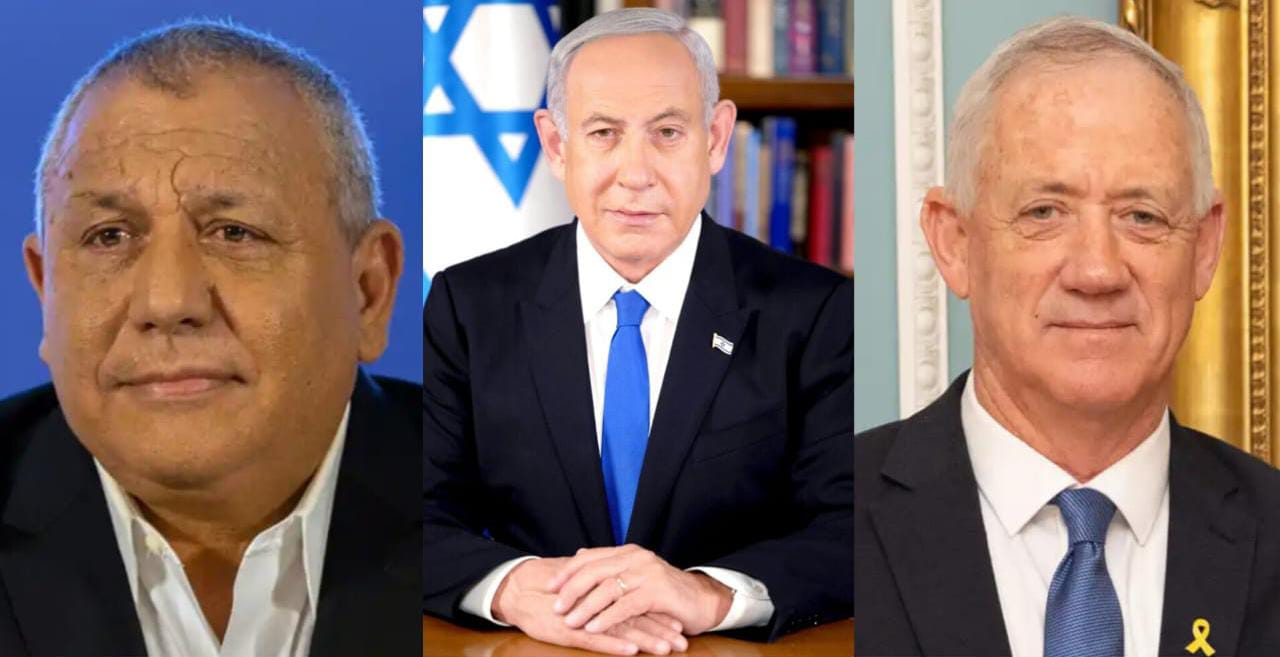
Israel’s Prime Minister Benjamin Netanyahu faces a closely contested parliamentary election on October 27, as latest opinion polls show opposition challenger Gadi Eisenkot’s Yashar! party leading his Likud party, while the withdrawal of Benny Gantz’s Blue and White has added uncertainty to the country’s political landscape.
A Walla poll published on October 20 put Eisenkot’s party at 23 seats in the 120-member Knesset, compared with 19 for Netanyahu’s Likud, widening the gap between the two parties to four seats.
The poll, conducted on October 19 among 601 respondents, also showed Naftali Bennett and Yair Lapid’s Beyachad alliance rising to 14 seats, while Yair Golan’s Democrats were projected to win nine seats.
READ ALSO: CICA Summit in Baku: Iran, Türkiye, Pakistan, Kuwait, Palestine Walk Out As Israel President Speaks
However, neither major political bloc was projected to secure the 61 seats required to form a government.
Netanyahu’s coalition bloc stood at 48 seats, against 54 for opposition parties, leaving both sides dependent on post-election negotiations and possible support from smaller parties.
The poll’s margin of error was four percentage points, meaning individual seat changes should be treated cautiously.
The election comes amid continuing public debate over Netanyahu’s leadership, his government’s handling of the security crisis following the October 7, 2023 Hamas-led attacks, and Israel’s subsequent wars and regional confrontation with Iran.
Blue And White Withdraws
A major development ahead of voting day was the withdrawal of Gantz’s Blue and White party after repeated polls showed it struggling to reach Israel’s 3.25 per cent electoral threshold.
Gantz, a former defence minister and chief of staff of the Israel Defense Forces, announced on October 19 that his party would not contest the election, saying he would continue working towards political unity.
The decision marked a significant setback for a party that previously emerged as one of Netanyahu’s principal electoral challengers and participated in national unity arrangements.
Gantz also joined Netanyahu’s emergency government after the October 2023 attacks before leaving the war cabinet in June 2024 amid disagreements over the government’s direction.
Israel’s Central Elections Committee subsequently announced that Blue and White ballot slips would be removed from polling stations after all candidates on its list formally withdrew. Votes already cast for the party at military polling stations and Israeli diplomatic missions abroad would be invalidated.
The withdrawal could redirect some of Gantz’s former supporters towards other parties, but its ultimate impact on the election remains uncertain. One question is whether those votes will strengthen established opposition parties or help smaller political lists cross the electoral threshold.
Fragmented Political Landscape
Other parties expected to play important roles include Itamar Ben-Gvir’s far-right Otzma Yehudit, Shas, Avigdor Liberman’s Yisrael Beiteinu, the Arab-led Joint List, United Torah Judaism, Religious Zionism–Zehut and Mansour Abbas’s Ra’am.
The performance of these parties could determine which political bloc is able to negotiate a governing majority. Under Israel’s proportional representation system, voters choose party lists, and the prime minister must emerge from post-election coalition-building rather than a direct presidential-style vote.
The electoral threshold is particularly important for smaller parties. Those failing to secure at least 3.25 per cent of the vote do not enter the Knesset, potentially affecting the distribution of seats among the parties that qualify.
Arab-led parties may also influence the parliamentary arithmetic. However, both leading contenders face political and ideological obstacles to relying on Arab parties for coalition support, despite their potential importance in determining whether either camp can assemble a majority.
Security And Palestinian Questions
Although the election could change Israel’s political leadership, a change of government may not produce a fundamental shift in the country’s security policy.
Netanyahu and his leading challengers have taken hard-line positions on Iran and rejected Palestinian statehood, although they differ over domestic governance and aspects of how Israel should pursue its security objectives.
A Reuters analysis published on October 21 said Israel’s approach to Iran, military deterrence and the maintenance of buffer zones could remain central to national policy regardless of the election outcome.
The next government will also face continuing challenges surrounding Gaza, the occupied West Bank, relations with neighbouring countries and the wider regional security situation.
With voting scheduled for October 27, the contest between Netanyahu and Eisenkot has become a major test of public support for the incumbent prime minister and the opposition’s ability to translate electoral gains into a functioning government.
Yet, even if one party finishes ahead of the other, the absence of a clear parliamentary majority means the decisive struggle may continue after election day, when political leaders negotiate alliances to secure the 61 seats needed to govern.