
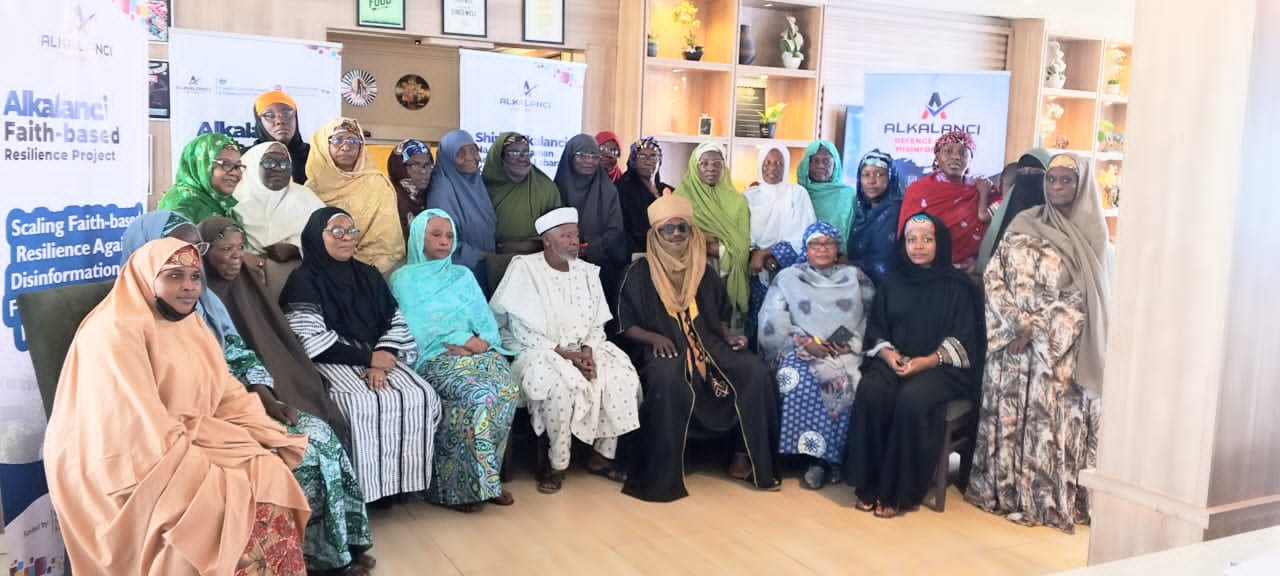
The ALKALANCI Faith-Based Resilience Project has organised a two-day workshop to sensitise women religious leaders on how to identify, verify and avoid spreading misinformation, disinformation and fake news, as part of efforts to strengthen community resilience against false information ahead of elections.
The training targeted women religious leaders because of their significant influence and roles in society, particularly in guiding families, shaping public opinions, communicating religious values and influencing decisions within their communities.
Speaking during an interview with journalists, including GLOBAL TRACKER correspondent, Sani Magaji Garko, Bamaz Victoria, Programme Manager of ALKALANCI, said the initiative funded by United Kingdom government was designed to strengthen the capacity of religious leaders to navigate the rapidly changing information environment.
She explained that the widespread availability of mobile phones and internet access had made it possible for virtually anyone to generate and circulate information, unlike in the past when traditional media organisations largely controlled the flow of information through established editorial and gatekeeping processes.
According to her, many people lack the necessary knowledge and skills to distinguish credible information from false narratives, a situation that has contributed to the spread of misinformation with serious consequences, including health problems, deaths and conflicts.
Victoria said the organisation, which works in the fact-checking and information integrity space, recognised that fact-checking organisations could not debunk false information as quickly as it spreads, making community participation essential in addressing the challenge.
She explained that religious leaders were selected because they are among the trusted voices in society and could help take the knowledge acquired during the training back to their communities.
She said the project adopted a train-the-trainer approach, under which participants would not only benefit from the workshop but also educate other people on identifying and rejecting false information.
Victoria added that the programme was also being organised ahead of elections because of the role misinformation and disinformation have played in electoral processes in Nigeria and other parts of the world.
She, however, clarified that the objective was not necessarily to stop people from producing false information, but to build what she described as information “inoculation”, whereby people would be able to recognise misleading content, reject it and avoid acting on it, regardless of who shared it.
On his part, Alhassan Bala, Editor of the ALKALANCI fact-checking platform, urged members of the public to critically examine information, establish its accuracy and verify its source before sharing it with others or circulating it across different platforms.
He said women religious leaders would be equipped with critical-thinking skills to carefully assess information received or sent to them before taking necessary actions or passing it to members of their communities.
Bala also cautioned journalists against allowing the pressure to break news ahead of competitors to undermine professional standards, stressing that every piece of information must be properly analysed and verified before publication.
He warned that publishing unverified breaking news could damage the credibility and integrity of media organisations that audiences have trusted over the years.
“As somebody is trying to break the news, he may end up breaking the organisation’s integrity,” he cautioned, maintaining that journalists should avoid publishing stories that have not been adequately verified, irrespective of the pressure to be first to inform the public.
The ALKALANCI editor further called on media organisations, including newspapers, online platforms and television stations, to establish dedicated fact-checking desks to scrutinise reports before publication or broadcast.
For organisations unable to establish such units, he recommended stronger partnerships and collaboration with independent fact-checking organisations to ensure that information disseminated to the public is accurate and properly verified.
In his remarks, the Chairman of the Nigerian Council of Ulama, Kano State Chapter, Sheikh Ibrahim Khalil, who was represented by Sheikh Abubakar Ibrahim Tofa, cited Qur’anic teachings emphasising the importance of verifying information and discouraging the spread of falsehood.
Tofa referred to religious injunctions against circulating unverified information, particularly the guidance contained in Surah Al-Hujurat, verse 6, which instructs believers to verify reports before acting on them to avoid harming others through ignorance.
He assured the ALKALANCI Faith-Based Resilience Project that the Kano State Council of Ulama would support its efforts to tackle the menace of misinformation, disinformation and fake news.
Similarly, the Emir of Kano, Khalifa Muhammad Sanusi II, represented by Adam Auwal Mudi Yakasai, representative of the District Head of Rimin Gado, welcomed the training and described it as timely in view of the growing challenges associated with the spread of false information.
He also assured the ALKALANCI fact-checking project of the Kano State Emirate Council’s support in promoting information integrity and addressing the circulation of misinformation and disinformation.
The workshop brought together religious leaders and other stakeholders to strengthen their understanding of information verification, responsible communication and the dangers associated with spreading unsubstantiated claims.
The initiative underscores the importance of involving trusted community figures, religious institutions, journalists and members of the public in efforts to address the growing threat of misinformation, particularly as the country approaches another electoral period.