
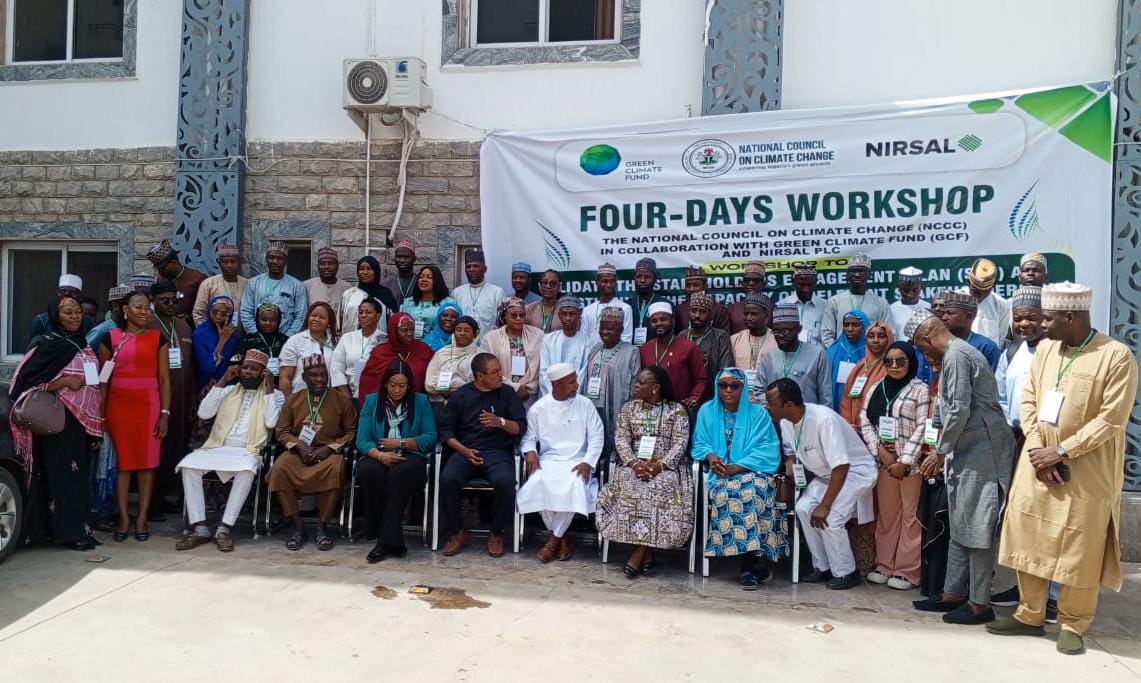
The National Council on Climate Change (NCCC) has engaged key stakeholders from government institutions, financial organisations, development partners, civil society groups and the private sector to review and validate Nigeria’s Green Climate Fund (GCF) Stakeholder Engagement Plan (SEP), as part of efforts to strengthen the country’s access to international climate finance.
The four-day workshop, organised in collaboration with the Nigeria Incentive-Based Risk Sharing System for Agricultural Lending (NIRSAL Plc), was held at R&K Hotels in Kano, with participants expected to examine and contribute to a framework that will improve coordination, transparency and inclusive participation in climate finance initiatives.
The NCCC also called for stronger institutional collaboration and meaningful involvement of women, young people, persons with disabilities, smallholder farmers and other vulnerable groups in climate-related decision-making to ensure that international funding addresses the actual needs of communities affected by climate change.
READ ALSO: JNC, Kano Govt Prepare 1,000 Civil Servants For Life After Retirement
The Director-General of the Council, Dr. Omotenioye Majekodunmi, made the call on Tuesday in opening remarks delivered on her behalf by Mr. Falemu Ayodeji, Chief Scientific Officer, Climate Finance, at the commencement of the workshop.
Majekodunmi explained that securing international climate finance required more than technically sound project proposals, stressing that effective institutional coordination, transparency, accountability and inclusive stakeholder participation were equally important.
She noted that Nigeria’s climate priorities cut across critical sectors, including agriculture, energy, water resources, infrastructure and transportation, making cooperation among government institutions, financial organisations, development partners, academia and affected communities essential.
According to her, the proposed Stakeholder Engagement Plan would establish a structured and sustainable framework for identifying relevant stakeholders, defining their responsibilities and setting clear procedures for consultation and participation.
She said the document would also provide for gender equality, social inclusion, accessible communication channels, feedback mechanisms and monitoring arrangements, replacing fragmented and occasional consultation processes with a more coordinated approach.
The NCCC Director-General emphasised that women, young people, persons with disabilities and smallholder farmers must have meaningful opportunities to participate in decisions affecting their livelihoods and communities.
She noted that the Council, which also serves as Nigeria’s National Designated Authority to the Green Climate Fund, considers effective stakeholder coordination central to strengthening the country’s climate finance governance and facilitating access to international funding.
Majekodunmi urged the consultants handling the assignment to ensure that the final document aligned with Nigeria’s national climate change priorities, existing institutional arrangements and relevant Green Climate Fund requirements.
She further called for clear provisions on institutional responsibilities, information disclosure, consultation procedures, feedback management and follow-up actions to guarantee that the plan would be practical and sustainable.
The Director-General stressed that the success of the initiative should not be measured solely by the production of a validated document, but by its ability to strengthen public participation, improve institutional collaboration and support Nigeria’s efforts to mobilise and effectively utilise climate finance.
She urged participants to make constructive contributions throughout the validation process to ensure that the final document reflected the country’s institutional realities and climate finance needs.
Majekodunmi commended the Green Climate Fund for supporting the initiative and acknowledged NIRSAL Plc as the delivery partner for the readiness programme. She also appreciated the consultant and technical team for their work on the proposed plan.
She particularly thanked the Kano State Government for hosting the workshop and facilitating the participation of key stakeholders, while reaffirming the Council’s commitment to providing technical guidance and promoting institutional collaboration for the successful implementation of the initiative.
Earlier, the Kano State Commissioner for Environment, Hamza Safiyanu Kachako, represented by the Director of Climate Change at the Ministry of Environment, Umar Saleh Anka, welcomed the NCCC and its partners to the state and appreciated their continued support for Kano’s climate change initiatives.
Kachako urged participants to actively contribute to the validation exercise, stressing that the proposed plan must reflect local realities, cultural values and ethical considerations to guarantee broad acceptance and effective implementation.
He attributed Kano State’s progress in climate governance, including its third-place position among the 36 states in the 2026 Subnational Climate Governance Performance Rating and Ranking (SCGPR 3.0), to technical assistance and support from the NCCC and the Federal Ministry of Environment.
The commissioner recalled that the NCCC had previously provided technical assistance during the development of Kano State’s climate change policy, noting that experts from the Council contributed to the review process without demanding payment.
He described access to climate finance through the Green Climate Fund and other international mechanisms as critical to addressing the growing climate change challenges confronting Kano State.
Kachako further urged stakeholders to carefully examine the proposed document and make constructive recommendations before its final validation, insisting that its provisions must accommodate the traditions, cultures, values and ethical considerations of Nigerian communities.
He explained that although policy documents could be reviewed periodically, their provisions often influence institutions and communities for several years, making it necessary to develop a practical, inclusive and sustainable framework.
The commissioner also encouraged participants to balance local realities with global perspectives during the review process, while engaging in open discussions with mutual respect and maturity.
The engagement represents part of Nigeria’s broader efforts to strengthen its climate finance readiness, improve institutional coordination and establish an inclusive framework capable of supporting the country’s access to international climate funding for projects addressing climate change and its effects on vulnerable communities.