
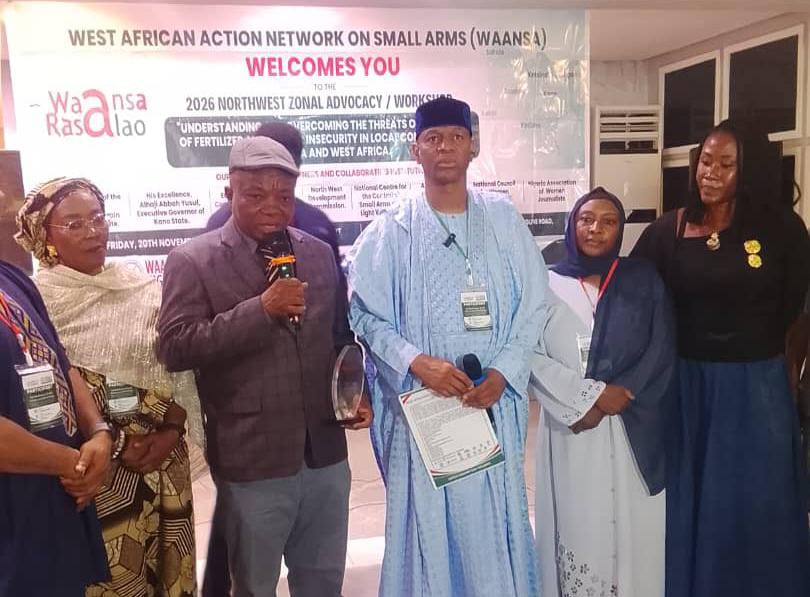
BY: NASIRU MOHAMMED WAZIRI, ABUBAKAR DAYYAB SAFANA
The West African Action Network on Small Arms (WAANSA) has called for stronger security measures, improved border monitoring and increased community awareness to address the misuse of fertilisers and growing insecurity in local communities across Nigeria and West Africa.
The call was made at the organisation’s first North-West Zonal Advocacy Workshop held in Kano.
The workshop, titled “Understanding and Overcoming the Threats of Dual Use of Fertiliser and Border Insecurity in Local Communities in Nigeria and West Africa,” brought together representatives of government institutions, security agencies, the media and other stakeholders.
Speaking at the event, the Director-General of the National Productivity Centre, Alhaji Baffa Babba Dan Agundi, who chaired the occasion, described the initiative as timely, particularly in view of the prevailing security challenges confronting communities in the North-West.
He noted that farmer-herder conflicts and other security threats continued to undermine agricultural productivity, peaceful coexistence and the livelihoods of rural communities.
Dan Agundi stressed the need for collective action, public awareness and stronger collaboration among government institutions and community stakeholders to address emerging security threats without disrupting legitimate agricultural activities.
In her remarks, the President of WAANSA, Hajiya Jamila Abubakar, described agriculture as a major source of livelihood, economic development and food security.
She noted that although fertilisers were essential for improving agricultural productivity, their potential misuse for harmful purposes required increased vigilance, responsible regulation and effective public sensitisation.
Hajiya Abubakar called for sustained cooperation among stakeholders to ensure that measures aimed at addressing insecurity did not undermine legitimate farming activities or the livelihoods of rural populations.
Also speaking, the First Regional Vice-President of WAANSA, Mr Martins Egwe, said the North-West workshop was the organisation’s next major engagement following the official launch of the project at the International Conference Centre, Abuja.
He explained that the decision to extend the initiative to the North-West reflected the strategic importance of the region in addressing the proliferation and misuse of small arms, insecurity and other emerging threats to community safety.
Egwe acknowledged the contributions of the Director-General of the National Productivity Centre, Alhaji Baffa Babba Dan Agundi, towards bringing the programme to Kano.
He emphasised the need for stronger regional cooperation, intelligence sharing and community-based advocacy to tackle security challenges that transcend national and international borders.
In a goodwill message, the Deputy Director of News and Current Affairs at the Federal Radio Corporation of Nigeria (FRCN), Kaduna Zonal Station, Yahaya Umar Balarabe, represented by Khadijah Aliyu, reaffirmed the corporation’s commitment to supporting initiatives that promote national security, agricultural development and public enlightenment.
She said Radio Nigeria had remained a longstanding partner in promoting peace, security and agricultural development through its radio programmes, news reports, features and public affairs broadcasts.
According to her, the media has a significant responsibility to educate citizens about emerging security threats, discourage harmful practices and promote peaceful coexistence among communities.
She assured that Radio Nigeria would continue to use its extensive broadcasting platforms to disseminate credible information, raise public awareness and encourage constructive conversations on issues affecting national development.
The workshop is expected to strengthen stakeholder engagement, improve public understanding of the security risks associated with fertiliser misuse and promote practical approaches to addressing border-related insecurity.
Participants are also expected to explore strategies for balancing effective monitoring of agricultural inputs with farmers’ legitimate access to fertilisers through cooperation among security agencies, agricultural authorities, traditional institutions and local communities.