
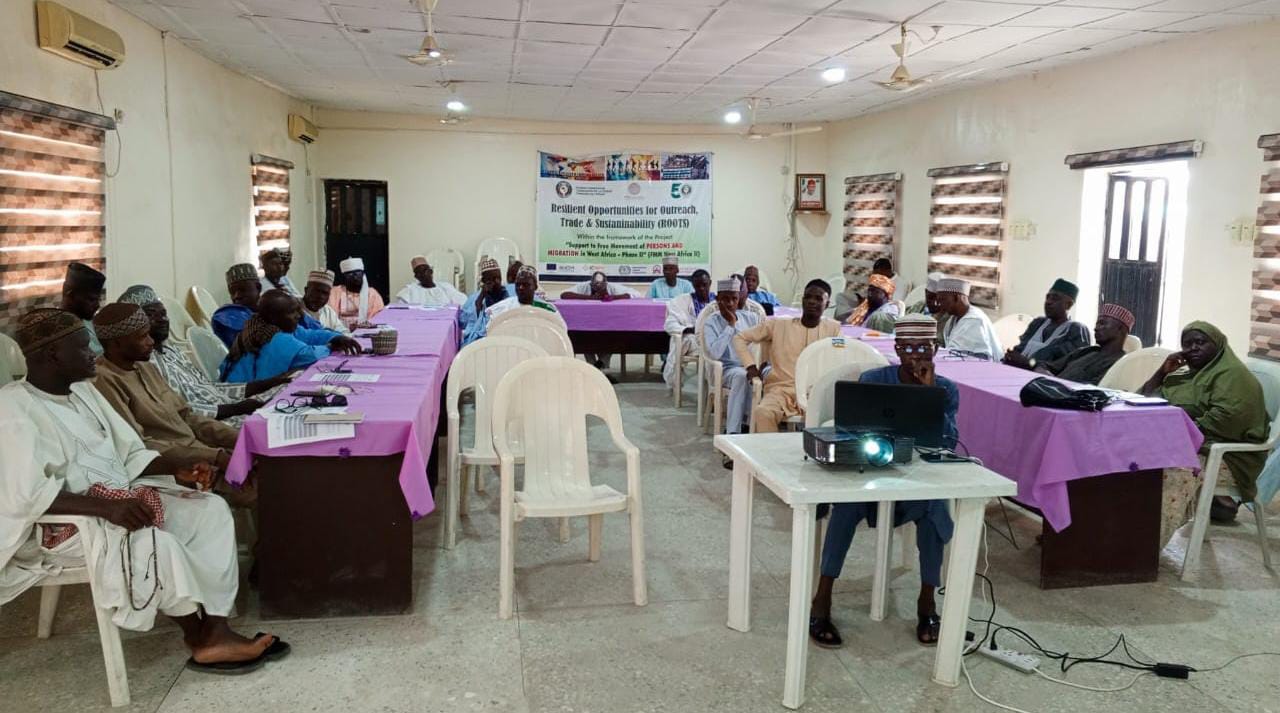
The Adolescent Health and Information Project (AHIP) has called for stronger collaboration among traditional institutions, local government authorities, government agencies, civil society organisations, women and youth groups and community representatives to tackle the growing challenge of irregular and undocumented migration in Kano State.
The call was made during a Policy Dialogue with Traditional Leaders and Local Government Authorities and Outcome Harvesting Meeting organised by AHIP as part of efforts to promote safe, legal and regular migration while addressing some of the factors driving young people and women towards dangerous migration journeys.
The engagement brought together stakeholders drawn from Dala, Gwale, Kano Municipal, Ungogo, Tarauni, Nassarawa, Kumbotso, Fagge and Bunkure Local Government Areas of Kano State.
READ ALSO: Prominent Kano Politician Sani Lawan Kofar Mata Dies, Burial Monday
The target participants included traditional and local government leaders, government institutions, civil society organisations (CSOs), women and youth groups as well as community representatives.
The programme forms part of broader migration interventions involving AHIP and the International Organization for Migration (IOM), with support from the European Union under the Free Movement of Persons and Migration in West Africa Phase II programme. AHIP’s documented ROOTS activities focus on safe and regular migration, migrants’ rights, community engagement, livelihood support and reducing the risks associated with irregular migration.
Speaking during the engagement, AHIP Executive Director, Hajiya Mairo Bello, said the programme was designed to mobilise all available mechanisms and stakeholders at community level to sensitise young people and women on the dangers associated with irregular and undocumented migration.
Bello said the organisation was particularly focused on engaging traditional and local government leaders, government institutions, CSOs, women’s and youth groups and community representatives to take the sensitization campaign to the grassroots.
According to her, the objective was not to discourage legitimate migration, but to ensure that people who intend to travel abroad are properly informed and encouraged to use safe, legal and officially recognised migration channels.
She warned that unsafe migration journeys could expose people to trafficking, exploitation, forced labour, abuse, health challenges and loss of life.
Bello also appealed to all stakeholders to intensify efforts against irregular migration, saying that many Nigerians had lost their lives while travelling abroad in search of better economic opportunities and what they believed would be lucrative or “white-collar” employment.
She urged traditional rulers, local government authorities, parents, community leaders and civil society organisations to play active roles in educating young people about the dangers of deceptive recruitment and undocumented migration.
The AHIP Executive Director further disclosed that the organisation, in collaboration with the National Commission for Refugees, Migrants and Internally Displaced Persons (NCFRMI) and other relevant stakeholders, was supporting returned migrants from foreign countries through skills-acquisition and livelihood programmes.
She said the initiative was intended to enable returnees acquire practical skills, establish sustainable livelihoods and become self-reliant after returning to their communities.
Recent reporting on AHIP’s ROOTS programme supports this aspect of the intervention. The programme has trained more than 200 returning migrants in agribusiness, alongside financial literacy and business-management training, while other activities have targeted vulnerable women and young people.
Bello said such interventions were important because economic vulnerability and lack of opportunities could increase the pressure on young people to embark on unsafe migration journeys.
She therefore called for stronger partnerships between government institutions, development partners, traditional authorities, communities and civil society organisations to address the root causes of irregular migration.
Also speaking, the District Head of Darmanawa in Tarauni Local Government Area, who also doubles as the Village Head of ’Yar-Akwa, Comrade Jamil Wada, assured participants of the commitment of traditional and local authorities to tackling the menace.
Wada said the local government council was engaging relevant stakeholders across the area to strengthen the response to irregular migration.
He said the Office of the District Head of Darmanawa and the Tarauni Local Government Council were working closely to intensify sanitization campaigns and engage directly with people at the grassroots.
According to him, the engagement would enable traditional institutions and local authorities to discuss directly with community members, particularly young people and women, about the dangers associated with unsafe migration.
He stressed the need for sustained community dialogue, saying that the involvement of grassroots people was essential to addressing the factors that encourage people to embark on dangerous migration journeys.
Wada assured that traditional and local government structures would continue to work with relevant stakeholders to discourage irregular and undocumented migration and promote safe and legal alternatives.
The engagement is coming against the backdrop of concerns over Kano’s role as a major migration route and return point. In August, AHIP disclosed that returned migrants were arriving through Kano almost weekly, with stakeholders calling for stronger coordination among government agencies, traditional institutions, CSOs and development partners.
The AHIP ROOTS programme has also previously brought traditional, religious and local-government stakeholders together to discuss safe migration, reintegration and community resilience in Kano. During one such engagement, stakeholders highlighted the risks of exploitation, trafficking, health problems and death associated with dangerous migration routes.
The Policy Dialogue and Outcome Harvesting Meeting therefore provided an avenue for stakeholders to assess interventions, share community experiences and identify mechanisms for improving sensitization and support for people affected by migration.
The participants also discussed the importance of ensuring that information about migration is accurate and accessible, particularly for young people who may be vulnerable to traffickers and deceptive recruitment agents.
AHIP’s wider migration activities include capacity building for CSOs and women’s groups on the ECOWAS Protocol on Free Movement of Persons and migrants’ rights. The organisation says the activities are intended to improve awareness of safe and regular migration pathways and reduce exposure to exploitation, trafficking and other dangers.
Stakeholders at the dialogue consequently emphasised the need for collective action, sustained community sensitization and stronger livelihood opportunities as part of efforts to reduce irregular migration.
They also stressed that migration itself should not be viewed as inherently negative, but that people should be encouraged to migrate through safe, orderly, legal and documented channels.