
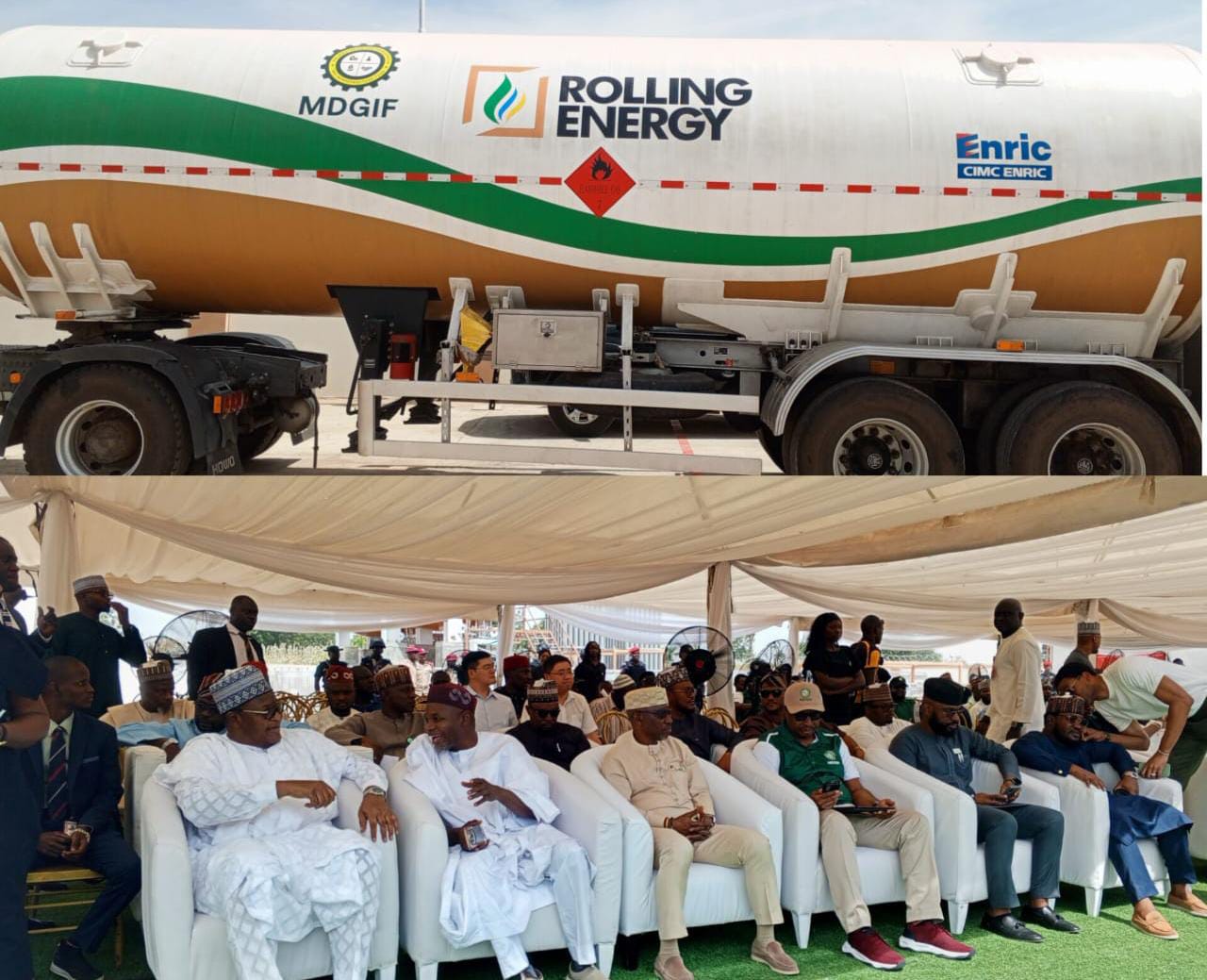
The Federal Government has commissioned three major gas infrastructure facilities in Kano State under a partnership between the Midstream and Downstream Gas Infrastructure Fund (MDGIF) and Rolling Energy Limited, in a move aimed at expanding access to cleaner and more affordable energy, strengthening transportation and industrial activities, and accelerating Nigeria’s transition to gas-powered economic growth.
The two facilities, located at Tamburawa in Dawakin Kudu Local Government Area and Hotoro Quarters along Maiduguri Road in Tarauni Local Government Area, were formally commissioned on Tuesday by the Minister of State for Petroleum Resources, Rt. Hon. Ekperikpe Ekpo, Ph.D.
The three facilities identified by the minister are the LCNG distribution hub at Tamburawa, a retail station within the Tamburawa complex, and an LCNG daughter and retail station at Hotoro. They were developed by Rolling Energy Limited with support from the MDGIF as part of efforts to expand Nigeria’s domestic gas infrastructure and make natural gas more accessible to consumers.
Speaking at the commissioning ceremony, Ekpo described the project as an important milestone in the Federal Government’s efforts to translate its gas policies into practical infrastructure capable of delivering economic benefits to Nigerians.
He said the facilities represented an important part of the domestic gas value chain, covering the receipt, storage, processing, distribution and retail supply of natural gas to end users.
“The Tamburawa facility has a stated distribution capacity of 300,000 standard cubic metres of gas per day and is equipped with LNG storage and regasification infrastructure, enabling it to convert liquefied natural gas into compressed natural gas for distribution to vehicles and daughter stations,” said the Minister.
He explained that the Hotoro facility, with a stated capacity of 21,000 standard cubic metres per day, would serve as a daughter and retail station, helping to bring gas closer to motorists, transport operators and other consumers in the state.
The minister said the facilities would deepen gas penetration in Kano and neighbouring areas, provide cleaner energy alternatives, support businesses and transportation, and stimulate economic activities through improved access to domestic gas.
Ekpo linked the project to President Bola Ahmed Tinubu’s Renewed Hope Agenda, noting that the administration was committed to moving beyond policy declarations towards the delivery of practical infrastructure that would make Nigeria’s abundant gas resources available for homes, businesses, industries and the transportation sector.
He congratulated Rolling Energy Limited, the MDGIF, the Kano State Government, regulators, investors and technical partners for their contributions to the project before formally declaring the three facilities open.
In his remarks, the Executive Director of the MDGIF, Mr Oluwole Adama, said the Kano project was part of a wider partnership with Rolling Energy Limited to deliver 18 retail gas infrastructure facilities across three states and the Federal Capital Territory.
Adama explained that the Tamburawa mother station would receive liquefied natural gas, regasify it and convert it into compressed natural gas for direct vehicle refuelling and onward distribution to daughter stations, while the Hotoro facility would bring the product closer to consumers.
He said the combined facilities were designed to support the daily refuelling of up to 2,500 cars and tricycles, as well as approximately 200 trucks, subject to operational conditions and gas availability.
The MDGIF chief described the infrastructure as particularly important to Kano because of the state’s position as a major commercial, manufacturing and transportation centre in northern Nigeria.
He noted that the availability of gas closer to end users would help reduce the distance over which fuel had to be transported, improve access for businesses and transport operators, and potentially lower operating and logistics costs.
“Today in Kano, the petrol price is about ₦1,420 per litre and an equivalent CNG energy cost of approximately ₦600, if a tricycle operator is consuming the equivalent of 10 litres of petrol daily could spend about ₦14,200 on petrol compared with ₦6,000 on CNG,” said the Executive Director.
“With this figures, an operator of tricycle in Kano could save about ₦8,200 daily, or nearly ₦246,000 monthly, if he converted to CNG,” Said Adama.
The MDGIF Executive Director urged transport unions, fleet owners, businesses and investors to take advantage of the facilities, while calling on Rolling Energy to maintain high standards of safety, operational efficiency and customer confidence.
He stressed that the success of the infrastructure would ultimately depend on its effective use by motorists and businesses, rather than simply having the facilities installed and ready for operation.
Earlier, the Chief Executive Officer of Rolling Energy Limited, Alhaji Mubarak Umar Garba Danbatta, described the commissioning as a significant moment for the company and Kano State, which he identified as his home.
Danbatta said Rolling Energy was established with a vision of making cleaner, more affordable and accessible energy available, particularly in northern Nigeria, where inadequate gas infrastructure has remained a major challenge to the development of the domestic gas market.
He recalled that the company began its CNG infrastructure expansion on May 29, 2023, with the delivery of its first CNG daughter booster station at Soluderu Park in Ilorin, Kwara State, a project he said was completed in less than 30 days.
He also highlighted the company’s subsequent expansion, including a high-capacity CNG daughter booster station at Jahi in Abuja in May 2026 and another facility in Karu, Abuja, commissioned the previous Friday in collaboration with the State House and the Presidential Initiative on Compressed Natural Gas and Electric Vehicles.
According to him, the Tamburawa LCNG mother station was designed to handle five million standard cubic feet of gas per day and has two LNG storage tanks with a capacity of 55 metric tonnes each, giving it a combined storage capacity of 110 metric tonnes.
He said the Hotoro daughter station has an LNG storage capacity of eight metric tonnes, while other daughter stations being developed in the company’s expansion programme have larger storage capacities.
Danbatta explained that the Tamburawa facility could fill approximately 12 CNG tube skids daily, potentially supporting up to six daughter stations, while also supplying LNG to customers requiring the product for industrial and other purposes.
He said the facility would change the company’s previous supply arrangement, under which gas was sometimes sourced from locations such as Ajaokuta and Obajana in Kogi State and transported over long distances to serve stations in other parts of the country.
With the Tamburawa infrastructure, he said, gas would be brought closer to consumers in Kano and neighbouring states, creating opportunities for investors interested in establishing CNG stations without having to develop the entire gas supply chain themselves.
The Rolling Energy CEO added that the company was also developing vehicle conversion capacity through workshops using Greco CNG conversion kits, with a projected combined capacity of 66 vehicle conversions daily across five stations.
Danbatta said the company intended to expand its operations into Jigawa, Katsina, Sokoto, Zamfara and other underserved markets, while pursuing further investments in Kwara State and discussions with the Niger State Government.
In a goodwill message delivered on behalf of Governor Abba Kabir Yusuf, the Kano State Commissioner for Renewable Energy, Gaddafi Sani, commended the Federal Government, MDGIF and Rolling Energy Limited for bringing the facilities to the state.
The governor described the project as a welcome development capable of supporting Kano’s energy and economic development objectives, particularly through improved access to alternative sources of energy for transportation, businesses and industries.
He called for the effective utilisation, proper maintenance and sustainability of the facilities to ensure that residents and businesses derive maximum benefits from the investment.
The governor’s representative also emphasised the importance of initiatives that would strengthen the state’s energy infrastructure, stimulate economic activities and create opportunities for residents.
The commissioning is expected to strengthen Kano’s position as a major energy and commercial hub in northern Nigeria, particularly as the state serves as a strategic gateway for the movement of agricultural produce, livestock, manufactured goods and other commodities to different parts of the country.
The availability of additional gas infrastructure could also encourage more transport operators and commercial vehicle owners to consider switching from petrol and diesel to compressed natural gas, provided that supply remains reliable and the cost of conversion is affordable.