
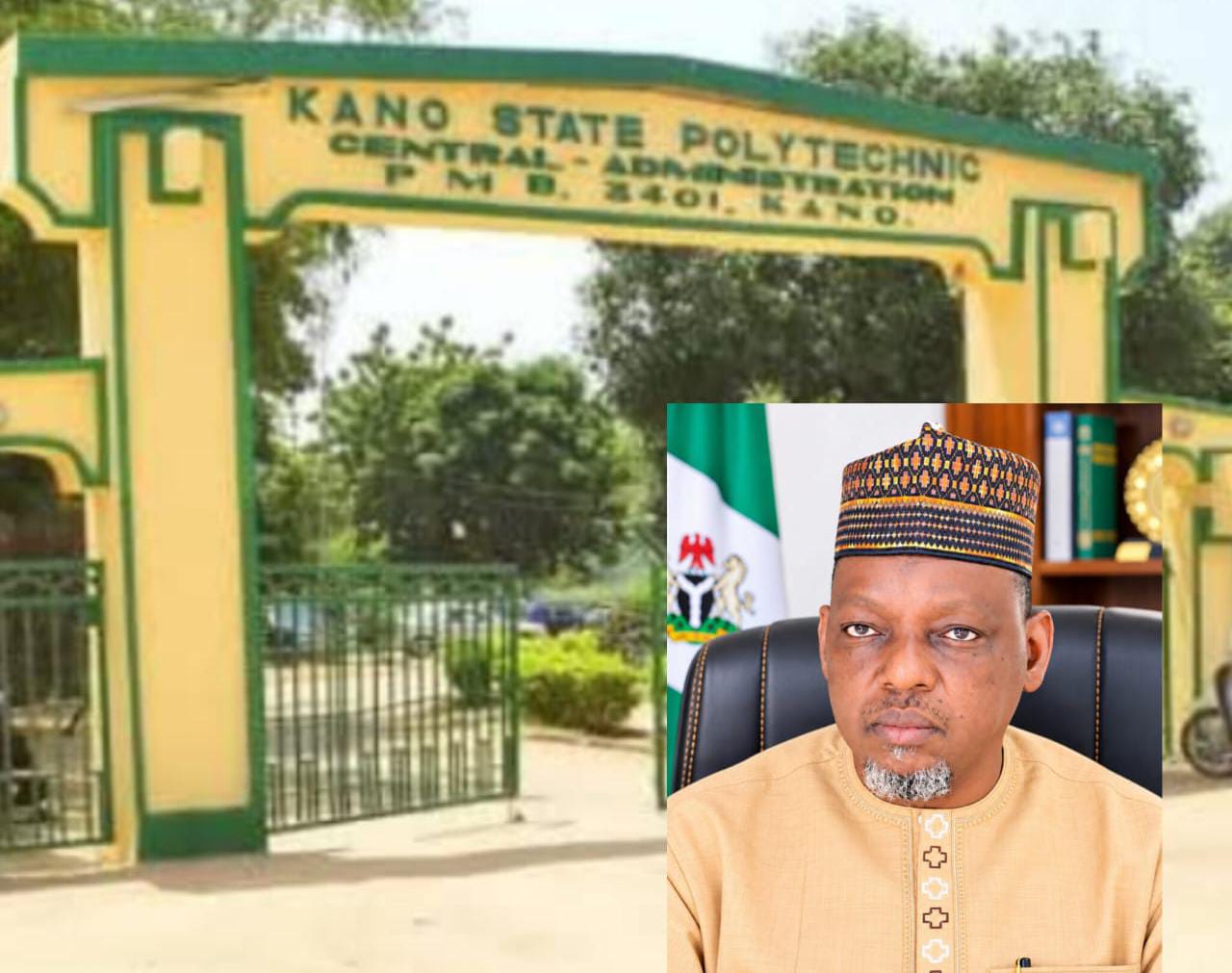
The Rector of Kano State Polytechnic Dr. Abubakar Umar Faruk has responded to several Global Tracker and The Historica Nigeria Publications outlining allegations of financial and administrative mismanagement, health related issues, some wrong doing in Polytechnic community as well as the collapse of the Only Institutions Microfinance Bank (MFB).
The Rector in an article of Interview shared to journalists in Kano on Wednesday also outlined several achievements recorded under his leadership at the Polytechnic.
The Article read in full;
INTERVIEWER: Recent reports published by some online media platforms in Kano have raised several questions regarding your leadership of Kano State Polytechnic, including allegations concerning your health, administrative capacity, financial accountability and the closure of the Polytechnic Microfinance Bank. What is your general reaction to these publications?
RECTOR: First, I welcome constructive criticism because no public institution or public office holder should consider himself above scrutiny. Kano State Polytechnic belongs to the people of Kano State, and the public has every right to ask questions about its administration, finances, academic standards and development.
However, there is a fundamental difference between journalism and allegations in a manner that creates an impression of wrongdoing before the facts been established.
My position is straightforward: I am prepared to answer legitimate questions about my administration, and I believe that the best way to assess leadership is through verifiable records, institutional performance, transparency and measurable achievements.
Since I assumed office on December 4, 2023, my administration has focused on repositioning the Polytechnic through academic expansion, infrastructural development, strategic partnerships, staff welfare and improved institutional administration.
We have encountered challenges, as every public institution does, but we have also recorded significant development. I believe the public deserves a balanced account of both.
PART ONE: THE POLYTECHNIC MICROFINANCE BANK CONTROVERSY
INTERVIEWER: Let us begin with one of the major issues attracting public attention: the closure of Kano State Polytechnic Microfinance Bank. What exactly happened, and what is the history behind this development?
RECTOR: This is a matter with a long history, and it is important to understand its background before drawing conclusions.
The Polytechnic Microfinance Bank commenced operations in 2019 with an initial share capital of ₦20 million provided by the Polytechnic.
From the financial records available to us, the bank experienced persistent financial difficulties and operated at a loss for several years. Indeed, the reports available to management indicated that the bank had not recorded a profit before the turnaround efforts that commenced under my administration.
When I assumed responsibility, I recognized that the Bank required a serious managerial and operational restructuring. Our first steps were ensuring that its leadership was headed by someone with practical banking experience, a demonstrable track record and the professional capacity to address the challenges confronting the institution.
With the appointment of a new Managing Director and the support of the Polytechnic management and community, efforts were made to reposition the bank.
I am pleased to say that the bank subsequently began recording monthly profits from August 2025 through June 2026, according to the financial reports presented to us.
Therefore, my administration inherited a distress bank with longstanding financial difficulties and we initiated measures that placed it on a path towards recovery. Unfortunately, while these efforts were yielding results, the bank encountered a separate regulatory challenge that eventually led to the revocation of its operating licence.
INTERVIEWER: So, specifically, what was the immediate reason for the closure of the bank? Was it financial mismanagement, insolvency or failure to meet regulatory requirements?
RECTOR: The principal reason communicated to us by the regulatory authorities was the bank’s inability to meet the revised minimum capital requirement.
The Central Bank of Nigeria introduced new capital requirements for microfinance banks operating in metropolitan, and institutions operating under the relevant tier-one category were required to maintain a minimum capital base of ₦250 million.
Remember that our bank commenced operations with just ₦20 million in 2019. It had also experienced years of financial difficulties before the management restructuring.
Although we were making efforts to improve its financial position and had begun recording profits, the Bank still faced substantial challenge of raising its capital base to the new regulatory threshold.
The CBN subsequently revoked the licences of 46 microfinance banks, including ours, following the regulatory exercise.
It is therefore important to distinguish between the specific regulatory reason for the revocation of the licence and any allegations of financial misconduct. The regulatory correspondence and examination reports available to us identified recapitalization as the major challenge.
INTERVIEWER: Some reports appear to associate the closure with possible financial mismanagement. Can you categorically clarify whether the CBN’s examinations established financial misconduct?
RECTOR: Let me be very clear: I would not want the public to be confuse with the failure to meet a regulatory capital requirement as proven case of financial misconduct.
The CBN examined the Bank’s records on two occasions during the 2025–2026 financial years. The principal regulatory concern communicated to us was the need to recapitalize the bank to the prescribed minimum capital requirement before the deadline.
The Bank also engaged a consultant to review its financial position, and the findings of that review are relevant to understanding the bank’s condition and the turnaround efforts.
I am not suggesting that the bank should be exempted from regulatory scrutiny. On the contrary, every financial institution must comply with the regulations governing its operations.
What I am saying is that allegations of financial misconduct must be supported by evidence and established through the appropriate investigative and regulatory processes. They should not be inferred simply because a bank lost its operating licence for failing to meet a capital requirement.
INTERVIEWER: Before the licence was revoked, what concrete steps did you take to prevent the closure of the bank?
RECTOR: We did not fold our arms. We understood the implications of the CBN’s directive and explored several possible solutions.
In fact, the need to increase the bank’s capital had been communicated by the regulatory authorities even before my appointment as Rector and Chairman of the bank.
During my administration, however, I intensified efforts to ensure that the relevant stakeholders understood the urgency of the situation.
I formally communicated the regulatory requirements and the bank’s financial challenges to the Polytechnic management, the Governing Council and the Kano State Ministry responsible for higher education.
We also presented other practical options to the Governing Council, including:
1. Exploring the possibility of relocating the bank from its existing regulatory tier to Tier Two, which had a lower minimum capital requirement of ₦50 million.
2. Considering the sale of the bank to interested investors as an alternative means of preserving its value and preventing the total loss of the institution’s banking licence.
Beyond these formal approaches, we also reached out to individuals, particularly prominent alumni of the Polytechnic, including political leaders who had graduated from this institution, to solicit their support.
I have copies of the relevant correspondence in my office. These documents can be made available for examination by appropriate stakeholders and journalists.
Our objective was simple: to prevent the loss of an institution that had the potential to recover and contribute meaningfully to the Polytechnic’s financial and economic activities.
INTERVIEWER: The Governing Council is the highest governing authority of the Polytechnic. What happened after you presented these options to the Council?
RECTOR: The Council considered the situation and resolved to pursue financial support from relevant stockholders.
It also approved the engagement of a consultancy firm, R I & Co, to review the bank’s financial position and explore possible partnerships that could assist in resolving the challenges.
The arrangement was that the consultant would help explore other options, including potential partners.
However, my proposal to sell the bank to interested investors was not approved by the Council at that time.
I respected the Council’s decision because institutional governance requires that the Rector and management operate within the established decision-making framework.
It is important to understand that the bank’s challenges were not being handled by one individual acting alone. The Governing Council was involved, and there were established processes for considering the available options.
INTERVIEWER: After receiving the licence revocation notice, did you make any further attempt to reverse the decision?
RECTOR: Yes. Given the seriousness of the situation, I considered it necessary to make a further appeal to the regulatory authorities.
I wrote to both the Central Bank of Nigeria and the Nigeria Deposit Insurance Corporation, requesting a two-week grace period to enable us to explore emergency recapitalization or conclude discussions with interested buyers who had already indicated their willingness to acquire the bank.
Unfortunately, we had not received a response to that appeal at the time of our subsequent enquiries.
I also understand that other affected banks had made similar representations following the regulatory action.
However, I would prefer that the regulatory authorities provide the definitive clarification on the status of those appeals and the subsequent liquidation or resolution processes.
INTERVIEWER: Looking back, do you believe the closure could have been avoided if all the necessary interventions had been implemented earlier?
RECTOR: It is difficult to answer that question with absolute certainty because the bank’s challenges predated my appointment.
What I can say is that the bank’s financial difficulties had accumulated over several years, and the new capital requirement created an additional challenge that required substantial financial intervention.
We made efforts to address the situation through government engagement, the Governing Council, consultants, prospective investors and alumni.
The bank had also begun recording profits following the management restructuring, which demonstrated that there was potential for recovery.
My concern is that an institution that had begun showing signs of improvement eventually lost its operating licence because it could not meet the new capital threshold.
INTERVIEWER: What would you like the public to understand about the closure of Kano State Polytechnic Microfinance Bank?
RECTOR: I want the public to understand three important things.
First, the bank had longstanding financial difficulties before I assumed office.
Second, my administration initiated management reforms that resulted in the bank beginning to record monthly profits from August 2025 through June 2026.
Third, the immediate regulatory challenge that led to the revocation of the licence was the inability to meet the revised minimum capital requirement of ₦250 million.
These are issues that should be examined through the bank’s financial records, CBN correspondence and the independent consultant’s report.
I have no interest in concealing facts. My responsibility is to explain the decisions taken, the interventions pursued and the circumstances surrounding the bank’s closure.
PART TWO: GOVERNANCE, FINANCIAL ACCOUNTABILITY AND THE GOVERNING COUNCIL’S QUERY
INTERVIEWER: Another issue raised in recent publications concerns a reported 14-day query issued to the management by the Governing Council through the Rector’s office, relating to departmental allocations, responsibility allowances, practical consumables and internally generated revenue. What is your response?
RECTOR: First, I want to emphasize that the Governing Council has a legitimate responsibility to exercise oversight over the administration of the Polytechnic. As Rector, I recognize and respect that responsibility.
A query is an administrative instrument designed to seek clarification, obtain explanations and request relevant supporting documents. It should not automatically be interpreted as a finding of guilt or proof of financial misconduct.
There is a clear distinction between a request for explanation, an administrative investigation, an established finding and a proven case of misconduct.
Where the Council requests information concerning expenditure, revenue, allocations or administrative procedures, management has a responsibility to provide the relevant explanations and records through the appropriate channels.
I therefore believe that such matters should be handled objectively and in accordance with the Polytechnic’s financial regulations, administrative procedures and principles of due process.
INTERVIEWER: Some members of the public may ask whether management is willing to make its financial records available for proper scrutiny. What is your position?
RECTOR: Absolutely. Accountability is not optional in public service.
Every public institution must maintain proper financial records, ensure that funds are used for their intended purposes and provide the necessary documentation to authorized oversight bodies.
My administration has no objection to legitimate scrutiny by the Governing Council, auditors or other competent authorities.
In fact, financial transparency and institutional accountability are essential to sustaining public confidence.
However, it is equally important that financial issues are examined on the basis of complete records and established procedures rather than assumptions or selective presentations.
I welcome any lawful and properly constituted examination of our financial activities.
PART THREE: HEALTH, LEADERSHIP AND ADMINISTRATIVE CAPACITY
INTERVIEWER: One particularly sensitive aspect of the publications is the repeated reference to your reported health condition, including claims of partial paralysis and suggestions that you can only work for approximately three hours a day. What is your response?
RECTOR: I believe this issue should be approached with sensitivity, responsibility and respect for human dignity.
Every human being may encounter health challenges at different stages of life. Such challenges should not automatically become grounds for questioning someone’s character, dignity or professional contributions.
I also believe that personal medical information deserves privacy.
However, when someone occupies a public office, the public has a legitimate interest in knowing whether the institution is functioning effectively and whether official responsibilities are being discharged.
My approach has been to continue providing leadership, supervising institutional activities, participating in official engagements and working with the management team to advance the Polytechnic’s objectives.
The most appropriate way to assess my administration is through institutional performance, the execution of approved programmes, academic activities, staff welfare, financial accountability and the progress of ongoing projects.
I would rather have my leadership evaluated against these responsibilities and the available evidence than have unverified medical claims become the defining narrative about my administration.
INTERVIEWER: Some members of the Polytechnic community may be concerned about whether the institution’s daily administration is receiving adequate attention. What assurance can you give them?
RECTOR: Kano State Polytechnic operates through established administrative structures, including the management team, deputy Registrars, directors, heads of departments, academic boards and other statutory committees.
Institutional administration is not designed to depend exclusively on one individual. It is based on defined responsibilities, delegation, teamwork and established procedures.
As Rector, my responsibility is to provide strategic leadership, supervise the implementation of institutional policies, coordinate management activities and ensure that the Polytechnic remains focused on its mandate.
We have continued to pursue academic programmes, infrastructural interventions, staff development and strategic partnerships.
I believe the institution’s records and the activities taking place across its various schools provide a more objective basis for assessing administrative performance.
PART FOUR: ACADEMIC EXPANSION AND INSTITUTIONAL REFORMS
INTERVIEWER: Let us move from the controversies to the performance of the institution. Since your appointment on December 4, 2023, what would you consider the most significant achievements of your administration?
RECTOR: One of our major priorities has been expanding academic opportunities and strengthening the institutional structure of Kano State Polytechnic.
A Polytechnic must remain responsive to changing educational demands, technological advancement and the needs of the labour market.
We have therefore pursued several academic reforms and structural developments.
Among the major initiatives are:
1. Establishment of the School of General and Remedial Studies
We established and restructured the School of General and Remedial Studies to provide additional educational opportunities for candidates seeking alternative pathways into National Diploma programmes.
2. Upgrade of the Continuing Education Centre (CEC)
The former Continuing Education Centre was upgraded into the School of Continuing Education and Postgraduate Studies (SCEPS), strengthening the Polytechnic’s capacity to provide continuing education and advanced professional learning opportunities.
3. Introduction of Postgraduate Diploma Programmes
We expanded postgraduate educational opportunities through the introduction of postgraduate diploma programmes in disciplines including:
– Accounting and Finance.
– Business Administration.
– Public Administration.
– Computer Science.
– Microbiology.
– Engineering-related fields, etc.
4. Establishment of the School of Vocational and Technical Education
We established the School of Vocational and Technical Education (SOVTECH) to strengthen practical skills development, technical education and vocational training.
5. Expansion of ND and HND Programmes
We have also pursued the approval and development of additional National Diploma and Higher National Diploma programmes in emerging and professional disciplines.
In line with this we proposed accreditation of number of courses that are relevant to the current reality, these programs are.
National Diploma in Laundry
National Diploma in Polymer
National Diploma in Crime Management
National Diploma in Microfinance
National Diploma in Community Health
National Diploma in Health Information Science
National Diploma in Nutrition and Dietetics
National Diploma in Artificial Intelligence
National Diploma in Public Health
National Diploma Food Science
National Diploma Petroleum Engineering
National Diploma Mass Communication
Higher National Diploma Mechanical Engineering
Higher National Diploma Textile Technology
Higher National Diploma in Computer Engineering
Higher National Diploma in Mechatronics
Higher National Diploma in Library and Information science
6. Establishment of a Distance Learning Centre
The establishment of the Distance Learning Centre represents another step towards expanding access to education and creating opportunities for learners who may not be able to participate in conventional full-time programmes.
These initiatives reflect our determination to make the Polytechnic more relevant, accessible and responsive to contemporary educational needs.
INTERVIEWER: Some people may see the creation of new schools and programmes as administrative restructuring. What practical benefits do these initiatives offer students and the people of Kano State?
RECTOR: The real value of academic expansion is the opportunity it creates for people.
Every additional programme, when properly approved, resourced and implemented, provides opportunities for more young people to acquire relevant qualifications and professional competencies.
The establishment of the School of Vocational and Technical Education, for example, reflects the importance of practical training and technical competence in economic development.
Similarly, continuing education, postgraduate programmes and distance learning can expand access for people seeking to improve their qualifications and professional capabilities.
Our objective is not simply to increase the number of schools. It is to ensure that academic expansion is accompanied by qualified personnel, adequate facilities, relevant curricula and quality assurance.
We want our graduates to leave the Polytechnic with qualifications and practical competencies that make them useful to society.
PART FIVE: INDUSTRY PARTNERSHIPS, DIGITAL SKILLS AND EMPLOYABILITY
INTERVIEWER: Graduate unemployment remains a major national challenge. What is your administration doing to ensure that students graduate with skills that are relevant to employers and the modern economy?
RECTOR: This is one of the most important questions facing technical and vocational institutions in Nigeria.
Education should not end with the award of certificates. Our graduates must possess the practical skills, professional competence and problem-solving abilities required by employers and the wider economy.
That is why we have prioritized partnerships with government agencies, private organizations and industry stakeholders.
Some of these initiatives include:
1. Partnership with NITDA
We have pursued collaboration with the National Information Technology Development Agency towards establishing an Applied Learning Centre under the Three Million Technical Talent (3MTT) initiative.
The objective is to strengthen digital competencies and prepare students for opportunities in the technology sector.
2. IDEAS Project
Through collaboration with the Federal Ministry of Education’s IDEAS Project, we have pursued opportunities for digital skills training and improved technical capacity.
3. TVET Program
Through collective efforts, two of our centers, Skills Development Centre (SDC) and Innovation and Vocational Enterprise Institute (IVEI) became accredited centers for the Technical and Vocational Education Training (TVET) programme. Hundreds of students were trained and graduated through Cohort 1 and 2 of the programme.
4. Partnership with Dangote Cement Plc
Our collaboration with Dangote Cement Plc has facilitated internship opportunities for outstanding students in Civil Engineering and Building Engineering Technology.
The partnership also facilitated arrangements for the establishment of a Block Makers Academy, providing practical opportunities in construction-related skills development.
5. Establishment of the Career Service Centre
Through Tetfund Intervention, we established a Career Service Centre to improve graduate employability through career counselling, professional development, industry engagement and employment-related support.
6. Career Development and Professional Talks
We have also facilitated career talks and professional engagements to expose our graduating students to employment opportunities, entrepreneurship and the expectations of the labour market.
Our philosophy is that a Polytechnic must maintain a strong relationship with industry because technical education becomes more meaningful when classroom learning is connected to practical experience.
INTERVIEWER: There have also been reports about support from OPay Digital Services Limited. Can you explain what the partnership entails?
RECTOR: We are grateful for the support received from OPay Digital Services Limited, particularly because private-sector participation is important in strengthening educational institutions.
Through this engagement, the Polytechnic secured ₦10 million for the establishment of an Artificial Intelligence Centre at the Department of Banking and Finance.
This initiative is intended to promote exposure to emerging technologies and strengthen students’ understanding of artificial intelligence and its applications.
Additionally, OPay Digital Services Limited provided a scholarship support commitment of ₦60 million for students.
This is an important intervention because financial difficulties should not prevent capable students from accessing educational opportunities.
Our responsibility is to ensure that such partnerships are properly coordinated and that the intended beneficiaries receive the benefits.
PART SIX: INFRASTRUCTURAL DEVELOPMENT AND CAMPUS RENEWAL
INTERVIEWER: Infrastructure is one of the most visible measures of institutional development. What are the major infrastructural achievements recorded under your administration?
RECTOR: Infrastructure has received considerable attention because a conducive learning environment is essential to academic excellence.
We have pursued projects through the support of the Kano State Government, the Tertiary Education Trust Fund (TETFund) and the Polytechnic’s internally generated resources.
Some of the major interventions include:
At the School of Technology:
General renovation of the School of Technology through the State Government.
Asphalt overlaying of road networks across the school through the State Government.
Renovation and furnishing of the Department of Printing Technology through the State Government.
Repair of two heavy printing machines in the Department of Printing Technology through the State Government.
At the School of Management Studies:
Supply and installation of a 500KVA transformer, including poles, cables and other accessories.
Reconstruction and furnishing of the Cooperative Economics and Management Department building, which was destroyed by fire in 2019.
Construction of an academic building to improve teaching and learning facilities.
Other Institutional Infrastructure:
Rehabilitation of lecture halls and academic facilities.
Rehabilitation of the Mechatronics and Autotronics Department.
Renovation and furnishing of 500 seater lecture theater and construction of new toilets.
Construction of female students’ toilets at the school of management studies and school of general and Remedial studies
Construction of a perimeter fence at the School of Environmental Studies, Gwarzo.
Installation of 30KVA solar power systems.
Renovation of the Polytechnic Central Clinic.
Renovation of other administrative facilities.
Provision of potable water across various schools.
Renovation of more than 150 staff and students’ toilet facilities.
Development of skills acquisition facilities and specialised workshops.
Construction and development initiatives across the Polytechnic’s campuses, including the new campus at Gwamai, Dawakin Tofa Local Government Area.
Development of Soil Laboratory at the School of Environmental Studies, Gwarzo through Need Assessment projects initiated by the Federal Ministry of Education
Renovation /upgrading of Hostel at S.E.S Gwarzo
Renovation /upgrading of Gwantanama Hostel at SORTED Rano
Renovation /upgrading of Library at S.E.S Gwarzo
Renovation /upgrading of Library at S.O.T
Procurement, installation testing and commissioning of mass communication Equipment
Supply, installation and commissioning of office furniture.
Renovation of Entrepreneurship innovation building.
Construction and furnishing of Academic Building at S.M.S
Procurement, installation testing and commissioning of Various laboratory and workshop equipment.
Supply, installation testing and commissioning of Furniture and bakery equipment.
These projects and many other represent our commitment to improving the physical environment in which students learn and staff discharge their responsibilities.
INTERVIEWER: Security is another major concern for educational institutions. What has your administration done to strengthen security across the Polytechnic’s campuses?
RECTOR: We recognise that security is fundamental to the successful operation of any educational institution.
Students, staff and visitors must feel safe within the institution’s campuses.
We therefore pursued and secured a TETFund security intervention valued at approximately ₦500 million.
The intervention covers several important areas, including:
Specialized training for security personnel.
Installation of Closed-Circuit Television (CCTV) cameras at strategic locations across the institution’s unit schools.
Provision of new security uniforms.
Supply of modern security gadgets.
Provision of eight branded security motorcycles.
These measures are intended to strengthen surveillance, improve the response capacity of security personnel and enhance safety across our campuses.
We understand that security requires continuous attention, and we remain committed to working with the relevant authorities to protect lives and property.
PART SEVEN: STAFF WELFARE AND HUMAN CAPITAL DEVELOPMENT
INTERVIEWER: Staff welfare is essential to institutional productivity. What specific measures have you introduced to improve the working conditions of teaching and non-teaching staff?
RECTOR: I strongly believe that an institution cannot achieve sustainable development without motivated and professionally supported staff.
Our staff members are the backbone of the Polytechnic, and their welfare has remained an important consideration in our administration.
We have pursued several initiatives, including:
1. Regular Promotion Exercises
We have conducted promotion exercises for teaching and non-teaching staff to support career progression and recognize professional contributions.
2. Academic Development Through TETFund
We have supported academic staff pursuing Master’s and Doctoral degrees through TETFund interventions.
3. Professional Training and Development
We have sponsored staff to attend professional workshops, conferences, seminars and other capacity-building programmes.
4. Improved Allowances for Casual Workers
We have improved the monthly allowances of casual workers, with reported increases from the previous range of ₦7,000–₦10,000 to ₦30,000.
5. Improved Engagement with Staff Unions
We have continued to engage staff unions and other relevant stakeholders to strengthen communication, address concerns and maintain a conducive working environment.
6. Inclusion of Chief Lecturers in Institutional Administration
We have also expanded the participation of Chief Lecturers in the Polytechnic’s administrative structure, including representation at Academic Board meetings.
These measures reflect our belief that institutional progress must include the welfare, professional growth and participation of the people who make the institution function.
INTERVIEWER: Some people may regard the inclusion of Chief Lecturers in the administrative structure as a minor administrative adjustment. Why was it necessary?
RECTOR: Institutional administration benefits from the involvement of experienced academics.
Chief Lecturers possess valuable professional and institutional knowledge. Their inclusion in relevant administrative and academic discussions strengthens participation, broadens institutional perspectives and creates opportunities for experienced academics to contribute to policy implementation.
We believe that governance should encourage participation, consultation and the responsible use of institutional expertise.
PART EIGHT: LEADERSHIP, INSTITUTIONAL STABILITY AND THE WAY FORWARD
INTERVIEWER: Despite the achievements you have highlighted, every institution has areas requiring improvement. What are the major challenges still confronting Kano State Polytechnic?
RECTOR: There is no public institution that can honestly claim to have resolved all its challenges. At this juncture, I must sincerely acknowledge and appreciate the efforts of His Excellency, the Executive Governor of Kano State, Engr. Alhaji Abba Kabir Yusuf for executing various developmental projects at the Institution. Recently, he approved the total sum of N508.1 Million Naira for the renovation, accreditation and convocation ceremony of the Institution.
However, Kano State Polytechnic has a large institutional structure, multiple schools and campuses, thousands of students and a significant workforce. Managing an institution of this size requires continuous investment, planning and cooperation.
Our challenges include the need for additional infrastructure, improved equipment for practical training, adequate funding, continuous staff development, stronger industry partnerships and the expansion of modern teaching and learning facilities.
We also need to ensure that the expansion of academic programmes is supported by adequate human and material resources.
My administration recognizes these realities, and we continue to engage the Kano State Government, TETFund, private-sector partners, alumni and other stakeholders to address them.
The important thing is to remain focused on solutions rather than pretend that challenges do not exist.
INTERVIEWER: Looking ahead, what kind of institution do you want Kano State Polytechnic to become?
RECTOR: My vision is to see Kano State Polytechnic emerge as a stronger, more competitive and more innovative institution of technical and vocational education.
We want an institution that produces graduates who can compete effectively in the labour market, establish businesses, solve practical problems and contribute to national development.
We want to strengthen digital education, technical skills, entrepreneurship, research, industry collaboration and practical training.
We also want to continue improving our infrastructure, strengthening academic standards, promoting staff development and expanding opportunities for students.
Our ambition is not simply to increase the size of the Polytechnic. It is to improve the quality, relevance and impact of the education we provide.
INTERVIEWER: Recent publications and discussions may have generated concerns within the Polytechnic community. What is your message to staff and students?
RECTOR: My message is that Kano State Polytechnic must remain greater than any individual controversy.
The institution belongs to the people, and its future should not be compromised by rumours, speculation, personal disagreements or unnecessary distractions.
I encourage our staff to remain committed to their professional responsibilities and our students to remain focused on their education and personal development.
We must continue to work together, respect institutional structures and pursue excellence.
Constructive criticism is welcome, but we must not allow disagreements to undermine the academic environment or the progress of the institution.
INTERVIEWER: Finally, what would you like to say to the media organizations that have published these reports, the Governing Council, stakeholders and the people of Kano State?
RECTOR: My message to the media is that the freedom to investigate and report public affairs comes with a responsibility to verify information, maintain fairness and respect the dignity of individuals.
I have no objection to journalists asking difficult questions about my administration. In fact, I believe that public institutions become stronger when they are subjected to responsible scrutiny.
However, allegations should not be presented as established facts, and personal health matters should not be exploited to create sensational narratives.
To the Governing Council, I reaffirm my respect for its statutory responsibilities and my commitment to working within the established governance framework.
To the Kano State Government, our staff, students, alumni and other stakeholders, I express my appreciation for their continued support and cooperation.
We recognize that there is still much work to be done. We also recognize the need to strengthen accountability, improve our systems and sustain the gains already recorded.
I remain committed to the development of Kano State Polytechnic.
My ultimate concern is the institution, its students, its staff and its contribution to the development of Kano State and Nigeria.
Let us allow facts, evidence and institutional performance to guide our judgments. Let us prioritize the future of the Polytechnic above every personal disagreement.
Kano State Polytechnic is bigger than any individual, and its development must remain our collective responsibility.
INTERVIEWER: Thank you for the opportunity, I appreciate your time, Sir.
RECTOR: Thank you for having me.
EDITORIAL CONCLUSION
THE RECORD MUST BE EXAMINED IN ITS ENTIRETY
The issues discussed in this interview touch on important questions of public accountability, institutional governance, leadership capacity and the future of technical education in Kano State.
While the controversies surrounding the Polytechnic Microfinance Bank, the reported Governing Council query and questions about the Rector’s health deserve responsible examination, they should not be treated as substitutes for a comprehensive assessment of the institution’s performance.
Dr. Abubakar Umar Farouk’s administration has presented a record of academic expansion, infrastructural interventions, strategic partnerships, digital skills development, staff welfare initiatives and institutional reforms.
These claims must ultimately be evaluated against official records, project completion reports, financial documentation, regulatory correspondence and independently verifiable outcomes.
At the same time, the Rector’s willingness to address difficult questions provides an opportunity for stakeholders to examine the issues through evidence rather than speculation.
The central question should therefore remain: Is Kano State Polytechnic making measurable progress in fulfilling its mandate? That is the standard by which every public institution and every public office holder should be assessed.
Kano State Polytechnic deserves scrutiny, transparency and constructive engagement. Above all, it deserves a future defined by academic excellence, innovation, accountability and sustainable development.