
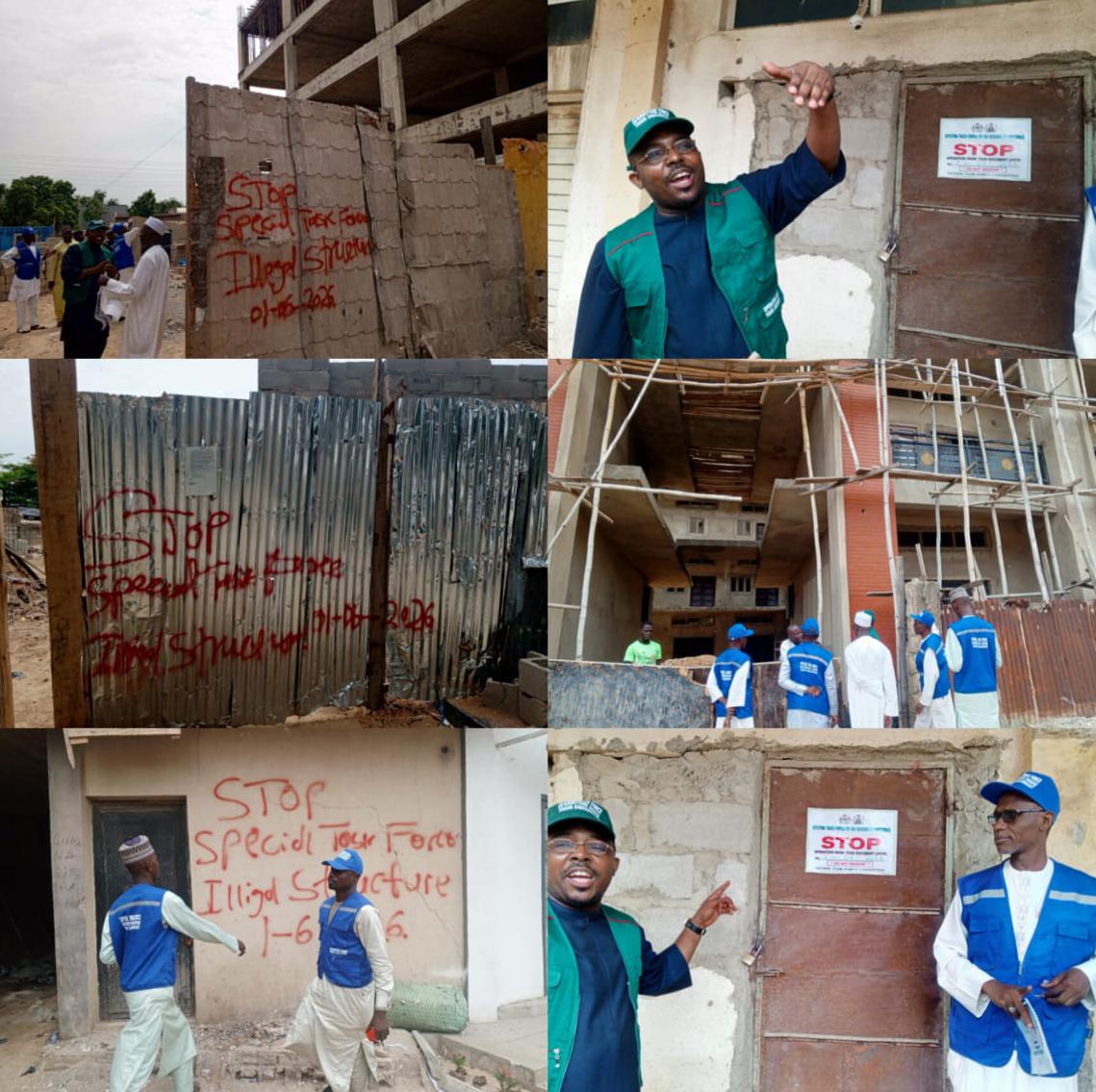
The Kano State Government’s Special Task Force Committee on Illegal Structures has commenced a major enforcement operation across the state capital, sealing no fewer than 13 buildings and construction sites found to be in violation of building regulations, land-use approvals, and urban planning standards.
The exercise, which forms part of the government’s ongoing efforts to restore order in physical development and safeguard public safety, was carried out by the committee chaired by the Director-General of the Kano Geographic Information System (KANGIS), Dr. Dalhatu Aliyu Sani.
The enforcement operation followed the recent inauguration of the 11-member committee by the Kano State Government to tackle the growing menace of illegal structures and unauthorized developments, particularly within Kano metropolis.
Speaking during the exercise, Dr. Dalhatu Aliyu Sani said the operation was aimed at protecting lives and property, preserving the state’s master plan, and ensuring strict compliance with approved building standards and regulations.
He stressed that the administration of Governor Abba Kabir Yusuf remains committed to sustainable urban development and would not tolerate any action capable of endangering residents through illegal construction activities.
According to him, some of the affected structures were found to have violated approved building plans, while others had allegedly undergone unauthorized changes of use from residential to commercial purposes without obtaining the necessary approvals from relevant authorities.
Dr. Sani explained that one of the major concerns of the committee was the growing trend of converting residential buildings into hotels, commercial centres, and other business ventures in areas not designated for such activities.
He noted that such practices not only violate planning regulations but also place enormous pressure on public infrastructure, create environmental challenges, and pose serious safety risks to surrounding communities.
The structures sealed during the enforcement exercise include:
- No. 42 Gidan Maitangaran Upstairs.
- Property belonging to Alhaji Sani Sharu, No. 405 Gandun Albasa New Layout, originally approved by KNUPDA in 2013.
- Property belonging to Kabiru Sani Kwangila Yakasai at No. 21 Sokoto Road, where a building permit was reportedly subject to renewal and the property had allegedly been converted to hotel use.
- Building belonging to Alhaji Adamu, originally approved for residential purposes but reportedly converted into a hotel.
- Structure belonging to Alhaji Inuwa Waya located on Sokoto Road.
- Structure located at No. 3 Sabo Bakin-Zuwo Road, off Sokoto Road.
- Loona Cafe, situated at No. 4 Magaji Rumfa Road.
- An uncompleted building located along Murtala Muhammad Way.
- Building belonging to Alhaji Garba Sadauki Kibiya, located at No. 73 Ahmadu Bello Way.
- An illegal structure located along Ahmadu Bello Way.
- Structure situated at No. 148 Jigirya B. Hadejia Road.
- Construction site belonging to Ayman Jammal at No. 10 Tsauna Close Estate, reportedly designated for showroom purposes.
- Modern Sawmill and Furniture facility, initially approved for residential purposes but allegedly being converted for commercial use.
The committee disclosed that some of the structures were considered potential threats to public safety, including a commercial plaza located around Dangi Bridge, where concerns were reportedly raised over compliance with planning and structural safety requirements.
Dr. Sani emphasized that all commercial buildings and major structures must undergo Integrity Tests designed to assess construction quality, structural stability, compliance with approved standards, and overall safety for public use.
He stated that obtaining initial approval for construction does not grant developers the right to arbitrarily alter the purpose of a building without obtaining fresh approvals from relevant authorities.
“Any building must serve the exact purpose for which it was approved. If approval was granted for residential use, the owner cannot simply convert it into a hotel, shopping complex, office facility, or other commercial enterprise without following due process and obtaining the necessary approvals,” he said.
The KANGIS Director-General further explained that the committee’s mandate extends beyond enforcement to public enlightenment and preventive measures aimed at promoting compliance with urban planning regulations.
He urged developers, property owners, investors, and residents across Kano State to ensure that all future developments conform to approved plans and meet prescribed standards before commencement of construction.
According to him, all structures, whether residential or commercial, must satisfy requirements relating to structural integrity, engineering standards, environmental considerations, and land-use regulations.
“We are appealing to building owners and the general public to always obtain proper approvals and ensure compliance with all building regulations. These laws are designed to protect lives, property, and the future development of Kano State,” he stated.
Dr. Sani reassured residents that the ongoing enforcement exercise is not intended to frustrate genuine investors but rather to create a safe, orderly, and sustainable environment where development can thrive without compromising public safety.
He warned that the committee would continue monitoring developments across the metropolis and would not hesitate to take appropriate action against individuals or organizations found violating planning regulations.
Residents and stakeholders have welcomed the exercise, describing it as a timely intervention capable of addressing indiscriminate construction and preventing building-related disasters.
The enforcement operation marks one of the first major actions undertaken by the newly inaugurated Special Task Force Committee, signaling the Kano State Government’s determination to protect its urban master plan, strengthen regulatory compliance, and ensure the safety and wellbeing of residents across the state.