
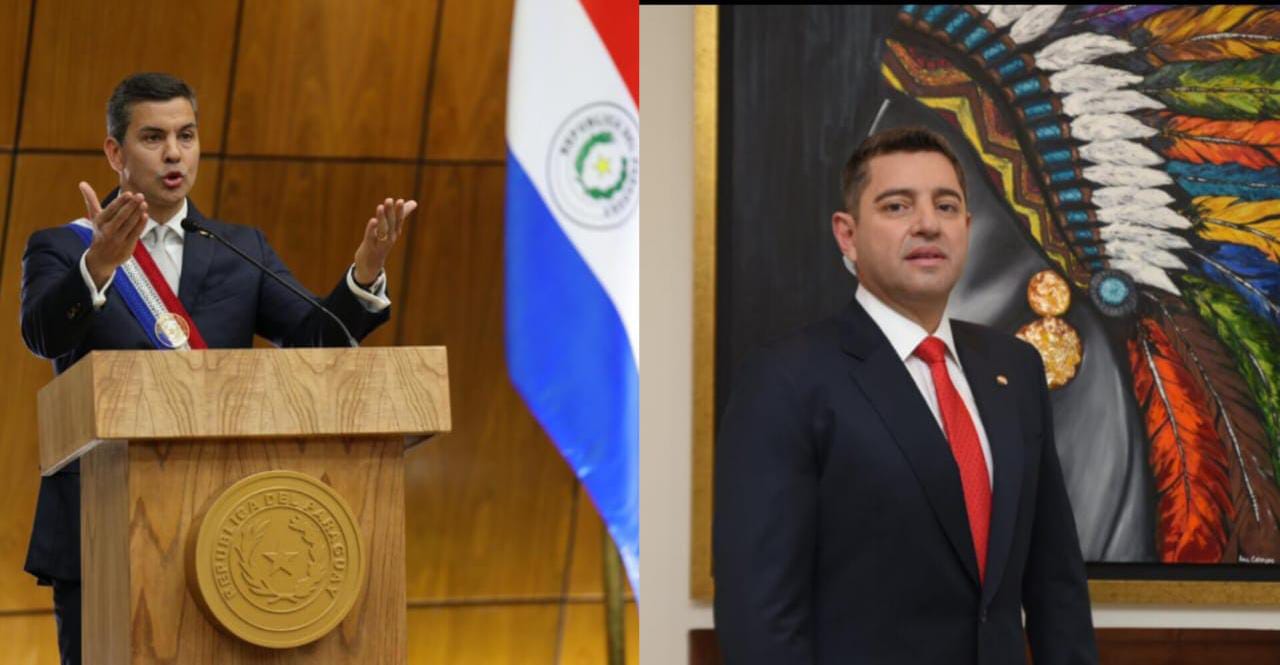
Paraguay has plunged into a major political and financial crisis following the impeachment and removal of President Santiago Peña over allegations of misconduct, conflict of interest and interference in financial regulatory oversight linked to the collapse of Ueno Bank, one of the country’s largest digital financial institutions.
The dramatic development occurred on Friday, November 6, 2026, when the Paraguayan Senate voted overwhelmingly to remove Peña from office, bringing his presidency, which began in August 2023, to an abrupt end.
The decision followed mounting public protests, growing political pressure and investigations into the circumstances surrounding the collapse of Ueno Bank, which affected millions of customers across the South American country.
READ ALSO: Brazil Election: Lula Defeats Bolsonaro, Wins Fourth Non-consecutive Presidential Term
According to reports by Reuters and the Associated Press, all 44 senators present voted in favour of removing Peña, while one senator was absent. The decision followed an earlier unanimous 78-0 vote by the Chamber of Deputies, which approved the impeachment charges and forwarded the case to the Senate for determination.
The immediate trigger for the political crisis was the intervention of Paraguay’s Central Bank in Ueno Bank after the financial institution reportedly failed to meet the country’s minimum solvency requirements. The intervention, announced on Tuesday, November 3, 2026, resulted in the freezing of customers’ accounts and disrupted access to savings, payments and banking services.
Ueno Bank had experienced rapid expansion in recent years, becoming Paraguay’s fifth-largest bank by deposits and attracting approximately three million customers, representing nearly two-thirds of the country’s adult population. The institution reportedly held more than $800 million in public funds, making its collapse a significant concern for the country’s financial system and public institutions.
The impeachment allegations against Peña centred on his previous business connections with Grupo Vázquez, the holding company associated with Ueno Bank, in which he reportedly held shares before divesting them in 2025. Lawmakers questioned whether his financial interests and political relationships compromised his responsibility to ensure independent regulation of the banking sector.
Another major allegation concerned the appointment of Carlos Carvallo, a former executive associated with Ueno, as governor of Paraguay’s Central Bank, the institution responsible for supervising financial institutions and protecting the country’s banking system. Legislators also questioned the placement of approximately $355 million belonging to the state pension fund in Ueno Bank, alleging that the deposits exceeded applicable legal limits.
Peña denied wrongdoing and maintained that the crisis was fundamentally a regulatory and financial matter. He also challenged the speed of the impeachment proceedings, arguing that he had insufficient time to examine the allegations and prepare his defence. His legal representatives requested additional time, but lawmakers rejected the request and proceeded with the impeachment process.
Before his removal, Peña submitted his resignation on Thursday, November 5, expressing concern that his continued presence in government could deepen political divisions and institutional instability. However, Congress rejected his resignation and continued with impeachment proceedings. His removal through impeachment also deprived him of the lifetime Senate membership and associated parliamentary protections that would ordinarily follow a presidential resignation under Paraguay’s constitutional arrangements.
Following his impeachment, authorities placed Peña under house arrest pending his appearance before prosecutors investigating alleged financial misconduct. The investigations include allegations of breach of trust, influence peddling and the possible misuse of public office for personal benefit. Former Central Bank governor Carlos Carvallo was also targeted by an arrest warrant, while several former Ueno executives were detained. Peña has not been convicted of any criminal offence, and the allegations remain subject to judicial investigation.
Meanwhile, former Vice President Pedro Alliana was sworn in as Paraguay’s new president on Friday, November 6, 2026, shortly after Peña’s removal. The 52-year-old conservative politician took the constitutional oath before Congress in Asunción, the country’s capital, becoming the 53rd president of Paraguay. He is expected to complete the remaining presidential term, which ends in August 2028.
Alliana, a member of the governing Colorado Party, previously served as vice president under Peña. Before joining the country’s executive leadership, he served as governor of Ñeembucú Department and spent several years in the Chamber of Deputies, including a period as its president. His assumption of office represents a constitutional transfer of power rather than a new electoral mandate. However, his administration is already facing scrutiny because prosecutors have also opened investigations involving him in connection with the wider banking scandal.
In his initial response to the crisis, Alliana pledged that customers affected by the collapse of Ueno Bank would not be abandoned. He promised that the government would work towards compensating affected depositors and restoring confidence in the country’s financial institutions. Meanwhile, Paraguay’s Central Bank has maintained that the broader banking system remains stable, with deposit insurance expected to cover approximately 97 per cent of Ueno’s customers. Initial repayments to some eligible depositors have already commenced.
The banking crisis has generated widespread public anger, with thousands of Paraguayans taking to the streets of Asunción and other cities to demand the recovery of their savings and accountability for those responsible. Protesters included pensioners, workers, students and business owners whose financial activities were disrupted by the bank’s intervention. Demonstrations intensified as lawmakers debated Peña’s impeachment, with some protesters demanding criminal prosecution of the former president and other officials implicated in the scandal.
Investigations have also extended to the bank’s controlling shareholder, Miguel Vázquez, and other senior executives. Prosecutors have reportedly charged 27 individuals in connection with alleged financial crimes, including breach of trust and attempted fraud. Authorities have conducted searches of properties associated with the bank’s business interests and seized luxury vehicles and other assets as part of the investigations.
Beyond the immediate financial consequences, the crisis has exposed divisions within Paraguay’s ruling Colorado Party, which has dominated the country’s political landscape for decades. Former President Horacio Cartes, a powerful political figure and Peña’s former mentor, publicly supported the president’s removal after their relationship deteriorated. Political analysts have linked the collapse of Peña’s political support to the growing rivalry between the two men, suggesting that internal party divisions contributed to the speed of his political downfall.
The development has attracted international attention because Paraguay has traditionally been regarded as one of South America’s relatively stable economies and an important destination for foreign investment. The crisis has therefore raised concerns about financial regulation, political accountability, public-sector investments and investor confidence. Neighbouring Brazil is also monitoring the situation because of the potential economic and social consequences of instability in Paraguay.
Paraguay’s political transition is particularly significant because it demonstrates the use of constitutional impeachment procedures to remove a sitting president rather than a military takeover or an electoral defeat. However, the investigations surrounding Ueno Bank, the involvement of political and financial figures and the challenge of recovering customers’ savings suggest that the country faces a difficult period ahead.
With Pedro Alliana now occupying the presidency, attention has shifted towards whether his administration can restore public confidence, protect depositors, strengthen financial regulation and ensure that those found responsible for the banking crisis are held accountable. The outcome of the investigations and the government’s handling of the financial fallout are likely to shape Paraguay’s political and economic direction in the months ahead.