
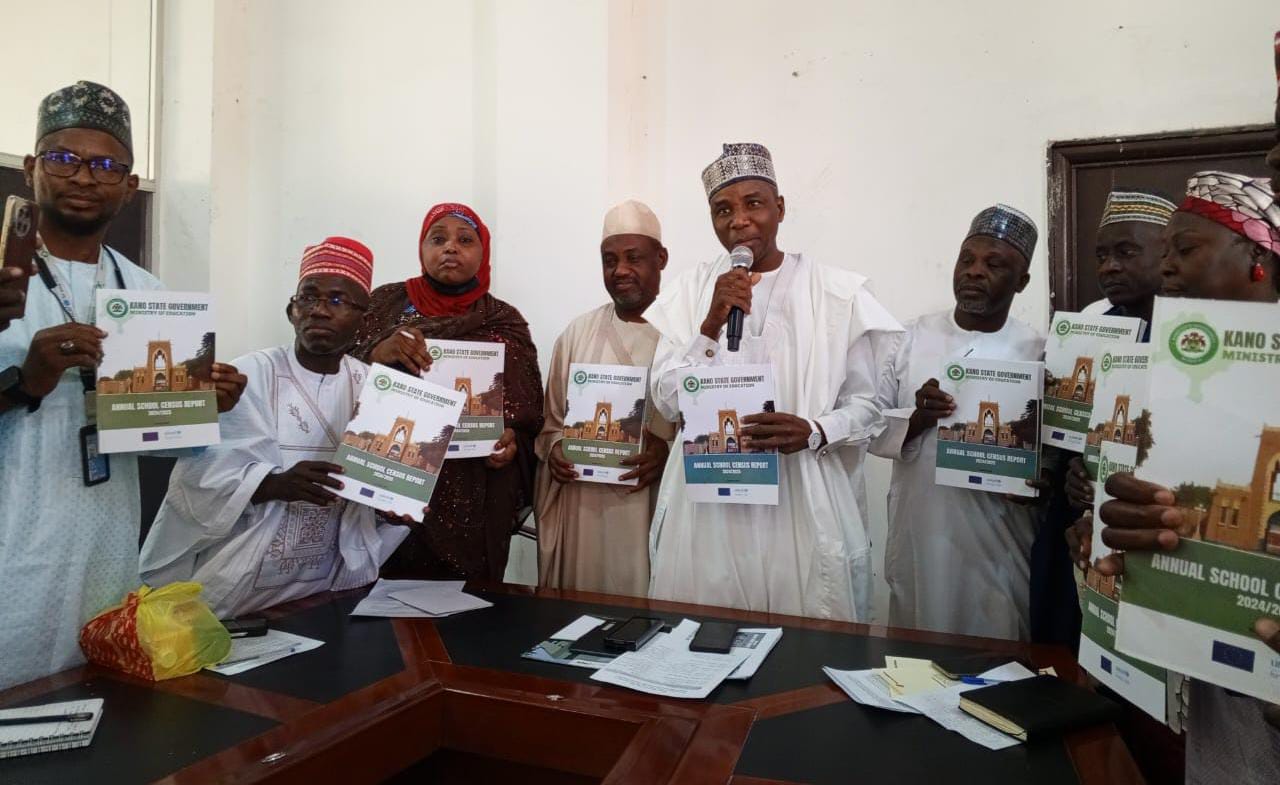
In a historic move aimed at strengthening evidence-based education planning, Kano State has become the first state in Nigeria to produce a comprehensive Annual School Census (ASC) report for the 2024/2025 academic session.
The report, disseminated today by the state Ministry of Education, provides detailed data on schools, students, teachers, and resources across the state.
The dissemination ceremony was led by the Kano state Commissioner for Education, Gwani Dr. Ali Haruna Abubakar Makoda, and attended by key education stakeholders, including Alhaji Yusha’u Hamza Kafinchiri, Director of Planning, Research and Statistics (Dan Masanin Dokajin Kano), and representatives of the United Nations Children’s Fund (UNICEF), led by Hajiya Rahama who was represented by Alhaji Mustapha Shehu.
Speaking at the event, Commissioner Ali Haruna Abubakar Makoda emphasized that the ASC is a key tool for evidence-based planning and policy implementation in Kano State.
“The Annual School Census (ASC) allows us to understand the real needs of our schools, students, and teachers. With this data, we can plan more effectively, allocate resources properly, and implement education policies that truly meet the needs of our people,” he said.
“Kano State continues to set a benchmark for other states by producing a comprehensive and fully documented ASC, ensuring transparency and accuracy in education planning.”
The Director of Planning, Research and Statistics, Alhaji Yusha’u Hamza Kafinchiri (Dan Masanin Dokajin Kano), presented detailed data from the census, including the student–teacher ratios across schools in the state:
- 105 pupils per teacher in pre-primary and primary schools.
- 50 students per teacher in junior secondary schools.
- 37 students per teacher in senior secondary schools.
- 35 learners per instructor in adult and non-formal education centres.
He explained that these figures are essential for teacher deployment, resource allocation, and monitoring and evaluation across Kano State schools.
The report provides statistics on the state’s school system:
- 7,331 public primary schools with 4,715,234 pupils
- 1,451 junior secondary schools with 509,314 students
- 800 senior secondary schools with 412,518 students
- 49 Science and Technical Schools Board (STSB) schools with 31,236 students
- 63 adult and non-formal education centres with 19,049 learners
Education experts describe Kano State’s initiative as a model for Nigeria, demonstrating how reliable data drives policy, improves school management, and ensures equitable resource allocation.
UNICEF Reaffirms Support.
The ASC 2024/2025 was supported and financially backed by United Nations Children’s Fund (UNICEF), reinforcing Kano State’s commitment to improving educational outcomes.
Representing UNICEF at the event, Hajiya Rahama who was assassinated/presented by Alhaji Mustapha Shehu praised the state government for its dedication to data-driven decision-making.
“UNICEF is proud to support Kano State in conducting a detailed and reliable school census. Accurate data is critical for improving education planning, ensuring that children have access to quality learning opportunities,” she said.
The ASC report also informs future teacher deployment, infrastructure development, and implementation of reforms across primary, secondary, technical, and adult education, solidifying Kano State’s leadership in education planning.