
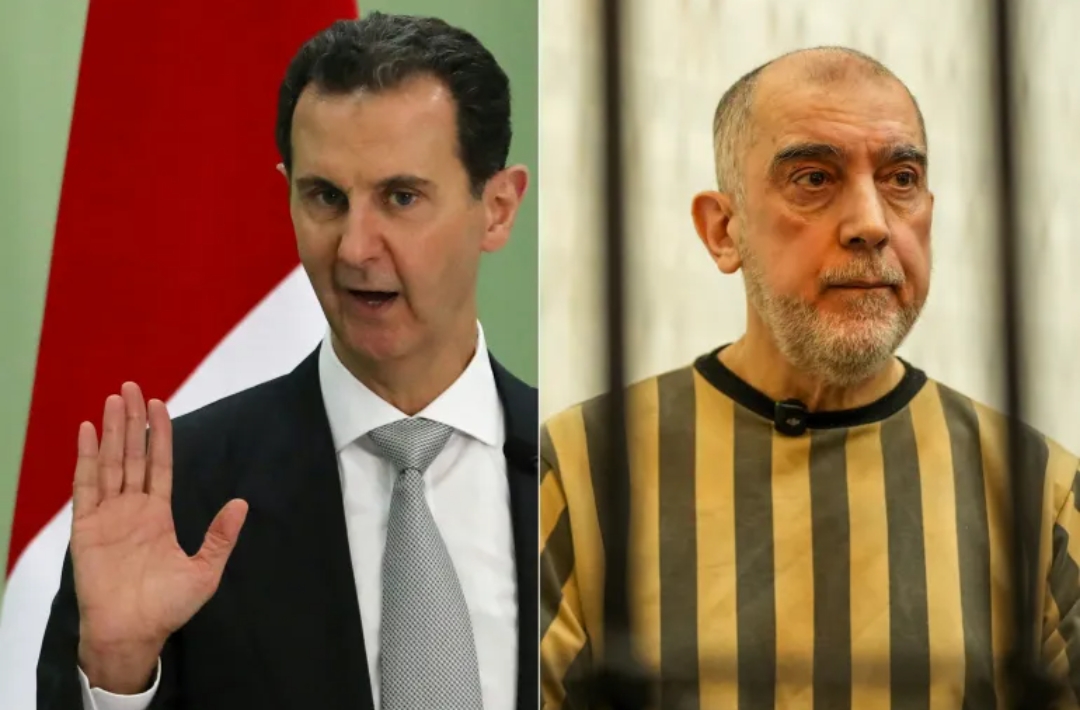
Celebrations have erupted in parts of Syria following a landmark court ruling sentencing former President Bashar al-Assad, his brother Maher al-Assad and their cousin Atef Najib to death over crimes committed during the country’s long-running conflict.
The verdict, delivered by a criminal court in Damascus, marks one of the most dramatic developments in Syria’s post-Assad transition and represents an unprecedented attempt by the country’s new authorities to hold senior figures of the former regime accountable for killings, torture and other serious crimes.
The ruling has generated strong reactions among Syrians who opposed the Assad government, particularly families of people killed, detained, tortured or forcibly disappeared during the conflict.
READ ALSO: BREAKING: Kurdish-led SDF Launches Attacks Against Syrian Army in Aleppo
In Damascus, people gathered around the Palace of Justice following the announcement, with some carrying photographs of relatives who died or disappeared during the Assad era. Crowds expressed satisfaction with the verdict, viewing the sentences as a long-awaited form of justice.
Similar scenes were reported in Daraa, the southern Syrian city where the uprising against Assad’s rule began in 2011. Residents celebrated the judgment in a place that has enormous symbolic significance in Syria’s modern history.
The unrest that began in Daraa more than 15 years ago eventually developed into a devastating civil war that killed hundreds of thousands of people, displaced millions and drew in regional and international powers.
Atef Najib, Assad’s cousin and former head of political security in Daraa, was among those sentenced to death. His name has remained closely associated with the government’s early crackdown on protesters in the city, making his conviction particularly significant to residents.
Celebrations were also reported in Idlib, which became one of the most important opposition strongholds during the Syrian conflict. Residents gathered after the ruling to express their reaction to the punishment of senior figures from the former regime.
The court’s decision followed investigations into serious crimes allegedly committed under the Assad government, including premeditated murder, killings, torture-related deaths, incitement to violence and crimes against humanity.
The ruling against Bashar al-Assad is particularly significant because he ruled Syria for nearly a quarter of a century after succeeding his father, Hafez al-Assad, in 2000.
The Assad family’s rule, which lasted more than five decades, ended in December 2024 when opposition forces captured Damascus and Bashar al-Assad fled the country.
Bashar al-Assad was sentenced in absentia, meaning he was not present in court to hear the judgment. He is believed to be living in Russia, which granted him asylum following the collapse of his government.
His brother Maher, a former senior military commander who played a prominent role in the regime’s military operations during the civil war, was also sentenced to death.
Atef Najib, meanwhile, was among the former regime officials whose actions during the early stages of the uprising became a focus of post-Assad investigations.
The verdict represents a major turning point in Syria’s transitional justice process, but it has also raised questions about the fairness and independence of the proceedings.
Human rights advocates and legal experts have stressed that accountability for atrocities committed during the Syrian conflict should be accompanied by transparent trials, due process and the rights of defendants.
For supporters of the new authorities and many victims of the former government, however, the sentences represent a historic moment after years in which they believed perpetrators of serious abuses would never face justice.
The celebrations in Damascus, Daraa and Idlib therefore carry both political and emotional significance.
For families of victims, the verdict is being viewed as recognition of the suffering they endured during years of war, imprisonment, disappearance and displacement.
But the practical implementation of the sentences remains uncertain.
Because Bashar and Maher al-Assad are outside Syria, the death penalties cannot be immediately carried out. Their enforcement would require the men to be brought under the control of Syrian authorities, something that would depend heavily on Russia’s position and the wider diplomatic environment.
The ruling also comes as Syria continues to struggle with the difficult task of rebuilding the country after more than a decade of conflict.
President Ahmed al-Sharaa’s transitional administration is seeking to reunify the country, integrate competing armed formations into state institutions, address Kurdish demands in the northeast, rebuild relations with regional and international powers and revive an economy devastated by war.
The new government is also facing the challenge of balancing accountability for the former regime with national reconciliation.
While many Syrians want those responsible for atrocities to be punished, the authorities must also prevent the pursuit of justice from creating another cycle of revenge and violence.
The celebrations following the death sentences illustrate the depth of anger that remains in parts of Syrian society more than a year after Assad’s overthrow.
For supporters of the former government, however, the verdict is likely to deepen concerns about political retribution and the direction of the country’s transitional justice process.
The reaction therefore reflects the complicated reality of post-Assad Syria: a country emerging from a devastating war, celebrating the end of a decades-old political order, but still struggling to establish institutions capable of delivering justice, reconciliation, security and lasting peace.
For those who gathered in Damascus, Daraa and Idlib, however, the message was clear—the death sentences against Bashar al-Assad, Maher al-Assad and Atef Najib represent, in their eyes, a historic reckoning with the former regime and a symbolic victory for those who suffered under its rule.