
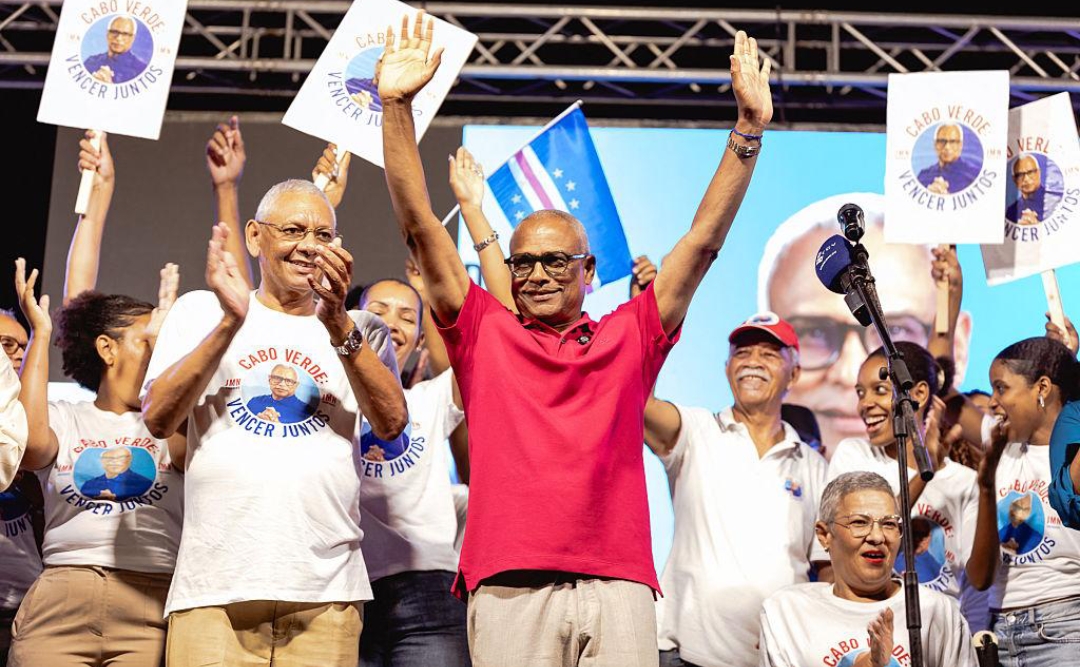
President José Maria Neves of Cape Verde has secured a second five-year presidential term after defeating five challengers in the November 15, 2026 presidential election, extending his leadership in the West African island nation following a campaign dominated by unemployment, rising living costs, poverty and the growing migration of young people in search of better opportunities abroad.
Provisional results announced on Monday, November 16, showed Neves securing 63.8 per cent of the votes from approximately 97 per cent of polling stations, comfortably exceeding the 50 per cent threshold required to avoid a second-round election.
His main challenger, former Justice Minister Joana Rosa, received 31.6 per cent, while the remaining four candidates shared less than five per cent of the votes.
READ ALSO: 2027: Suspected Thugs Attack Kwankwaso, Gwarzo’s Campaign Convoy In Bichi, Injure Supporters
The National Electoral Commission is expected to announce the final official results.
Six candidates contested the presidential election, including the incumbent Neves, who was backed by the African Party for the Independence of Cape Verde (PAICV), and Joana Rosa, who represented the opposition Movement for Democracy (MpD).
The other contestants were independent candidates Gilson João dos Santos Alves, Casimiro Jesus Lopes de Pina, Antero Lúcio Lopes Francês Tavares and Loisito Tavares de Sousa. Rosa made history as the first woman to contest the country’s presidency since Cape Verde gained independence from Portugal in 1975.
Following the announcement of the provisional results, Rosa conceded defeat and congratulated Neves on his victory.
She acknowledged the outcome while describing her participation as an important milestone for women’s political representation in the country.
Her campaign had focused on fighting corruption, political favouritism and unemployment, while advocating a stronger presidential institution capable of providing checks and balances against the governing party’s influence.
Neves, 66, described his re-election as a major victory and pledged to serve all Cape Verdeans, irrespective of their political affiliations, social backgrounds or geographical locations.
In his victory address, he promised to promote national unity, democracy, freedom and the rule of law, while building cross-party cooperation to address the country’s economic and social challenges. He also pledged to work for citizens living in the islands and those in the diaspora.
Several factors contributed to Neves’s victory, including his extensive political experience, incumbency advantage and the political strength of PAICV.
Before becoming president in 2021, he served as Cape Verde’s prime minister from 2001 to 2016 and previously held other public offices.
His longstanding presence in national politics gave him considerable public recognition, while his party’s victory in the May 2026 parliamentary elections further strengthened its political position ahead of the presidential contest.
PAICV’s parliamentary victory was another significant factor in the election. The party secured 37 of the 72 seats in the National Assembly, ending a decade of government by the opposition MpD and enabling Francisco Carvalho to become prime minister.
The outcome strengthened PAICV’s influence across the country’s political institutions and provided Neves with an established political platform during his re-election campaign.
Economic challenges also featured prominently during the campaign, particularly youth unemployment, rising living costs, fuel prices, poverty and the migration of young Cape Verdeans to countries such as Portugal and the United States.
Neves promised to promote employment opportunities, improve housing, healthcare and education, increase wages and tackle poverty. He also pledged to encourage economic growth and create better opportunities for young people to build their futures within the country rather than seeking employment abroad.
Despite Neves’s decisive victory, the election recorded a remarkably low voter turnout, with only approximately 31.7 to 32 per cent of the more than 400,000 registered voters participating.
Neves attributed the low participation partly to emigration, population movements and outdated electoral registers, promising to examine the problem and consider modernising the electoral system, including the possible introduction of electronic voting.