
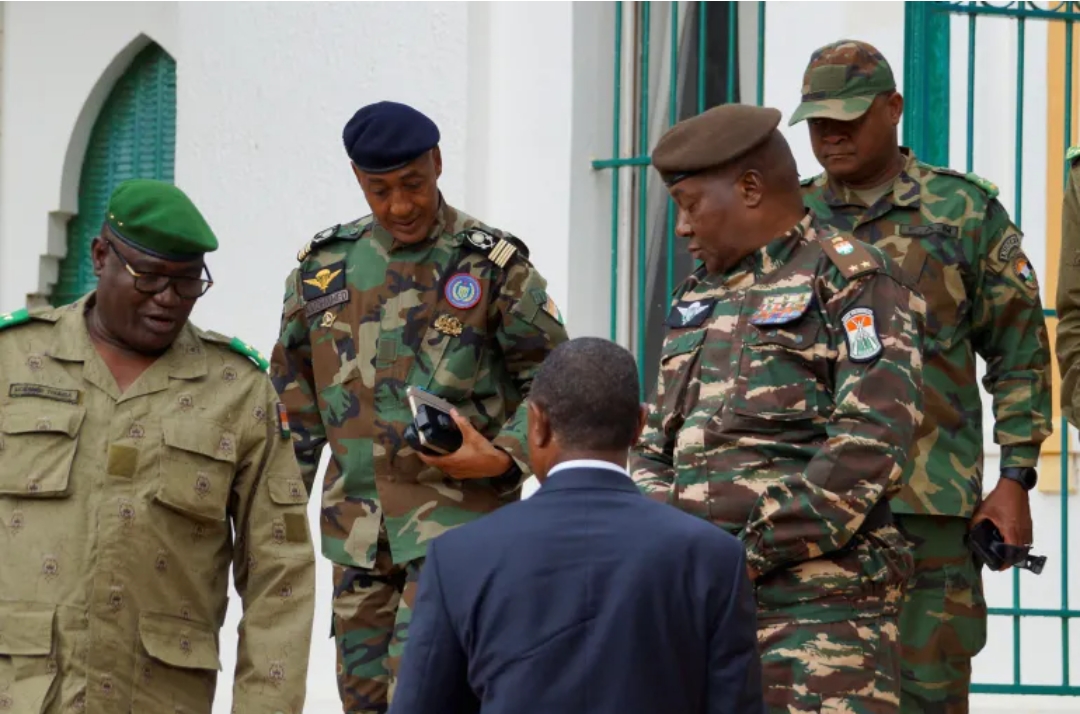
Niger has been plunged into a fresh political and military crisis following an attempted coup in the capital, Niamey, with persistent terrorists attacks, mounting military casualties and growing dissatisfaction within sections of the armed forces emerging as possible factors behind the uprising against the military government of General Abdourahamane Tchiani.
The attempted takeover began in the early hours of Saturday, August 29, when soldiers reportedly mutinied at Air Base 101, near Diori Hamani International Airport, before gunfire and explosions were heard around other strategic locations in the capital, including areas close to the presidential palace.
Niger’s Defence Minister, General Salifou Mody, confirmed that soldiers had attempted to seize sensitive sites, describing the incident as a mutiny and a breach of military discipline.
READ ALSO: Niger Faces Attempted Coup As Mutinous Soldiers Attack Airport, Presidential Area
He said loyalist forces had intervened and were progressively restoring control, while the authorities later announced that the uprising had been contained.
However, the incident has raised fundamental questions about the stability of Niger’s military government and the reasons why soldiers would attempt to overthrow a junta that itself came to power through a coup.
General Tchiani seized power in July 2023 after overthrowing President Mohamed Bazoum, with the military leaders arguing that the civilian government had failed to protect the country from jihadist insurgencies.
Three years later, however, armed groups linked to Islamic State and al-Qaeda remain active across significant parts of Niger.
The Tillabéri region, particularly the areas close to the borders with Mali and Burkina Faso, has become one of the country’s most dangerous theatres of conflict. Soldiers deployed in the region have repeatedly come under attack, while civilians have also suffered killings, displacement and disruption of livelihoods.
The continuing violence has created intense pressure on Niger’s armed forces.
Reports surrounding the attempted coup indicated that some of the soldiers involved were connected to military formations operating in areas such as Téra, Ouallam and Dosso, where troops have faced sustained terrorists attacks.
For soldiers serving in these areas, the persistence of insecurity despite the junta’s promises of improved security may have contributed to frustration and resentment.
WHY THE ATTEMPTED COUP ?
The precise motives of the mutineers have not yet been fully established, and Nigerien authorities have not publicly released a detailed list of their demands.
Nevertheless, the available reporting points to several possible causes.
First is frustration over the continuing terrorists insurgency.
The military government came to power promising to restore security, yet militant groups continue to attack military and civilian targets.
The persistence of these attacks has raised questions about the effectiveness of the government’s counter-insurgency strategy and could have deepened dissatisfaction among frontline troops.
Second is the heavy human cost of the war.
Nigerien soldiers have suffered significant casualties in attacks by terrorists groups.
Repeated deployment to dangerous frontline areas without a decisive improvement in security can generate serious grievances within the military.
The apparent participation of soldiers associated with some of the country’s most heavily affected regions has therefore attracted particular attention.
Third is possible dissatisfaction with the leadership of the junta.
The latest uprising is particularly significant because Tchiani himself rose to power through a military takeover.
The junta justified the 2023 coup by arguing that the previous government had failed to defeat the armed groups threatening Niger.
The attempted coup now creates a striking contradiction: soldiers who were expected to defend the military government appear to have challenged it because the security situation remains unresolved.
Fourth is the possibility of divisions within the armed forces.
The reported seizure of military personnel and attacks on sensitive installations indicate that the incident was more than an ordinary disciplinary dispute.
The involvement of soldiers at a strategically important military base near the international airport suggests that the organisers sought to gain control of key assets in the capital.
Whether the mutiny was limited to a small group or involved wider sections of the armed forces remains one of the most important questions facing the government.
Fifth; Niger’s changing foreign policy may also form part of the wider context.
Since the 2023 coup, the junta has dramatically changed the country’s international partnerships, distancing itself from France and other Western security partners while strengthening relations with Russia.
Niger has also joined Mali and Burkina Faso in the Alliance of Sahel States, seeking greater regional military cooperation outside the framework of ECOWAS.
But despite these geopolitical changes, the terrorists threat has continued.
The failure to produce a decisive reduction in militant violence could become a source of frustration among soldiers and sections of the population who expected the new security partnerships to deliver stronger results.
The attempted coup could have consequences beyond the political struggle in Niamey.
Any prolonged division within Niger’s armed forces could weaken the country’s ability to fight Islamic State- and al-Qaeda-linked groups.
terrorists organisations could exploit military distractions, reduced coordination and weakened command structures to intensify attacks against security positions and civilian communities.
This is particularly concerning in western Niger, where the Islamic State Sahel Province has maintained a significant operational presence around the Mali-Niger-Burkina Faso borderlands.
The government therefore faces a dual challenge: restoring complete military cohesion while continuing the fight against armed groups.
For now, General Tchiani remains in power and the authorities say loyalist forces have contained the attempted takeover.
But the crisis has exposed vulnerabilities within Niger’s military establishment that cannot be resolved simply by arresting or disarming the mutineers.
The government will have to address the grievances that contributed to the uprising, improve conditions for frontline troops, strengthen military command and demonstrate that its security strategy can produce tangible results.