
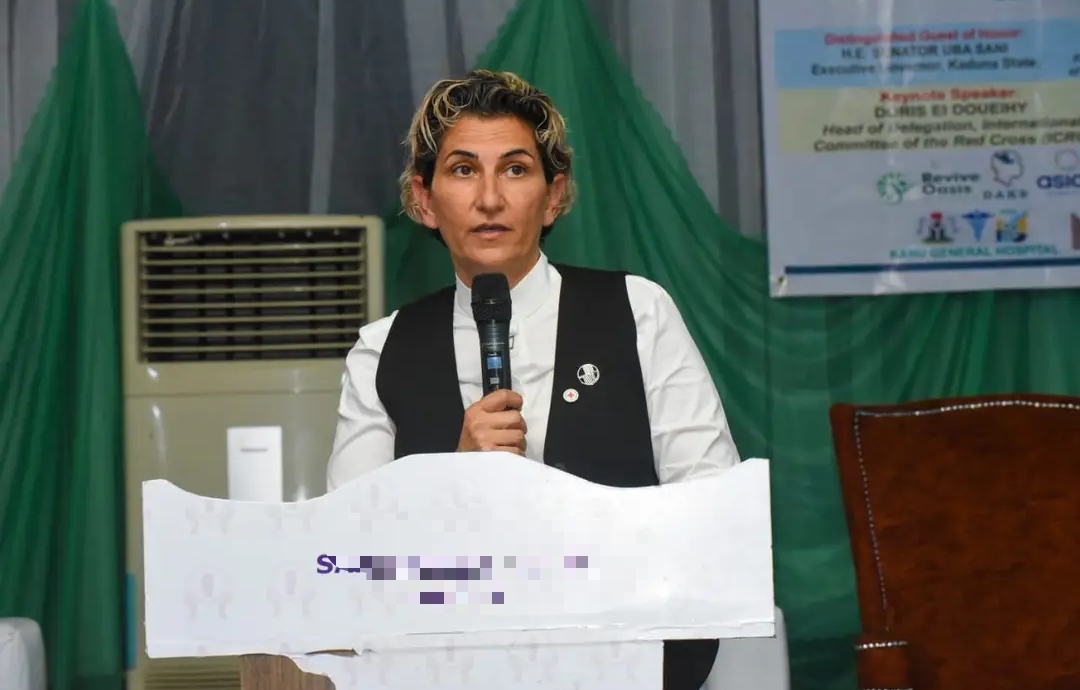
The International Committee of the Red Cross (ICRC) has urged Nigerian journalists to use their platforms to amplify the voices of people affected by armed conflict and humanitarian crises, stressing that humanitarian reporting must go beyond documenting the distribution of food and emergency supplies.
The ICRC Head of Delegation in Nigeria, Doris El Doueihy, made the call in Lagos while opening a two-day humanitarian reporting training workshop organised for journalists from across the country.
El Doueihy said humanitarian action was not limited to providing material assistance, arguing that documenting and communicating the experiences of affected communities was equally important.
READ ALSO: Landmine Crisis: 6,279 People Killed, Injured In 2024, ICRC Raises Concern
“Humanitarian needs are not only about responding by assisting people. It’s also about carrying their stories and ensuring that each and every one in the country and beyond the country knows about the suffering of the people,” she said.
According to her, effective collaboration between humanitarian organisations and the media is essential to ensuring that the realities confronting vulnerable populations are properly understood.
The ICRC official noted that although the organisation’s operations in Nigeria have historically been concentrated in the North-East because of the prolonged armed conflict in the region, its activities are gradually extending towards the North-West.
“It’s true that the ICRC in Nigeria is covering mainly the areas where there’s conflict, which is the North-East. Now, we are shifting a bit to the North-West,” she said, while noting that its major activities remain concentrated in the East.
She stressed that journalists operating outside conflict hotspots also have an important responsibility to report the experiences of victims living in affected areas.
“You, even if you are not in Adamawa, you are the voice of the people who are there. You are the voice of the people who don’t have a voice sometimes,” El Doueihy told the participants.
“In the conflict, the narrative is very important.”
The ICRC delegation head also used the occasion to clarify that the training was not designed to influence the editorial decisions of participating media organisations or dictate how journalists should report on the ICRC.
“We’re not here to tell you what to say about the ICRC or how to report on the humanitarian crisis,” she said.
“We’re here to talk in full transparency about how we see who we are, how we work, and how we see our relationship.”
She emphasised the importance of an independent press, saying journalists should remain free to question humanitarian organisations and report what they observe.
“It’s very important that the media remain free from dictating what should be said or not said… We need those free voices around the world. We need people to translate the reality of the suffering of the people on the ground,” she said.
El Doueihy added that agreement between the ICRC and the media was not the objective of the engagement, but rather mutual understanding and access to accurate information.
“We don’t have to agree all the time. This is not the aim,” she said.
“The aim is for us to know you better and for you to know the ICRC better, so whenever you’re reporting on anything, you have the full picture.”
Against the backdrop of increasing armed conflicts and humanitarian emergencies globally, the ICRC official urged Nigerian media organisations to strengthen first-hand reporting by sending journalists to affected communities and humanitarian operation sites.
She said direct exposure to humanitarian operations would enable journalists to better understand the challenges confronting both affected populations and humanitarian workers.
“It will be good if there is a possibility sometime for you to go to the field and see with your own eyes how the ICRC works, how the team is responding to that humanitarian crisis, so you can have a better understanding also of the reality on the ground,” she said.
El Doueihy commended the diversity of journalists participating in the training and described them as important links between conflict-affected communities and wider society.
She urged them to use their professional platforms to represent people whose voices are often missing from mainstream narratives.
“Continue to be good ambassadors… for the people who don’t have a voice, suffering in areas where they cannot reach audiences as much as you do,” she said.