
BY: MUHAMMAD BELLO ABDULLAHI
In Nigerian politics, power rarely disappears overnight. It is gradually withdrawn, one appointment at a time, one political meeting at a time, one party decision at a time and, sometimes, one conspicuous absence at a time.
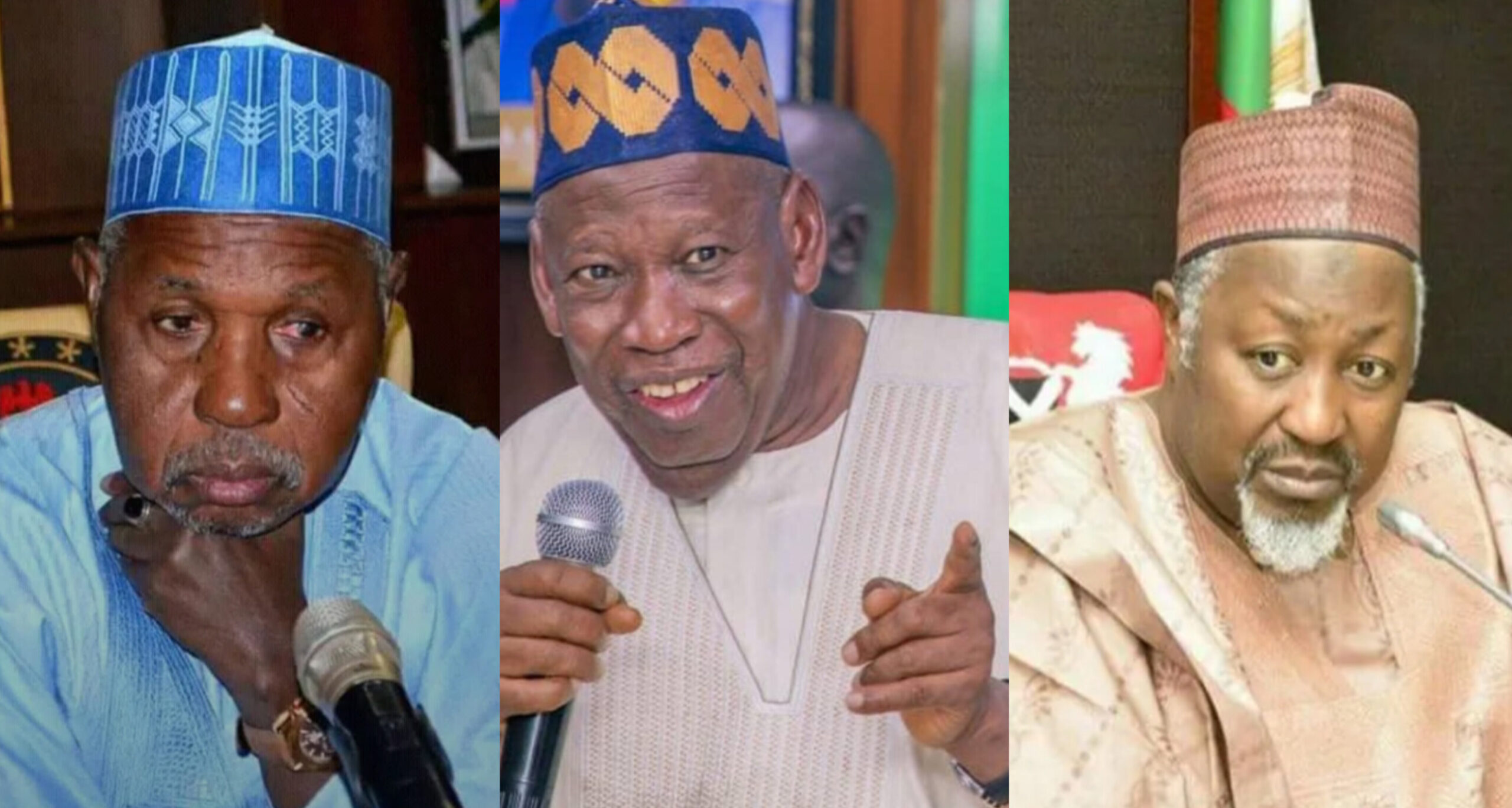
That appears to be the emerging story of three prominent northern politicians who once occupied important positions in the political architecture surrounding President Bola Ahmed Tinubu, they are former Jigawa State Governor and former Defence Minister Mohammed Badaru Abubakar, former Kano State Governor and former APC National Chairman Abdullahi Umar Ganduje, and former Katsina State Governor Aminu Bello Masari.
All three helped build, sustain or participate in the northern political networks that were important to the APC’s victory in 2023. Yet, as the 2027 presidential contest approaches, their positions in the party’s power equation appear considerably weaker than they were during the journey to the 2023 election.
The question is therefore unavoidable:
What happened to the men who were once regarded as important pillars of the northern APC establishment?
The 2023 coalition that changed after victory
The political circumstances of 2023 created a powerful alliance between Tinubu and influential northern politicians.
Ganduje was one of Tinubu’s most visible political allies in the North-West. Badaru controlled Jigawa’s political machinery after eight years as governor, while Masari presided over Katsina, one of the most politically significant states in northern Nigeria.
Their relevance was not merely symbolic.
The North-West represented an enormous electoral bloc, and the support of governors and influential political leaders was critical to Tinubu’s effort to overcome internal opposition within the APC and defeat the People’s Democratic Party’s Atiku Abubakar and Labour Party’s Peter Obi.
But elections have a peculiar way of changing relationships.
The politician who is indispensable during a campaign may become less indispensable after victory.
Once Tinubu became president, the political equation changed from coalition-building to power consolidation.
That is where the fortunes of these three men began to diverge from the centre of the administration.
BADARU’S JOURNEY FROM GOVERNOR TO THE POLITICAL SIDELINES.
Badaru appeared to have one of the strongest post-2023 political trajectories.
After completing his two terms as governor of Jigawa, he was appointed Defence Minister by Tinubu. It was a major federal appointment, and politically it placed Badaru among the most influential northern figures in the new administration.
But the position did not last indefinitely.
His resignation from the cabinet in December 2025 marked a significant change in his relationship with the federal power structure.
Whatever the reasons behind the departure, the political consequence was unmistakable: Badaru moved from the inner circle of federal executive power to the outside.That does not mean he ceased to be influential.
Far from it.
A former two-term governor with deep political relationships does not suddenly become politically irrelevant. But there is a major difference between possessing political capital and controlling the levers through which that capital can be deployed.
As a minister, Badaru had access to the federal executive machinery. Outside the cabinet, his influence depends much more heavily on relationships, networks and his ability to remain relevant to the emerging 2027 coalition.
For a politician preparing for a presidential election, that is a significant reduction in institutional leverage.
GANDUJE: FROM NATIONAL CHAIRMAN TO A DIFFERENT POLITICAL LANE
If Badaru’s decline in formal power was gradual, Ganduje’s was perhaps more politically dramatic.
The former Kano governor became APC National Chairman in 2023.
For a politician, few positions are more strategically important in a governing party.
The national chairman sits at the intersection of party administration, political negotiations, candidate selection, disciplinary processes and electoral mobilisation.
Ganduje was therefore not merely a supporter of the Tinubu administration; he was positioned at the heart of the party machinery.
But the arrangement eventually changed.
His tenure as APC chairman came to an end in 2025.
The significance of that development cannot be underestimated.
A former governor who had risen to the chairmanship of the ruling party had effectively moved from controlling a major component of the political machine to operating outside its formal centre.
His subsequent appointment as chairman of the Federal Airports Authority of Nigeria board preserved an official role for him, but it was a very different kind of political platform.
The contrast is telling.
The APC chairmanship gives a politician direct influence over party machinery. A federal board appointment gives prestige and responsibility, but not the same electoral leverage.That is the quiet language of political repositioning.
MASARI: THE FORGOTTEN PILLAR.
Masari’s story may be the most revealing.
As governor of Katsina from 2015 to 2023, he was an important member of the northern APC establishment.
Katsina is not just another state in electoral arithmetic. It is politically significant because of its size, population and strategic importance in the North.
Yet after leaving the governorship, Masari did not occupy a federal political position comparable to Ganduje’s party chairmanship or Badaru’s defence ministry.
Consequently, his public visibility in the national APC power struggle has diminished.
This raises a broader question about Nigerian politics:
Does political relevance survive without access to formal structures of power?
Sometimes it does.
But in the run-up to a presidential election, formal structures matter enormously.
The governors, ministers, party executives, legislators and political financiers who control access to grassroots structures tend to possess greater bargaining power than former officeholders whose influence is largely informal.
Masari’s apparent marginalisation should therefore be understood within this wider context.
Was it deliberate?
This is where the political investigation becomes more complicated.
There is no conclusive public evidence that Tinubu deliberately set out to sideline Badaru, Ganduje or Masari as a coordinated strategy.
But politics is not judged only by what leaders say.
It is also judged by patterns.
Three prominent northern figures who played meaningful roles in the 2023 political equation have seen their formal positions change significantly before the next presidential election.
First one lost a cabinet position.
Another lost the national chairmanship of the ruling party.
The third has remained largely outside the most powerful federal political positions.
To their supporters, this may look like deliberate political marginalisation.
To their critics, it may simply be the normal rotation of political influence.
Both interpretations deserve consideration.
THE RISE OF A NEW APC ESTABLISHMENT
The bigger story, however, may not be about Badaru, Ganduje or Masari at all.
It may be about the emergence of a new APC establishment.
The 2027 election will require the Tinubu camp to work with governors, legislators, party officials, political financiers and younger political operators whose influence is tied directly to the next election.
The president also has to manage competing ambitions within the ruling coalition.
Every appointment therefore has political implications.
Every removal creates winners and losers.
Every defection changes the balance.
And every alliance comes with a price.
This is why the APC of 2027 cannot simply be the APC of 2023.
The party that won power must now defend power.
That requires a different political architecture.
KANO: The BATTLEFIELD THAT EXPOSED THE PROBLEM.
The Kano political struggle perhaps best illustrates the changing northern equation.
Ganduje’s political influence has historically been closely associated with Kano, but Kano politics has become increasingly fragmented, with competing political forces and shifting alliances.
The rise and continuing influence of the Kwankwasiyya movement, the political calculations of Governor Abba Yusuf, the ambitions of Deputy Senate President Barau Jibrin and the APC’s attempt to strengthen its position in Kano have created a complicated environment.
For Ganduje, therefore, retaining relevance in Kano is more than a personal political objective.
It is a test of whether the old northern APC establishment can maintain its influence in one of Nigeria’s most electorally important states.
The answer remains uncertain.
The Jigawa question, Badaru faces a similar challenge in Jigawa.
After eight years in office, he remains one of the state’s most recognisable political figures. But the emergence of Governor Umar Namadi and the evolution of the state’s political structure mean that the balance of influence cannot simply be assumed to remain what it was under Badaru.
The crucial question is whether Badaru’s political network can continue to command loyalty independently of formal office.
If it can, his political relevance may survive his departure from the federal cabinet.
If it cannot, the loss of his ministerial position could accelerate the transfer of influence to a new generation.
The larger northern calculation
There is another reason these developments matter.
The 2027 election is not only about whether Tinubu wins a second term.
It is also about what happens to the APC after Tinubu.
Northern politicians are already thinking beyond 2027.
The question of who succeeds Tinubu in 2031 will inevitably influence today’s alliances.
That means some northern politicians may support Tinubu’s 2027 ambition while simultaneously positioning themselves for the post-Tinubu era.
This creates an unavoidable tension.
The president needs loyalty for 2027.
The politicians around him need political relevance for 2031.
Those interests overlap—but they are not identical.
And this is where old alliances can become uncomfortable.
A warning for the APC
If the APC believes that former governors and old political networks can simply be discarded without consequences, it may be making a dangerous calculation.
Badaru, Ganduje and Masari may no longer occupy the positions they once held, but each still represents a reservoir of political experience and relationships.
The same politicians who appear marginal today can become valuable tomorrow if circumstances change.
Nigerian politics is full of such reversals.
The politician declared finished today may become the coalition’s most important negotiator tomorrow.
The former ally pushed to the margins may become the bridge to a difficult constituency.
And the political network considered obsolete may suddenly become indispensable when votes are counted.
THE REAL TEST BEGINS NOW
The 2027 election will ultimately reveal whether the apparent reduction in the influence of Badaru, Ganduje and Masari represents genuine political decline or merely temporary repositioning.
For Tinubu, the challenge is to maintain a coalition broad enough to win without allowing competing centres of power to undermine his control.
For Badaru, Ganduje and Masari, the challenge is different: remain politically relevant without the institutional platforms that once amplified their influence.
That is the real power struggle taking place beneath the headlines.
The story is not simply that three former governors have been sidelined.
It is that the APC’s old northern power structure is being reorganised.
Whether that reorganisation strengthens Tinubu’s 2027 project or eventually creates resentment among displaced political allies remains one of the most important questions facing the ruling party.
In Nigerian politics, power is rarely surrendered willingly.
It is negotiated, redistributed and sometimes reclaimed.
Abd as 2027 approaches, Badaru,
Ganduje and Masari may discover that the most dangerous position in politics is not being defeated.
It is being underestimated.
Muhammad Bello Abdullahi is a Journalist and politician who can be reached; muhammadbellom32c@gmail.com