
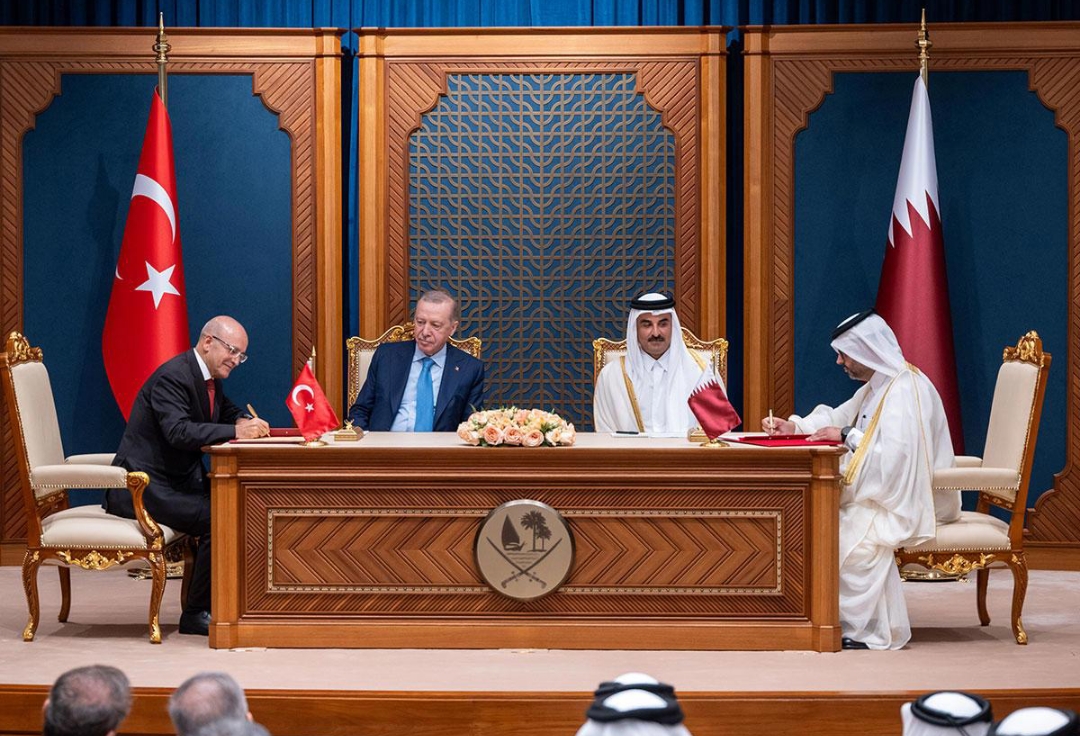
Türkiye and Qatar have signed a new Mutual Defence Agreement aimed at strengthening military cooperation, protecting their national sovereignty and improving collective security amid growing instability in the Middle East.
The agreement was signed on Friday, November 13, 2026, in Istanbul during the 12th meeting of the Türkiye-Qatar Supreme Strategic Committee, co-chaired by Turkish President Recep Tayyip Erdoğan and Qatar’s Emir, Sheikh Tamim bin Hamad Al Thani.
According to a joint communiqué issued after the meeting, both countries agreed to adopt a unified position against any external armed attack targeting either country or both. The agreement comes amid heightened regional tensions involving the United States, Iran and Israel, as well as concerns over the security of international shipping through the strategically important Strait of Hormuz.
READ ALSO: Tinubu Okays Posting Of Ambassadors to US, UK, France, Turkey
Both governments emphasised the need to protect national sovereignty, strengthen regional security and resolve conflicts through dialogue and diplomacy.
Under the agreement, Türkiye and Qatar will strengthen consultations on security threats, joint military exercises, defence industry cooperation, military training and exchanges of personnel.
The arrangement builds on their longstanding military partnership, including Türkiye’s military presence in Qatar and existing joint training programmes. For Qatar, the agreement provides a stronger security partnership with a major regional military power, while Türkiye consolidates its strategic influence in the Gulf. However, the two governments have not publicly disclosed the detailed operational arrangements or specified exactly what military response would follow an attack on either country.
The agreement should therefore not automatically be interpreted as a declaration of war against Iran, Israel or any other country, but rather as a framework for strengthening deterrence and coordinating their defence policies.
The two countries also agreed to expand cooperation in military technology, defence production and the development of indigenous military capabilities. During the meeting, they welcomed the signing of the Badr Memorandum by Türkiye, Qatar, Pakistan and Indonesia, which is intended to promote defence-industrial cooperation through joint production, technology development, information sharing and the exchange of military expertise.
The latest agreement also reflects the close relationship between Ankara and Doha, which became particularly important during the 2017 Gulf diplomatic crisis when Saudi Arabia, the United Arab Emirates, Bahrain and Egypt imposed a blockade on Qatar.
Türkiye supported Qatar during the crisis through military and economic cooperation. Beyond defence, both governments agreed to strengthen trade, investment and energy relations, including cooperation in liquefied natural gas (LNG), with an ambition to increase bilateral trade to five billion dollars. Turkish contracting companies have reportedly undertaken 206 projects in Qatar valued at approximately 20.8 billion dollars.
The leaders also discussed major international and humanitarian challenges, particularly the situation in Gaza, where they expressed concern over ceasefire violations and the deteriorating humanitarian situation. They called for the protection of civilians, unrestricted humanitarian access and support for Gaza’s recovery and reconstruction.
Both countries reaffirmed support for an independent Palestinian state based on the 1967 borders, with East Jerusalem as its capital. They also discussed developments in Syria, Lebanon, Yemen, Sudan, Libya and the Horn of Africa, expressing support for sovereignty, territorial integrity, peaceful conflict resolution and stronger humanitarian assistance.
Their discussions further covered counterterrorism, cybersecurity, law enforcement training and regional mediation, demonstrating that the Istanbul meeting extended beyond military cooperation to broader diplomatic and economic issues.
The new Mutual Defence Agreement represents a significant development in the changing security architecture of the Middle East. For Qatar, it offers a stronger strategic partnership with Türkiye and an additional framework for deterring external military threats, while Ankara gains a more consolidated position in the Gulf and expands its defence and diplomatic relationships across the region.