
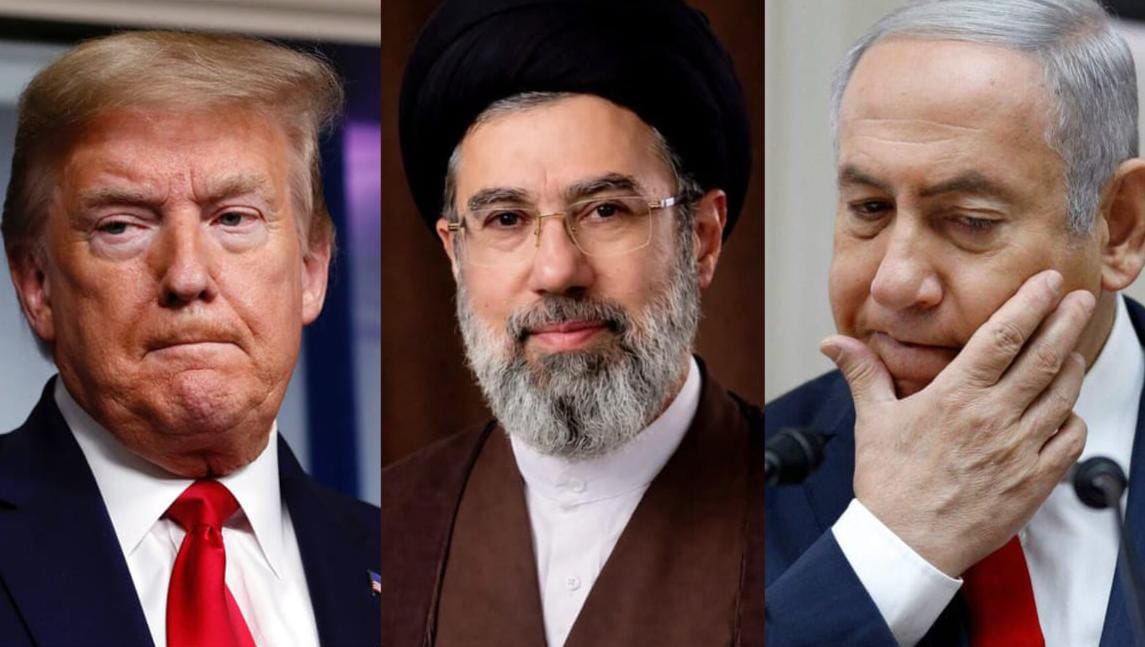
Iran’s Supreme Leader, Mojtaba Ali Khamenei, has called for war-crimes charges against leaders of the United States and Israel amid escalating military confrontations across the Gulf and Lebanon, dramatically intensifying diplomatic tensions in an already volatile Middle East crisis.
Khamenei’s remarks came as the United States launched a second consecutive day of strikes on Iranian coastal targets, while Tehran warned that the strategically vital Strait of Hormuz remains under “total Iranian control” and that further American attacks could trigger a broader regional escalation.
According to Iranian state-linked reports, Khamenei accused Washington and Israel of carrying out attacks on civilians, energy infrastructure and populated areas during the ongoing conflict involving Iran, Lebanon and Gulf waterways.
The Iranian leader reportedly demanded that international institutions investigate what Tehran describes as “war crimes” committed by American and Israeli leaders during military operations in the region.
The accusations emerged after renewed U.S. strikes reportedly targeted Qeshm Island and the southern Iranian cities of Sirik and Bandar-e Lengeh following a drone attack on a commercial vessel near the Strait of Hormuz.
Washington is said to view the strikes as part of efforts to protect maritime security and international shipping lanes after increasing threats to vessels operating in Gulf waters.
Tehran, however, accused the United States of violating the memorandum of understanding linked to the ceasefire framework recently announced after Pakistani mediation efforts.
Iran’s Foreign Ministry said Iranian forces responded by striking targets linked to U.S. forces, arguing that Washington had breached commitments designed to end the war.
At the center of the escalating confrontation is the Strait of Hormuz, one of the world’s most strategically important maritime corridors through which a substantial portion of global oil and gas exports passes daily.
Iranian Foreign Minister Abbas Araghchi warned that the Strait would remain under full Iranian control for the next 30 days, cautioning that any additional U.S. attacks would further destabilize the already fragile regional situation.
Araghchi’s remarks underscored Tehran’s determination to maintain strategic leverage over Gulf shipping routes while simultaneously warning Washington against further escalation.
The renewed tensions come despite recent comments by U.S. President Donald Trump that there would be “no more naval blockade” against Iran following what he described as major concessions made by Tehran during negotiations.
Trump’s earlier statement had briefly raised hopes that direct confrontation between Washington and Tehran might ease after months of military escalation, missile exchanges and growing fears of a wider regional war.
However, the latest military developments suggest the ceasefire remains highly fragile.
Meanwhile, the Lebanon front continues to intensify.
Israeli forces have expanded military operations deeper into southern Lebanon, including offensives around Beaufort Ridge and areas north of the Litani River, while Hezbollah insists it will continue armed resistance against Israel.
Naim Qassem recently declared the Israel-Lebanon framework agreement “null and void,” arguing that continued Israeli military presence inside Lebanese territory invalidates any ceasefire arrangement.
The conflict has increasingly drawn in regional powers.
Qatar, United Arab Emirates and Kuwait have condemned alleged Iranian attacks targeting Bahrain, warning that continued escalation threatens Gulf security and international energy supplies.
Bahrain occupies a particularly sensitive position because it hosts the headquarters of the U.S. Fifth Fleet, making it central to American naval operations in the region.
The ongoing conflict has also shaken global energy markets.
Concerns over attacks near the Strait of Hormuz caused volatility in oil prices, shipping insurance costs and petrochemical supply chains worldwide.
At the same time, Iran has been attempting to restore damaged energy infrastructure following months of strikes on major petrochemical and refining facilities.
Iranian officials recently announced that up to 80 percent of damaged refining and petrochemical capacity could return online within two months after extensive emergency reconstruction efforts.
Despite the rising rhetoric, diplomats continue to push for a broader political settlement aimed at preventing the region from sliding into full-scale war.
Pakistan previously announced that the United States and Iran had agreed to a ceasefire framework following intensive mediation efforts, though repeated military incidents and mutual accusations now threaten to undermine the fragile agreement.
International observers warn that the combination of Gulf maritime tensions, Israeli operations in Lebanon, Iranian retaliation and competing regional alliances has created one of the most dangerous moments in the Middle East in recent years.
Analysts say even limited incidents around the Strait of Hormuz or southern Lebanon could rapidly escalate into a much wider confrontation capable of disrupting global energy supplies, international trade and regional stability far beyond the Middle East.