
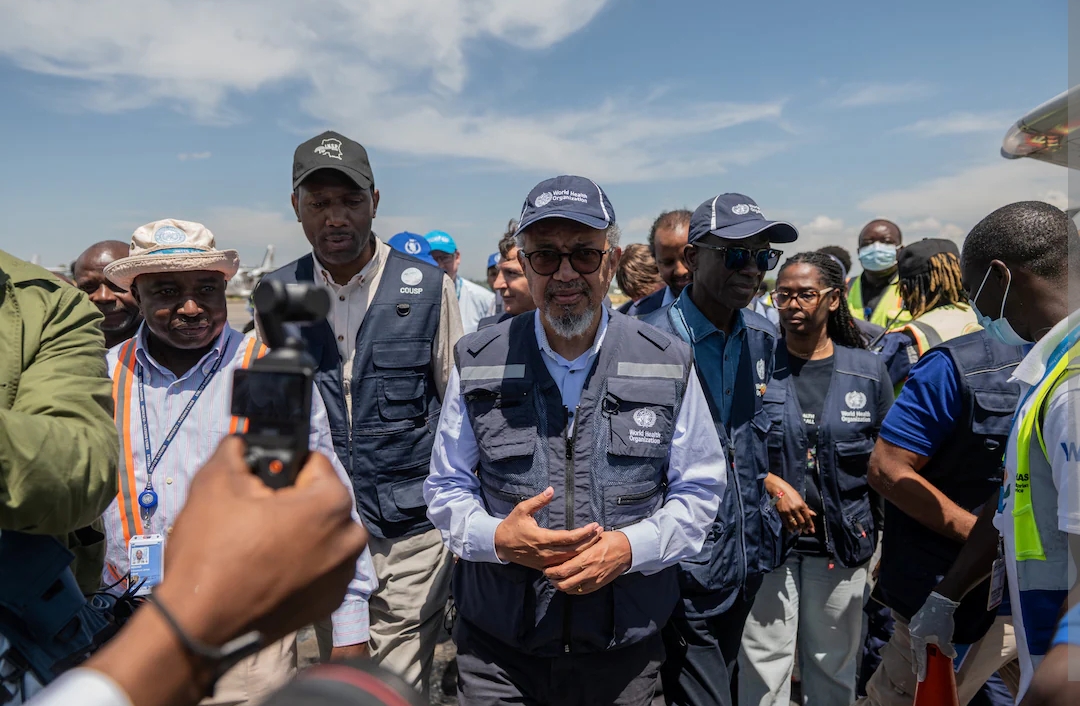
The head of the World Health Organization (WHO), Tedros Adhanom Ghebreyesus, has arrived in eastern Democratic Republic of the Congo DRC as health authorities battle one of the fastest-growing Ebola outbreaks in recent history, with confirmed infections nearly doubling within just 48 hours.
The visit by the WHO Director-General comes amid mounting international concern after Congolese health authorities announced that confirmed Ebola cases had surged to 225, up sharply from 121 cases reported two days earlier, highlighting the rapid spread of the deadly virus across affected communities in Ituri Province.
Tedros arrived in Bunia, the capital of Ituri Province and the epicentre of the outbreak, where he met health workers, local officials and community leaders as efforts intensify to contain a disease that has already claimed scores of lives and triggered a global health emergency.
READ ALSO: Ebola Outbreak Hits Conflict-Torn DR Congo as Red Cross Intensifies Response
Addressing residents and health officials, the WHO chief stressed that local communities would play a decisive role in stopping the epidemic.
“The response to Ebola cannot succeed without the trust, participation and leadership of local communities,” Tedros said, urging residents to cooperate with health authorities through early reporting of symptoms, contact tracing and safe burial practices.
The outbreak is caused by the Bundibugyo strain of Ebola, a rare but highly dangerous variant first identified in Uganda in 2007. Health experts say the current epidemic presents unique challenges because there is currently no approved vaccine or targeted treatment for the Bundibugyo virus.
The World Health Organization has declared the outbreak a Public Health Emergency of International Concern, its highest level of global alarm, reflecting fears that the disease could spread further within the region and beyond if aggressive containment measures are not sustained.
Medical humanitarian organization Doctors Without Borders (MSF) has described the epidemic as one of the fastest-spreading Ebola outbreaks ever recorded, warning that transmission rates are outpacing response efforts in some areas.
The outbreak has already inflicted a heavy toll on affected communities. Earlier reports indicated at least 131 deaths in the Democratic Republic of the Congo, while neighboring Uganda has confirmed imported cases linked to travelers from eastern Congo, including one fatality. Rwanda remains on high alert because of the risk of cross-border transmission, although no confirmed cases have been reported there.
Health officials say the outbreak’s rapid spread has been fueled by several factors, including population displacement, insecurity, weak healthcare infrastructure and delayed detection of infections in remote communities. The situation is particularly challenging in eastern Congo, where years of armed conflict have complicated humanitarian and medical operations.
The Bundibugyo virus is one of three Ebola virus species responsible for most major human epidemics. The deadliest strain, the Zaire Ebola virus, caused the devastating 2014-2016 West African Ebola epidemic, the largest outbreak in history, which infected more than 28,000 people and killed over 11,000 across Guinea, Liberia and Sierra Leone.
While Bundibugyo Ebola has historically recorded a lower fatality rate than the Zaire strain, experts warn that the absence of approved vaccines or specific treatments makes the current outbreak particularly dangerous.
In response, Congolese authorities have intensified emergency operations, deploying rapid-response teams, expanding laboratory testing, isolating infected patients and conducting extensive contact-tracing campaigns. The government is working closely with WHO, Africa CDC and other international partners to contain the epidemic before it spreads further.
Uganda has strengthened border surveillance, hospital screening and isolation facilities following confirmation of imported cases, while Rwanda has reinforced health monitoring at key border crossings and increased preparedness in healthcare facilities.
Despite these measures, international health agencies warn that the outbreak remains a serious threat. The sharp rise in confirmed infections within just two days has heightened fears that the epidemic could accelerate further unless containment efforts are significantly strengthened.
For WHO and its partners, Tedros’ visit to Bunia represents both a show of solidarity and an urgent call to action as authorities race against time to prevent the outbreak from becoming another major African public health catastrophe.