
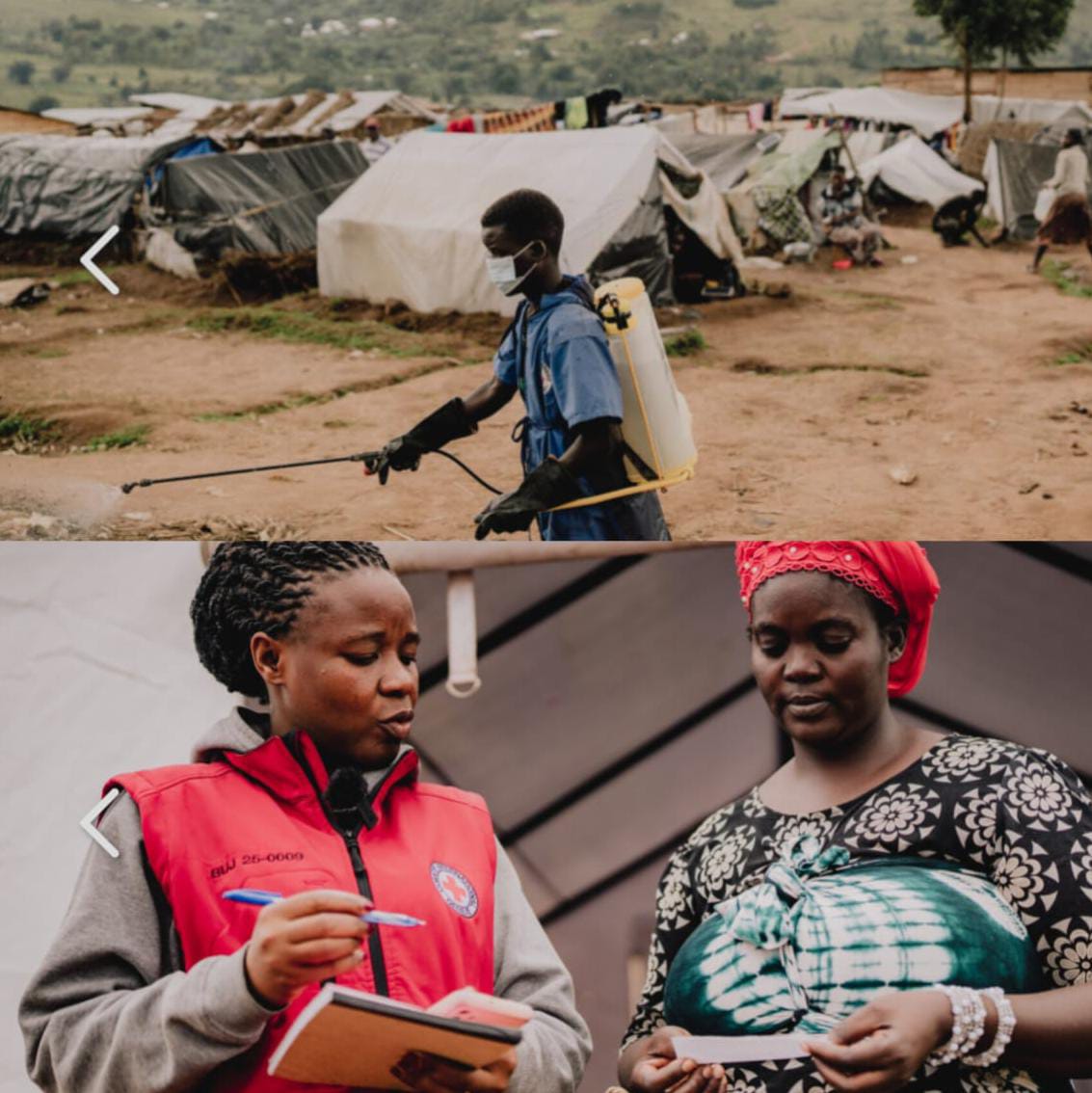
The International Committee of the Red Cross (ICRC) has intensified its humanitarian operations in 2025, scaling up efforts to reconnect separated families, support displaced persons, and improve living conditions for vulnerable communities affected by conflict and displacement.
In a statement sent to GLOBAL TRACKER by ICRC’s newsroom said as part of its global mandate to protect victims of armed conflict and restore family links, the ICRC reported significant achievements across multiple humanitarian sectors in Burundi and DRC Congo.
The Recent fighting in eastern Democratic Republic of the Congo (DRC) has pushed tens of thousands of people across the border into Burundi. More than 65,000 people have found refuge in Busuma camp, where living conditions remain extremely difficult.
Hidden among dense forests in northern Burundi, the camp has rapidly expanded since December. Rows of makeshift shelters and tents now stretch across the hillsides, home to families who arrived with little more than they could carry.
Esperance Sakina Hatari is from Mutarule, a village in the South Kivu. She arrived in December 2025 after fleeing violence in the DRC that forced more than half a million people to leave their homes.
Restoring Family Links
One of the core activities of the ICRC remains reuniting families separated by conflict, migration, and displacement.
The organization facilitated nearly 10,400 phone calls between refugees or asylum seekers and their separated relatives.
It also provided free internet access to more than 27,000 people, enabling them to reconnect with loved ones and maintain communication.
In addition, the ICRC Registered 730 new cases of unaccompanied and separated minors, highlighting the ongoing vulnerability of children in crisis situations.
Successfully located 119 missing persons and clarified their fate, bringing relief to families searching for answers.
To further strengthen family connections, the organization supported the exchange of 1,315 Red Cross messages between separated relatives in Burundi and those living abroad.
Assistance for Displaced and Vulnerable Communities;
Beyond restoring family links, the ICRC also expanded its material assistance to vulnerable households.
In 2025: 2,000 household essential kits were distributed, containing items such as blankets, mats, soap, kitchen utensils, mosquito nets, and buckets.
An additional 500 hygiene kits were provided, including water containers, soap, basins, purification tablets, and reusable sanitary materials.
These distributions are aimed at improving basic living conditions and personal hygiene, particularly in overcrowded displacement settings.
Water Supply and Sanitation Support
Access to clean water remains a critical challenge in many humanitarian contexts.
To address this, the ICRC Donated five 10,000-litre water bladders to support safe drinking water storage.
Financed water trucking activities to ensure a steady supply of potable water to affected communities.
In response to public health risks in displacement camps and reception centres, the organization also strengthened disease prevention efforts.
The ICRC provided; 120 sprayers and 120 personal protective equipment (PPE) kits Barrels of chlorine for disinfection activities, these supplies were used to support sanitation and hygiene operations, helping reduce the spread of infectious diseases in high-risk areas.
A Comprehensive Humanitarian Approach
The ICRC says its interventions reflect a holistic humanitarian strategy combining emergency relief, public health support, and family reunification services to address the complex needs of people affected by conflict and displacement.
As crises persist across different regions, the organization reaffirmed its commitment to protecting human dignity, restoring family links, and improving living conditions for the most vulnerable populations worldwide.