

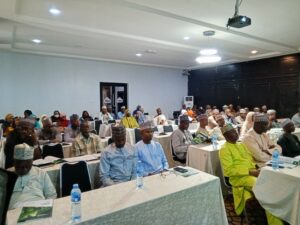
The Nigerian Institute of Training and Development (NITAD) has held its 30th Annual General Meeting (AGM) in Kano State, where it elected new national executives, reviewed institutional achievements, and reaffirmed plans to strengthen professional training standards across Nigeria.
The high-profile AGM brought together members of the institute, training professionals, policymakers, and stakeholders from across the country to assess progress made in the past year and chart a new direction for the institute’s growth and national relevance.
A major highlight of the AGM was the election of new national officers to steer the affairs of NITAD for the next two years.
READ ALSO: KIRS Commissions New Compliance, Enforcement Office to Boost Revenue Generation in Kano
The incumbent President and Chairman of Council, James Bulus, FITD, was re-elected after securing 85 votes, signaling renewed confidence in his leadership.
Other elected officers include:
1st Vice President: Adeyemi Ajayi> (80 votes)
2nd Vice President: Nnenna Nwadike-Christopher> (82 votes)
Treasurer: Modupe Olubunmi Fakayode> (77 votes)
Council members elected include:
Adenike Abiodun Adepoju> FITD (68 votes)
Chukwuma Onwuliri Edmund> FITD (67 votes)
Bassi Usman Emmanuel> (66 votes)
Kayode Surajudeen Alakija> (63 votes)
Abubakar Garba Umar> (62 votes)
Victor Owoniyi Awoniyi> (59 votes)
The election was widely described as peaceful and transparent, reflecting the institute’s commitment to democratic governance and institutional stability.
In his address, President James Bulus highlighted significant achievements recorded by NITAD within the review period, including major expansion in membership and institutional reforms.
He disclosed that over 375 new members were inducted across various categories, alongside 79 new corporate members within the last one year.
He further revealed that the institute adopted a zonal induction model, with Lagos and Abuja serving as major hubs, resulting in the induction of hundreds of professionals across regions.
The institute also strengthened its organizational structure by re-establishing regional blocs and appointing coordinators to enhance coordination, peer learning, and grassroots impact.
Training, Conferences, and Professional Development
According to the President, NITAD recorded significant milestones in professional development activities, including: Honouring 79 Fellows in 2025, Hosting the 2025 Annual Trainers Conference in Abuja, which attracted 501 participants, the highest in its history, Organizing the 2025 Trainers Week in Lagos and Planning the 2026 Learners’ Forum in Abuja, temporarily suspended due to the demise of Coach Onikosi.
He also noted improvements in staff welfare, including salary adjustments, recruitment of additional staff, and enhanced operational efficiency at the secretariat.
The NITAD leadership also emphasized reforms in professional certification and training regulation, including: Reintroduction of Mandatory Continuing Professional Education (MCPE) programmes, Strengthening of mentorship and professional upgrade systems and Resuscitation of the NITAD Practitioners’ License and renewal framework.
The institute stressed that its certification has become increasingly important for professionals seeking consultancy opportunities with the Federal Government of Nigeria.
Meanwhile, the Registrar and Chief Executive, Kayode Adejumo, FITD, highlighted NITAD’s rapid geographical expansion.
He explained that while the institute previously operated mainly from Lagos and later Abuja, it has now expanded into the South, Western regions, and the core Northern states.
He listed operational presence in:
Kano State.
Kaduna State.
Minna, Niger State.
He further disclosed plans to establish additional offices and state chapters in Zamfara and other states across the federation.
The Registrar also revealed that in 2025, NITAD carried out strategic courtesy visits and engagements with key institutions, including: FAAN, TESCOM, Lagos State Ministry of Establishment and Training, Office of the Head of Service of the Federation, ASCON Badagry, Kano State Head of Service, Joseph Ayo Babalola University (JABU) and Osun State.
He said these engagements, he said, strengthened stakeholder relationships and opened new avenues for collaboration in training and manpower development.
In his reelection speech, President James Bulus reaffirmed his commitment to strengthening stakeholder relationships and repositioning NITAD for greater impact.
He disclosed that the National Assembly has approved steps toward granting the institute chartered status, which will enhance its regulatory role in training and professional development across Nigeria.
He appealed to members for unity and support in achieving the institute’s rebranding and repositioning agenda.
“We are committed to strengthening relationships with all stakeholders and repositioning the institute to a higher level. With the approval for chartered status, NITAD will continue to regulate and standardize training across the country,” he stated.
The successful conduct of the 30th AGM and the re-election of the institute’s leadership marks a new phase of consolidation for NITAD as it expands its national footprint, strengthens professional standards, and deepens its role in Nigeria’s human capital development sector.
The AGM ended with renewed commitments to institutional growth, professional excellence, and nationwide capacity-building initiatives aimed at repositioning NITAD as a leading authority in training and development in Nigeria.