
Niger faced a serious military uprising on Saturday after mutinous soldiers attacked strategic locations in the capital, Niamey, including a major military base at the international airport and areas around the presidential palace, in what the military government described as an attempted coup.
Heavy gunfire and explosions were heard across several parts of Niamey from the night of Friday, August 28, into the early hours of Saturday, August 29, sending residents into panic and disrupting normal activities in the capital.
Reuters, AFP and Al Jazeera reported that the unrest involved soldiers who rebelled against their commanders at Base 101, the military installation adjacent to Diori Hamani International Airport. The mutineers reportedly fired at sensitive locations in the capital, including the presidential area.
READ ALSO: NFF President, Gusau Resigns Amid Deepening Nigeria’s Football Crisis
Niger’s Defence Minister, General Salifou Mody, subsequently confirmed that elements of the armed forces had engaged in what authorities described as a mutiny or insurrection.
In a statement broadcast on state television, Mody said the rebels had taken some soldiers hostage at the military base and opened fire on sensitive sites in the capital. He said loyalist defence and security forces had intervened and were progressively restoring control.
The minister urged residents to remain calm and continue their normal activities as security forces worked to bring the situation fully under control.
The unrest temporarily disrupted Niger’s state television and radio broadcasts. The signals were later restored, with state television broadcasting messages aimed at reassuring the population and reporting that security forces had contained the disturbance.
The Associated Press reported that the mutineers targeted sensitive sites from the area of Base 101, while security forces moved to secure strategic locations around the capital. Some officers were reportedly taken hostage during the mutiny as loyalist troops attempted to regain control.
By late morning, the Nigerien authorities said they were progressively regaining control of the affected areas. However, early reports indicated that the situation around the airport remained uncertain for some time, with security forces continuing operations against the mutinous soldiers.
Later reports from the Nigerien authorities described the uprising as contained, with security forces having recovered control of the sensitive sites targeted by the mutineers. The government nevertheless remained on alert following the overnight clashes.
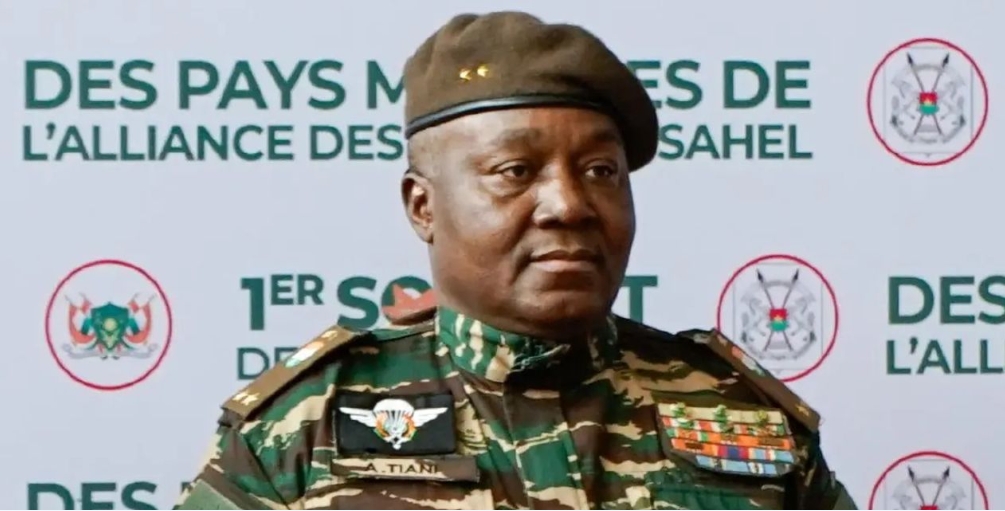
The incident represents the most serious challenge yet to the authority of General Abdourahamane Tchiani, who has ruled Niger since taking power in the July 2023 military coup that removed President Mohamed Bazoum.
Tchiani and his military government had justified the 2023 takeover largely on the grounds of deteriorating security and the failure of the previous civilian government to defeat armed groups operating across Niger.
Three years later, however, jihadist violence remains a major challenge, particularly in western Niger, where armed groups affiliated with al-Qaeda and Islamic State have continued to attack military and civilian targets.
Reuters reported that some of the soldiers involved in Saturday’s mutiny were linked to military units from Ouallam, Téra and Dosso, areas that have experienced intense fighting and heavy military casualties in the country’s battle against jihadist groups.
Analysts cited by Al Jazeera said the incident could reflect deeper institutional problems within Niger’s armed forces, including grievances over military deployments, equipment, rotation of troops and the government’s handling of the country’s worsening security situation.
The attempted uprising therefore carries significance beyond the immediate fighting in Niamey. It represents an apparent challenge from within the military establishment to a government that itself came to power through a military takeover.
Niger has also undergone a major geopolitical realignment since the 2023 coup. The country has moved away from traditional Western security partners, including France, while strengthening relations with Russia. It has also joined Mali and Burkina Faso in the Alliance of Sahel States (AES) after the three military-led countries withdrew from the Economic Community of West African States (ECOWAS).
The three countries have sought to develop a joint security architecture to confront jihadist groups operating across the Sahel, although insurgent attacks have continued to place enormous pressure on their armed forces.
Saturday’s events also occurred at a strategically important location. Base 101, situated near Diori Hamani International Airport, is a key military facility and has previously been targeted by armed groups. The airport itself is an important gateway into Niger’s capital.
The violence caused significant alarm among residents, with witnesses describing prolonged automatic gunfire and explosions in parts of the city. Some residents reportedly sheltered indoors as fighting continued around strategic locations.
As security forces moved to restore order, government supporters called for unity and backing for the military authorities.
The Nigerien government has not indicated that General Tchiani has been removed from power. Instead, the authorities have insisted that the attempted mutiny has been contained and that state institutions remain under government control.
The episode nevertheless exposes the growing pressures confronting Niger’s military leadership, which is simultaneously battling jihadist insurgencies, managing economic difficulties and navigating a major shift in the country’s foreign and regional alliances.
For now, Niamey has returned largely to calm, according to Nigerien authorities, but the attempted uprising is likely to raise fresh questions about cohesion within the armed forces and the durability of the military government that seized power three years ago.
The immediate priority for the authorities will be to determine who organised the mutiny, what motivated the participating soldiers, whether other military units were involved and whether the incident represents an isolated rebellion or evidence of deeper divisions within Niger’s security establishment.