
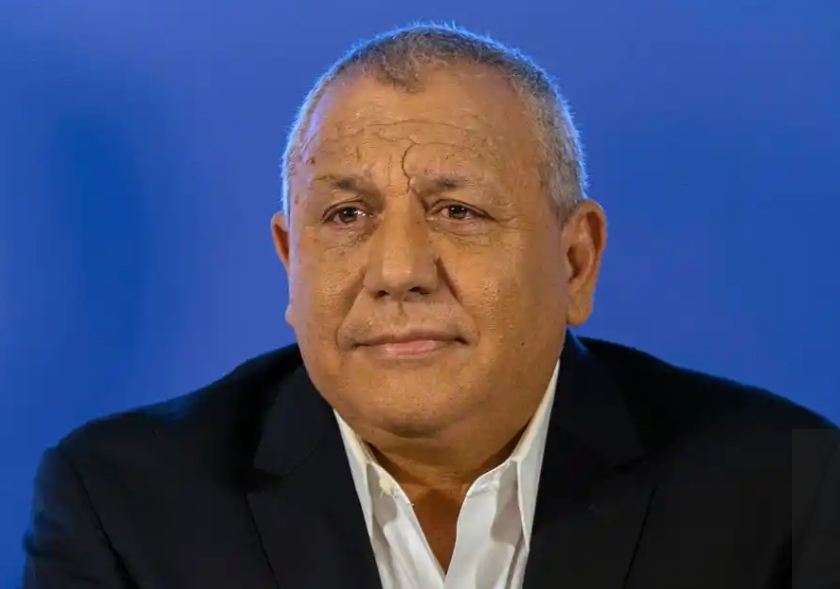
Israeli President Isaac Herzog has selected opposition leader and former military chief Gadi Eisenkot to form the country’s next government, following an inconclusive parliamentary election that dealt a significant political setback to incumbent Prime Minister Benjamin Netanyahu.
Herzog announced his decision on Saturday, November 7, 2026, after consultations with political parties represented in Israel’s 120-member parliament, the Knesset.
Eisenkot received recommendations from 67 lawmakers, compared with 46 who backed Netanyahu, while the remaining seven lawmakers declined to recommend either candidate.
READ ALSO: Israel Election: Netanyahu Faces Political Uncertainty As Arab Parties Win Record 19 Seats
The outcome gave Eisenkot the strongest parliamentary endorsement and positioned him to receive the mandate to negotiate the formation of a new government.
The decision followed Israel’s October 27 general election, which failed to produce an outright parliamentary majority for either of the country’s two major political blocs. Netanyahu’s right-wing and religious alliance secured 53 seats, while Eisenkot’s four-party Jewish-led opposition alliance obtained 48 seats. Arab-led political parties secured a combined 19 seats, making them influential in the negotiations over the country’s next administration.
Under Israel’s parliamentary system, a government generally requires the support of at least 61 members of the Knesset to command a majority. Although Eisenkot received more recommendations during the presidential consultations, he must still demonstrate that he can assemble a coalition capable of securing parliamentary confidence.
President Herzog was expected to formally hand Eisenkot the mandate on Sunday, November 8, giving him 28 days to negotiate with political parties and form a government, with a possible additional 14-day extension.
The president’s decision followed consultations during which different political parties presented their positions on the candidate they believed should lead the next administration.
Netanyahu’s political difficulties have been compounded by disagreements within his governing alliance, particularly over legislation concerning exemptions from compulsory military service for ultra-Orthodox Jewish men. United Torah Judaism, one of his longstanding political allies, declined to recommend him during the presidential consultations, reflecting disagreements over the failure of his government to secure the proposed legislation.
The disagreement weakened Netanyahu’s efforts to retain parliamentary support and created an opportunity for opposition parties seeking a change of leadership. Nevertheless, Netanyahu’s Likud party remained the largest individual political party in the Knesset, with 27 seats, and he continued to serve as prime minister pending the successful formation and inauguration of a new government.
The growing influence of Arab-led political parties has also become a significant factor in Israel’s political calculations. Their combined 19 parliamentary seats could prove decisive in determining the country’s next government. The Joint List and the United Arab List, also known as Ra’am, recommended Eisenkot during consultations with President Herzog, contributing to his total of 67 recommendations.
However, Eisenkot faces a political dilemma over whether to cooperate with the Arab-led parties in establishing his administration. Although their parliamentary support strengthened his position, he has ruled out bringing them directly into his governing coalition without addressing certain political and security conditions. Ra’am leader Mansour Abbas has indicated his party’s willingness to participate in an Eisenkot-led administration, while the Joint List has considered supporting a possible minority government from outside the coalition.
Political negotiations could therefore involve ultra-Orthodox parties, external parliamentary support from Arab-led parties or a broader national unity arrangement. However, disagreements over military service, national security and the country’s political direction could complicate efforts to secure the required majority.
Eisenkot, 66, is a retired Israeli military general who previously served as Chief of Staff of the Israel Defense Forces (IDF). He entered national politics in 2022 and became a prominent opposition figure. He also served in Netanyahu’s wartime cabinet following the Hamas-led October 7, 2023 attacks before becoming increasingly critical of the prime minister’s leadership and handling of the Gaza conflict.
His political emergence has attracted attention because of his military background and criticism of several policies pursued by Netanyahu’s government. Eisenkot has also opposed the influence of far-right political figures, including Itamar Ben-Gvir and Bezalel Smotrich, who have played influential roles in Netanyahu’s governing coalition. He has criticised settler violence against Palestinians, although his military background does not automatically suggest that his administration would adopt an anti-war foreign policy.
An Eisenkot-led government would inherit several major security and diplomatic challenges, including the humanitarian situation in Gaza, tensions with Iran, the confrontation involving Hezbollah in Lebanon and Israel’s wider relationships with Arab countries and international powers. His potential administration would also face questions concerning Palestinian statehood, military operations, regional security and the future of diplomatic engagements across the Middle East.
The political development has attracted international attention because of Israel’s strategic position in the Middle East and the implications of its domestic politics for regional stability. Any substantial change in the country’s foreign policy would depend on the composition of Eisenkot’s coalition, agreements reached with participating parties and the security priorities of the new administration.
If Eisenkot successfully forms a government and secures parliamentary confidence, Netanyahu will leave office, potentially ending his latest period in power. However, should Eisenkot fail to secure sufficient support within the allotted period, another candidate could be given an opportunity to form a government, while a prolonged political deadlock could eventually lead to another parliamentary election.