
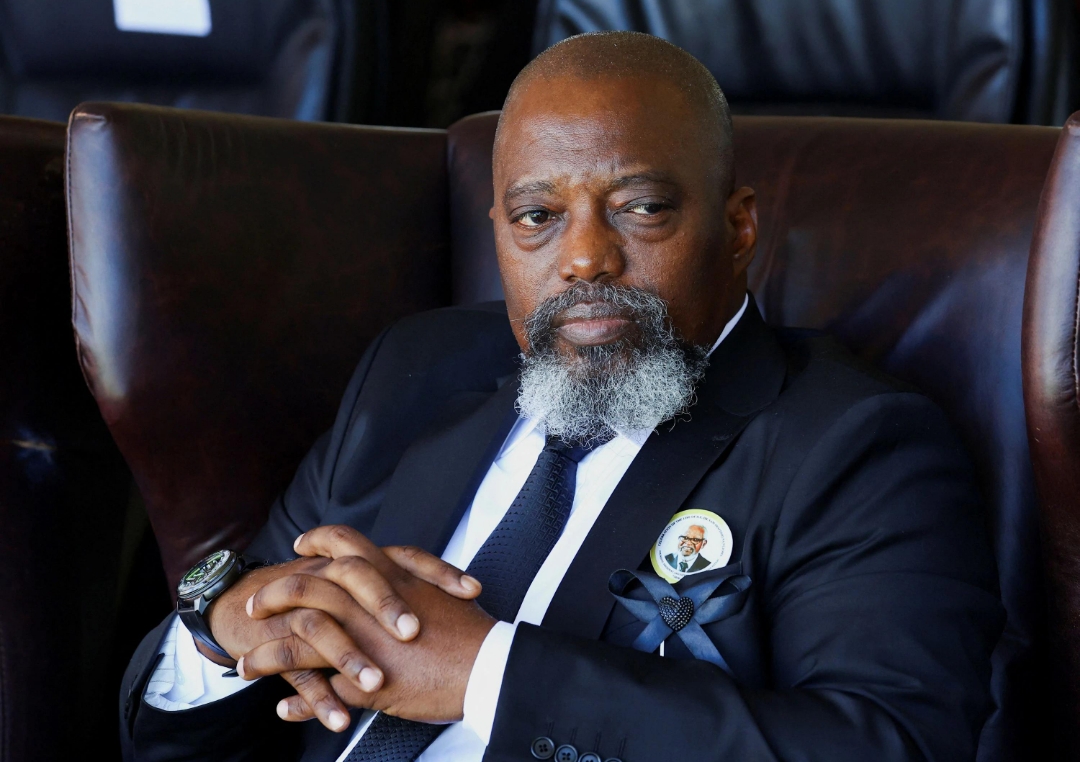
Former Democratic Republic of Congo (DRC) President Joseph Kabila has emerged as the overall leader of a new political and military coalition involving the M23 rebel movement and other armed groups fighting government forces, as the country’s prolonged conflict continues to displace millions of people and deepen one of Africa’s worst humanitarian emergencies.
The coalition, known as the Front for the Refoundation of the Nation (FRN), was announced on October 12, 2026, in Goma, eastern DRC, which M23 captured in January 2025.
The new coalition brings together prominent figures from the former Alliance Fleuve Congo (AFC)-M23 movement.
Its leadership includes Kabila as overall head, Corneille Nangaa and Bertrand Bisimwa in senior political positions, Sultani Makenga as a key military commander, and Freddy Kaniki as Secretary-General.
Kabila, who ruled the DRC from 2001 to 2019, had previously denied involvement in the rebellion despite accusations from the government in Kinshasa.
His emergence as coalition leader has further intensified tensions with President Félix Tshisekedi’s administration.
The Congolese government describes the FRN as a continuation of the former AFC-M23 alliance, while the coalition presents itself as a broader movement seeking political change.
The humanitarian consequences remain devastating, with displacement figures exceeding 6.28 million when internally displaced people and refugees are considered together.
A UNHCR assessment published in October 2026 estimated approximately 6.5 million internally displaced people and 603,990 refugees.
Separately, the United Nations Population Fund reported that about 21.2 million people require humanitarian assistance in the country.
Millions face food shortages, malnutrition, disease outbreaks, inadequate healthcare and limited access to clean water, while women and children remain particularly vulnerable to sexual violence, exploitation and other protection risks.
The conflict has been fuelled by decades of political instability, ethnic tensions, competition over land and mineral resources, and regional security disputes.
The DRC government, the United States and UN experts have accused Rwanda of supporting M23, allegations Kigali has repeatedly denied.
Kabila’s emergence as head of the coalition has also attracted international attention because a Congolese military court sentenced him to death in absentia in 2025 over convictions involving treason, war crimes and crimes against humanity linked to the rebellion.
He has rejected the accusations and described the proceedings as politically motivated. On November 3, 2026, the head of the UN peacekeeping mission in the DRC, James Swan, met Kabila and other FRN leaders in Goma amid continuing diplomatic efforts to address the conflict.
The emergence of the FRN raises fresh concerns about the future of peace negotiations and the possibility of further escalation across eastern Congo and the wider Great Lakes region. With millions displaced, more than 21 million people requiring humanitarian assistance and armed groups maintaining control over strategic territories, the DRC faces enormous challenges in restoring security and protecting civilians.
For millions of affected families, the urgent priorities remain access to food, healthcare, shelter and the opportunity to return safely to their homes.