
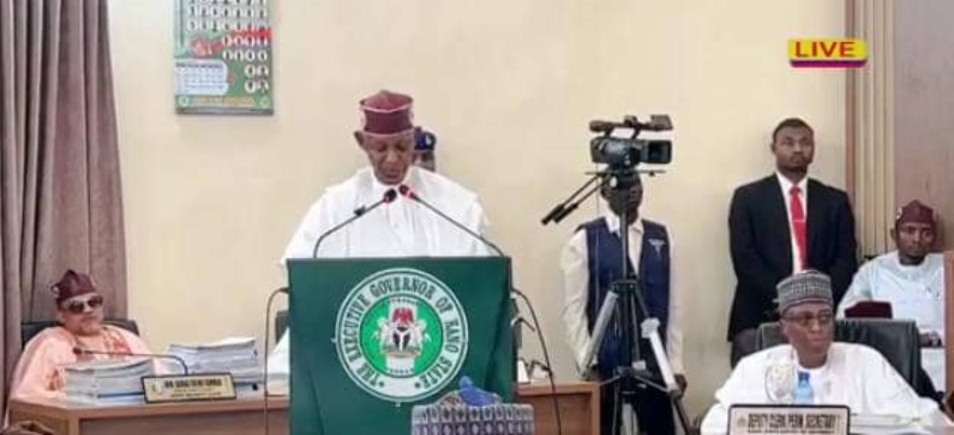
Kano State Governor, Alhaji Abba Kabir Yusuf, has presented a proposed budget of ₦1.107 trillion for the 2027 fiscal year to the State House of Assembly, with 63 per cent of the estimates earmarked for capital expenditure as his administration seeks to consolidate ongoing projects and accelerate development across the state.
The proposed budget, tagged “Budget of Consolidating Gains and Accelerated Rural Development,” stands at ₦1,107,024,004,244.48 and represents the fourth and final budget of the administration’s first tenure, which is scheduled to end on May 29, 2027.
Presenting the estimates before lawmakers, Governor Yusuf said the proposal was designed to consolidate achievements recorded since the inception of his administration in 2023, complete priority projects and strengthen essential public services before the expiration of his first tenure.
READ ALSO: HFN Threatens Kano Govt with Fine, Over Pillars’ Absence from Handball Premier League
The governor explained that the budget placed considerable emphasis on capital development, infrastructure expansion, human capital development and rural transformation, reflecting his administration’s intention to sustain ongoing programmes and extend development interventions to communities across the state.
A breakdown of the proposed expenditure shows that ₦693.47 billion, representing 63 per cent of the total budget, is allocated to capital expenditure, while ₦413.55 billion, representing 37 per cent, is earmarked for recurrent expenditure.
The capital allocation is expected to support infrastructure projects, development programmes and other investments, while recurrent expenditure will provide for the day-to-day running of government institutions and the delivery of essential public services.
Governor Yusuf said the capital-heavy structure demonstrated his administration’s commitment to investments capable of stimulating economic activities, improving public infrastructure and strengthening the living conditions of residents.
On revenue projections, the governor disclosed that Kano State expects to generate ₦692.64 billion in recurrent revenue during the 2027 fiscal year.
The projected revenue comprises ₦142.84 billion from Internally Generated Revenue (IGR) and ₦549.80 billion from the Federation Account.
He said the government would continue to strengthen its revenue-generation capacity while ensuring that available resources were directed towards priority development needs.
The governor also disclosed that more than 90 per cent of the programmes, projects and policies contained in his administration’s development blueprint had been achieved.
He maintained that the proposed budget would provide an opportunity to consolidate those achievements, complete ongoing projects and address outstanding development priorities, particularly in rural communities.
Yusuf further assured the lawmakers and residents that his administration would strengthen budget monitoring, transparency and accountability to ensure that allocated funds were judiciously utilised and that government projects delivered value for money.
He emphasised the importance of effective implementation, explaining that the success of the proposed fiscal plan would depend not only on the size of the allocation but also on the ability of ministries, departments and agencies to translate budgetary provisions into tangible results.
The governor subsequently presented the 2027 Appropriation Bill to the Kano State House of Assembly for legislative scrutiny, consideration and passage into law.
The proposal will now undergo legislative examination, during which lawmakers are expected to scrutinise the revenue projections, expenditure priorities and proposed allocations before taking further action on the bill.
The presentation follows the governor’s earlier directive to members of the State Executive Council to actively participate in reviewing the proposed budget estimates of their respective ministries, departments and agencies ahead of its submission to the legislature.
As the administration approaches the final months of its first tenure, attention will increasingly focus on the implementation of the proposed budget, particularly the completion of ongoing projects, the distribution of development initiatives across the 44 local government areas and the delivery of essential services to residents.
The 2027 budget is therefore expected to serve as the administration’s final major fiscal framework for its first tenure, with its implementation and outcomes likely to be central to assessments of the government’s development commitments.