
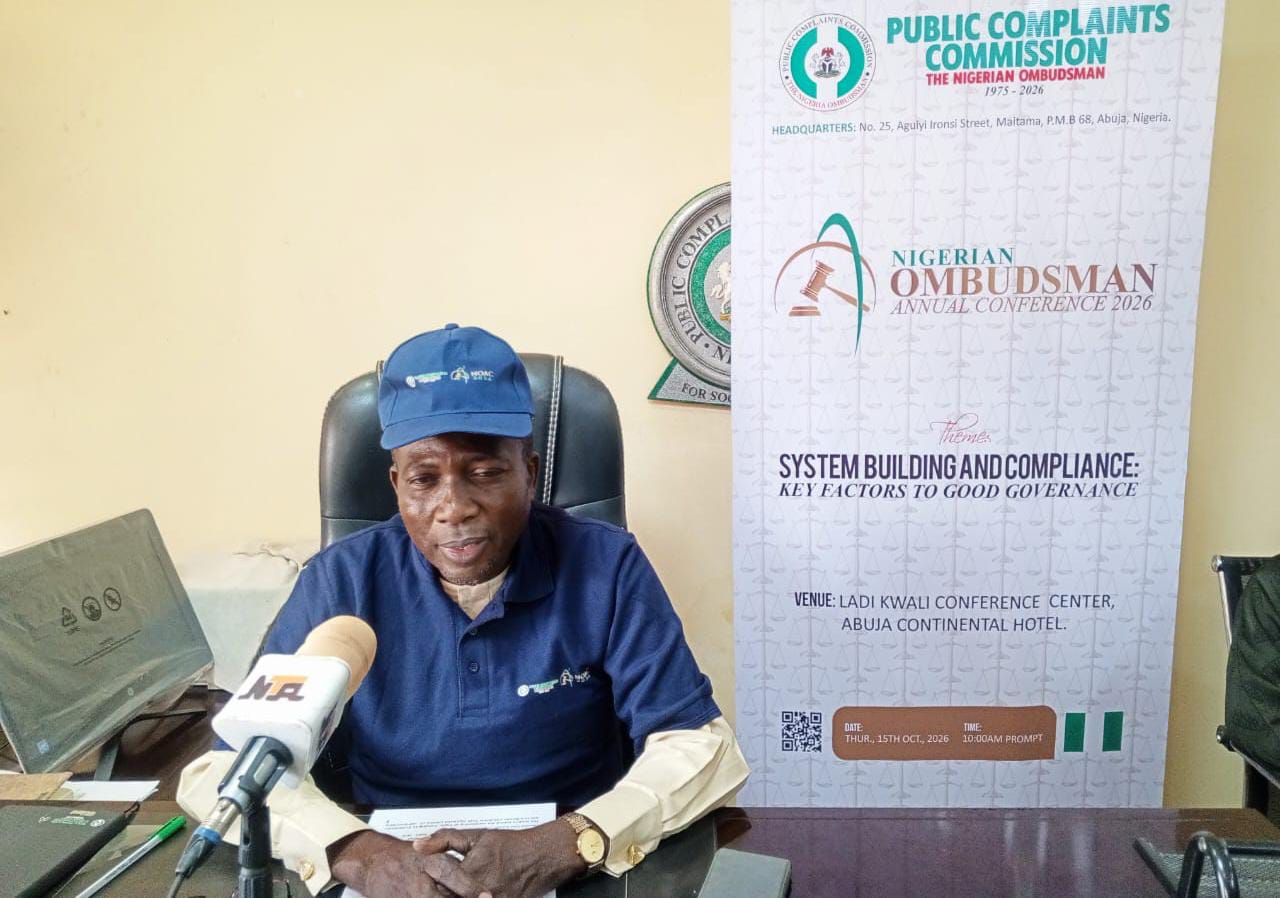
The Public Complaints Commission (PCC), Kano State Office, has received 3,397 petitions between January and September 2026, out of which 1,860 cases were resolved, while 1,537 remain pending,
The Federal Commissioner of the commission incharge of Kano Office Ibrahim Zakari Sarina disclosed this on Thursday during a press briefing to commemorate the 2026 Ombuds Day in Kano.
Sarina highlighted the commission’s interventions in addressing administrative injustice, unfair treatment, corruption and other grievances involving public institutions and private organisations.
According to the Commissioner, the Kano State Office also had 1,382 unresolved cases brought forward from 2025, bringing the total number of cases carried over and received within the period under review to 4,779.
He explained that the commission handles petitions from individuals and organisations against Ministries, Departments and Agencies (MDAs) at federal, state and local government levels, as well as private companies and financial institutions.
Sarina listed some of the major complaints received by the commission to include wrongful termination and dismissal from service, stagnation in service, non-payment of pensions and gratuities, land disputes, breach of trust and contractual agreements, delays in passing judgments and traffic-related petitions.
He said the commission had successfully resolved many of the cases without charging complainants, stressing that its services were particularly designed to assist ordinary citizens and vulnerable members of society who might otherwise struggle to obtain justice.
The Federal Commissioner explained that the Public Complaints Commission was established on October 16, 1975, by the then General Murtala/Obasanjo administration through Decree No. 31, now Cap P37, Laws of the Federation of Nigeria 2004, as amended.
He said the commission commenced operations in January 1976, with the late Alhaji Yusuf Maitama Sule serving as its first Honourable Chief Commissioner.
According to him, the commission has its headquarters at Maitama District, Abuja, with offices across the 36 states of the federation and the Federal Capital Territory.
In Kano, Sarina said the state office operates from the first floor of the Federal Government Secretariat Complex along Katsina Road, with five zonal offices serving the state’s 44 local government areas.
He identified the zonal offices as Bichi, Gaya, Gezawa, Gwarzo and Tudun-Wada, explaining that the arrangement was intended to bring the commission’s services closer to residents across the state.
Sarina described the Public Complaints Commission as an independent institution established to investigate complaints from citizens who feel aggrieved by the actions or inactions of government establishments, public officials and relevant private organisations.
He said its mandate covers administrative injustice, abuse of office, corruption, unfair treatment, wrongful termination of appointments, pension-related disputes, land disagreements and breaches of agreements, among other matters.
The Commissioner further described the Ombudsman as a mediator, reconciliator and protector of citizens, particularly the defenseless and disadvantaged, through impartial investigations and interventions between complainants and institutions or individuals against whom complaints are lodged.
He maintained that the commission’s responsibility was to promote fairness, accountability and administrative justice by ensuring that citizens have an accessible platform to seek redress without financial barriers.
Sarina also disclosed that the relationship between the commission and government Ministries, Departments and Agencies, as well as civil society organisations, had remained cordial, a development he said was important to the discharge of its responsibilities.
However, he acknowledged that the commission continued to face challenges in carrying out its constitutional duties, although he did not provide specific details of those challenges during the briefing.
He called for sustained recognition of the institution’s role in protecting citizens’ rights and promoting justice, describing the commission as a watchdog of social justice and an important instrument for addressing administrative misconduct.
The Commissioner concluded by reaffirming the importance of the Ombudsman in sustaining the fight against injustice and ensuring that aggrieved citizens, especially vulnerable members of society, have access to impartial intervention and redress.
The 2026 Ombuds Day celebration provided an opportunity for the Kano State Office to highlight its activities, review its complaint-handling record and restate its commitment to protecting citizens against administrative injustice.