
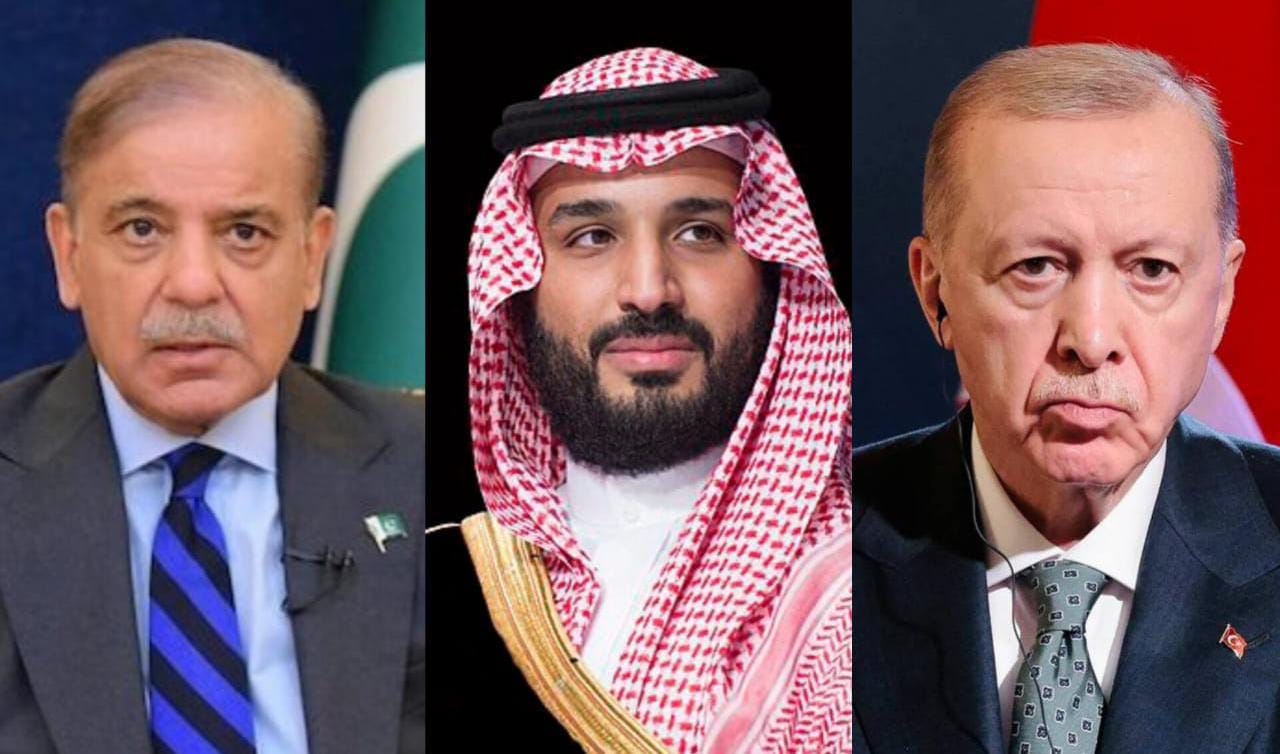
A new security architecture may be taking shape across the Middle East and beyond following the signing of a landmark defence agreement by Saudi Arabia, Türkiye and Pakistan, as the continuing Iran war and uncertainty over the future role of the United States in NATO raise questions about the durability of the traditional Western-led security order.
The three countries signed the Mecca Joint Defence Agreement on Friday, declaring that an armed attack against any one of them would be regarded as an attack against all three.
The agreement was signed in Mecca by Saudi Crown Prince Mohammed bin Salman, Turkish President Recep Tayyip Erdoğan and Pakistani Prime Minister Shehbaz Sharif amid heightened tensions across the Middle East.
The pact provides for deeper defence cooperation, joint deterrence and counterterrorism cooperation. The three governments have presented it as a defensive arrangement rather than the creation of a new military bloc or a sectarian alliance.
However, its timing and the military capabilities of the three signatories have given the agreement significance far beyond the immediate region.
Saudi Arabia is one of the world’s major oil producers and possesses enormous financial resources for military procurement.
Türkiye is a NATO member with one of the largest conventional militaries in the alliance and an increasingly powerful indigenous defence industry, while Pakistan is a nuclear-armed country with a large and experienced military.
Together, the three countries bring financial strength, military manpower, defence technology, strategic geography and nuclear capability into a single security framework.
Iran War Changes Regional Calculations
The agreement comes against the backdrop of the ongoing war involving Iran and the United States and a broader regional security crisis that has exposed the vulnerability of Gulf states and critical energy infrastructure.
The conflict has also placed the Strait of Hormuz at the centre of international attention because of its importance to global energy supplies.
Negotiations aimed at reopening the strategic waterway remain uncertain, with disagreements reportedly continuing over the conditions under which ships would be allowed to enter and leave the Gulf.
The situation has already affected energy markets, while the United States has reportedly used large quantities of long-range precision weapons during the conflict, raising questions about the sustainability of prolonged high-intensity military operations.
For Saudi Arabia, the war has reinforced the importance of having multiple security partners.
Riyadh has historically depended heavily on American military equipment and security cooperation. But the latest developments suggest that Saudi Arabia is increasingly interested in diversifying its strategic relationships rather than depending exclusively on Washington.
From Saudi-Pakistan Pact To Three-Nation Alliance
The new agreement also builds on a defence relationship that Saudi Arabia and Pakistan formalised in September 2025.
The two countries signed a Strategic Mutual Defence Agreement stating that aggression against one would be considered aggression against both, with the objective of strengthening joint deterrence and defence cooperation.
The inclusion of Türkiye now significantly expands that arrangement.
Türkiye’s participation is particularly important because Ankara is simultaneously a NATO member and a major independent military actor in the Middle East.
It means Türkiye can maintain its formal position within NATO while deepening a separate security partnership with Saudi Arabia and Pakistan.
This could give Ankara greater strategic room to manoeuvre at a time when relations between Washington and some of its European and Middle Eastern partners are undergoing significant changes.
Is This A New “Islamic NATO”?
Analysts are likely to debate whether the new agreement could eventually develop into an alliance comparable to NATO.
For now, however, such a description would be premature.
The agreement does establish a collective-defence principle, but the precise mechanisms for responding to an attack have not been publicly defined in the same institutional detail as NATO’s structures.
The pact also does not automatically mean that the three countries will establish permanent joint military forces or deploy troops whenever one member comes under attack.
Nevertheless, the collective-defence language is strategically important because it creates an explicit political commitment to treat an attack on one member as an attack on all.
US Role Under Growing Scrutiny
The development comes at a time when the future of America’s role in European and global security is increasingly being debated.
President Donald Trump’s repeated criticism of NATO burden-sharing and questions over America’s long-term commitment to the alliance have encouraged European governments to consider greater defence self-reliance.
The United States has not withdrawn from NATO, and NATO remains the principal transatlantic military alliance.
But even the possibility of a substantial reduction in Washington’s commitment has strategic consequences.
If European countries become less certain that American forces will always provide the military backbone of NATO, they are likely to invest more heavily in their own armed forces, air defence, intelligence, ammunition production, logistics and strategic capabilities.
The same logic appears increasingly relevant in the Middle East.
Countries that previously relied overwhelmingly on American security guarantees may now be looking for additional partnerships.
A More Multipolar Security System
The emerging pattern could eventually produce a more fragmented and multipolar international security system.
During the decades following the Cold War, American military power occupied a central position in the global security architecture.
The United States maintained extensive military alliances in Europe and Asia and a major security presence in the Middle East.
But the combination of the Iran war, changing U.S. foreign-policy priorities, Russia’s confrontation with the West and China’s growing influence is encouraging countries to develop more diversified strategic relationships.
Europe is strengthening its defence capabilities.
Middle Eastern states are developing new regional partnerships.
Türkiye is maintaining its NATO membership while expanding strategic relationships outside the traditional Western framework.
Pakistan is strengthening its security ties with Saudi Arabia while maintaining its longstanding strategic relationship with China.
Saudi Arabia, meanwhile, is seeking to balance its relationship with the United States with deeper partnerships with Türkiye, Pakistan, China and other powers.
Russia And China Could Benefit
The emergence of multiple security centres could also benefit Russia and China.
A weaker or more divided Western alliance system would create additional diplomatic and strategic space for Moscow and Beijing.
China, in particular, has strengthened its economic and diplomatic presence in the Middle East and has maintained relations with both Saudi Arabia and Iran.
Beijing’s role in helping Saudi Arabia and Iran restore diplomatic relations in 2023 demonstrated China’s ability to act as a major diplomatic player in a region historically dominated by American influence.
Russia, meanwhile, could benefit from divisions within NATO and from increased competition among regional powers.
Neither development means that Saudi Arabia, Türkiye or Pakistan is abandoning relations with Washington.
Rather, it suggests that governments are increasingly unwilling to depend on a single great power for their security.
Pakistan’s Nuclear Status Adds Strategic Weight
Pakistan’s participation gives the new arrangement an additional dimension.
Pakistan is a nuclear-armed state, although the agreement does not establish a Saudi nuclear umbrella or indicate that Pakistan will transfer nuclear weapons or technology to Saudi Arabia.
Nevertheless, Islamabad’s nuclear capability gives the three-country partnership an important strategic dimension.
Saudi Arabia contributes financial power and strategic geography; Türkiye contributes advanced defence technology and a large conventional military; Pakistan contributes military manpower, operational experience and nuclear deterrence.
The combination could make the partnership considerably more influential than a conventional bilateral defence agreement.
Saudi Arabia’s Strategic Calculation
For Riyadh, the agreement is also about reducing vulnerability.
Saudi Arabia has faced attacks from Iran and Iran-aligned groups in recent years, while the wider Gulf has experienced missile and drone threats.
The continuing Iran conflict has demonstrated that sophisticated air-defence systems and American military support do not eliminate the possibility of attacks on critical infrastructure.
The kingdom therefore has an incentive to develop relationships with countries capable of contributing different forms of military support.
The latest agreement provides another layer of deterrence.
Türkiye’s Expanding Role
Türkiye may be one of the biggest strategic beneficiaries of the changing environment.
Its NATO membership gives it access to the Western alliance, while its defence industry gives it increasing independence from foreign suppliers.
Its relationships with Saudi Arabia, Pakistan, Qatar and other regional powers give Ankara influence beyond NATO’s traditional geographic framework.
The new agreement could therefore strengthen Türkiye’s position as a bridge between Europe, the Middle East and South Asia.
What It Means For NATO
For NATO, the development is not an immediate threat.
Türkiye remains a NATO member, and the new pact does not require Ankara to leave the alliance.
However, it demonstrates that NATO members can simultaneously participate in independent regional security structures.
If uncertainty over America’s future commitment to NATO continues, other countries could increasingly follow this approach.
That could gradually transform NATO from an alliance centred overwhelmingly on American military power into one in which European and regional members assume greater responsibility for their own security.
The Bigger Picture
Taken together, the Saudi-Türkiye-Pakistan agreement, the Iran war and the debate over America’s future role in NATO point toward a potentially significant transformation in international relations.
The emerging system may no longer be defined simply by the contest between the United States and Russia or between the West and China.
Instead, regional powers are increasingly building their own networks.
Saudi Arabia is developing multiple strategic partnerships.
Türkiye is combining NATO membership with independent regional diplomacy.
Pakistan is strengthening its ties with both Saudi Arabia and China.
Europe is considering greater defence autonomy.
China is expanding its diplomatic and economic influence.
Russia is seeking opportunities created by divisions within Western alliances.
And the United States remains the world’s most powerful military actor but is increasingly pressing allies to carry more of the burden.
The most important question, therefore, is not whether the Saudi-Türkiye-Pakistan agreement immediately creates a new military bloc.
It is whether the agreement is an early sign of a world in which regional powers no longer assume that their security must depend on a single superpower.
If that trend continues, the international security system could move from a predominantly U.S.-led structure toward a more multipolar order made up of overlapping regional alliances and strategic partnerships.
The Iran war may prove to be one of the events that accelerates that transformation.
For the Middle East, Europe and the wider world, the strategic message is increasingly clear: countries are preparing for a future in which they may have to defend their interests with a wider range of partners—and, increasingly, with their own regional coalitions.