
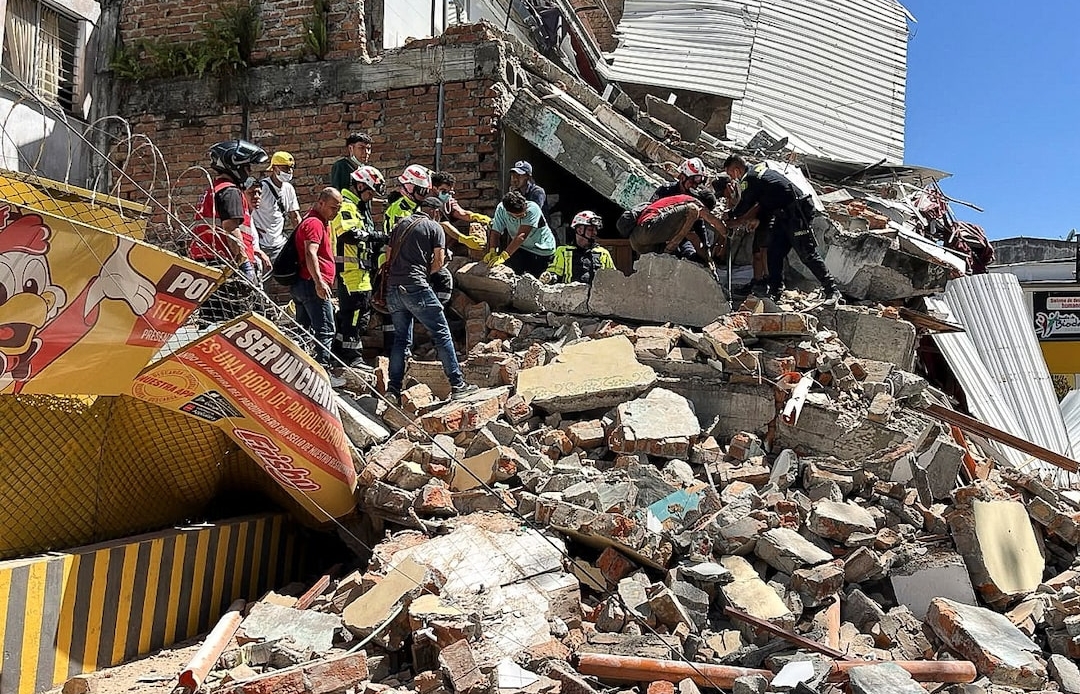
At least 111 people have been killed and dozens more injured after a powerful magnitude 7.4 earthquake struck western Colombia on Monday, triggering widespread destruction, collapsing buildings and leaving people trapped beneath rubble as emergency teams race to rescue survivors.
The earthquake, one of the strongest to hit Colombia in more than a decade, struck in the morning in the country’s western Chocó region, with its epicentre near San José del Palmar at a depth of about 107 kilometres.
The powerful tremor was felt across a wide area, including the cities of Pereira, Cali, Manizales, Quibdó and Bogotá, as well as parts of neighbouring Ecuador and Panama.
READ ALSO: Several Feared Dead, Scores Injured As 7.1-Magnitude Earthquake Rocks Japan
The death toll rose rapidly throughout the day as rescuers gained access to communities affected by the earthquake.
Initial reports put the number of fatalities at fewer than 20, before the figure rose to 47, 69, 77 and subsequently 111, underscoring the scale of the disaster and the difficulty of reaching some affected communities.
At least 87 people have been reported injured, although authorities are still assessing casualties and the figure could rise as rescue operations continue.
Buildings Collapse, People Trapped
The earthquake caused extensive structural damage across western Colombia, with more than 20 municipalities reporting damage.
Hundreds of buildings were damaged or destroyed, while rescuers continued searching collapsed structures for people believed to be trapped underneath the debris. San José del Palmar and surrounding communities in Chocó were among the areas particularly affected.
In Cali, multiple buildings collapsed and emergency teams were deployed to locations where residents were reportedly trapped.
The disaster also caused serious damage in Pereira, where sections of the airport infrastructure were damaged, and in Manizales, where a major cathedral tower collapsed during the earthquake.
Risaralda Department recorded some of the highest casualties, while significant deaths and destruction were also reported in Valle del Cauca and Caldas.
Airports And Transport Disrupted
The earthquake severely disrupted transportation across the region.
At least six airports suspended operations following damage and safety concerns, affecting airports serving Pereira, Manizales, Quibdó and other cities.
The damage to Matecaña International Airport in Pereira included sections of the terminal infrastructure, while other airports were closed to allow emergency inspections.
Roads and bridges were also damaged, complicating efforts to move emergency workers, medical supplies and rescue equipment into some of the worst-hit communities.
Government Declares Emergency
Colombian authorities have declared a state of emergency/national disaster to accelerate rescue, relief and reconstruction operations.
President Abelardo de la Espriella, who had only recently taken office, cancelled or postponed planned activities and ordered the government to concentrate on the earthquake response.
The president said the government would provide assistance to affected communities and indicated that he would travel to the disaster zone.
Emergency personnel, soldiers, police officers, firefighters and rescue workers have been deployed to affected areas to assist with search-and-rescue operations.
Authorities have urged residents to remain vigilant as aftershocks continue.
Several aftershocks were recorded following the main earthquake, including tremors measuring approximately magnitude 2.8 and 4.8.
International Support Offered
As the scale of the disaster became clearer, governments and international organisations began expressing solidarity with Colombia and offering assistance.
The United States, Israel, Mexico and Ecuador are among those reported to have offered support, while the United Nations has also expressed readiness to assist the Colombian authorities with the humanitarian response.
The international response comes as Colombia faces the difficult task of reaching remote and mountainous communities where damaged roads and infrastructure could delay rescue operations.
Strongest Colombian Earthquake In A Decade
The magnitude 7.4 earthquake is being described as Colombia’s strongest earthquake in roughly a decade.
Its impact was felt far beyond the immediate epicentre, with tremors reaching Bogotá and neighbouring countries.
Colombia is highly exposed to seismic activity because it sits in a complex tectonic region where major plates interact. The country’s western and Andean regions have experienced destructive earthquakes in the past.
The latest disaster also comes only weeks after neighbouring Venezuela was hit by devastating earthquakes, making the latest Colombian earthquake particularly alarming across northern South America.
Fear Of Rising Death Toll
Despite the official death toll of 111, emergency officials warn that the final number could increase.
Rescue teams are still searching collapsed structures, while some remote communities remain difficult to access.
The immediate priority remains locating survivors, treating the injured, evacuating people from unsafe buildings and providing food, water and temporary shelter to communities affected by the disaster.
With aftershocks continuing and rescue operations still underway, Colombian authorities are yet to determine the full scale of the destruction.