
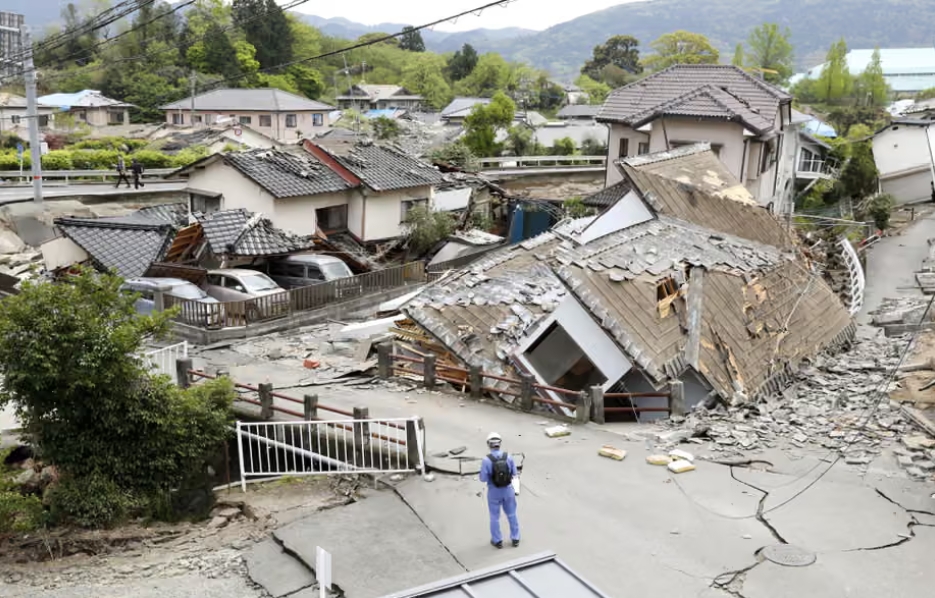
Several people are feared dead and scores of others injured after a powerful 7.1-magnitude earthquake struck Japan’s southern Kumamoto Prefecture on Tuesday, triggering widespread destruction, knocking out electricity to thousands of homes and forcing about 300,000 residents to evacuate.
Authorities said between 20 and 30 workers remained unaccounted for after a massive explosion ripped through the prefecture’s largest shopping mall shortly after the earthquake. Police fear several people may have been killed while rescue teams continue searching for survivors trapped beneath the rubble.
The powerful tremor ruptured roads, damaged bridges, collapsed buildings and disrupted transport services across the region, as officials warned residents to brace for strong aftershocks.
Japan’s public broadcaster, NHK, reported that one hospital treated more than 50 injured victims, while another received about 40 casualties, including at least 10 people in critical condition.
Several other passengers were also injured after the earthquake caused a high-speed Shinkansen bullet train to derail. Rail services across Kyushu were immediately suspended to allow safety inspections.
A tsunami warning issued shortly after the quake was later lifted, easing fears of coastal flooding.
Meanwhile, Japan’s Nuclear Regulation Authority confirmed that inspections at three nearby nuclear power plants found no abnormalities.
Prime Minister Sanae Takaichi said the government had received reports of multiple injuries, power outages, fires and extensive damage to roads, bridges and buildings.
“We have already been informed that people have been injured. Power outages and fires have occurred in some areas, and there has also been damage to roads and bridges and the collapse of buildings,” the Prime Minister said.
She urged residents to evacuate to safe locations and follow instructions from emergency authorities as aftershocks continued across the region.
Japan’s disaster management agency said about 300,000 people had been directed to evacuation centres, while hundreds of soldiers were deployed to assist search-and-rescue operations and humanitarian response efforts.
Air travel was also disrupted after the runway at Aso Kumamoto Airport was closed indefinitely, with airport authorities saying there was “no prospect of resuming operations” until safety inspections were completed.
The most severe damage appeared to be at an Aeon Mall in Kumamoto, where the explosion occurred after the initial earthquake.
Eyewitness Kazuya Tsurunaga said he was cleaning broken dishes inside a nearby pub when he heard a deafening blast.
“It was a huge impact. A large cloud of smoke billowed up, and because the wind happened to be blowing towards our shop, it looked as though volcanic ash was falling,” he said.
An Aeon spokesperson said customers and staff had been evacuated immediately after the earthquake and that the cause of the subsequent explosion remained under investigation.
Japan is among the world’s most earthquake-prone countries, experiencing frequent seismic activity due to its location along the Pacific “Ring of Fire.” The country accounts for about 20 percent of all earthquakes worldwide measuring magnitude 6.0 or greater, making disaster preparedness a critical part of daily life.