
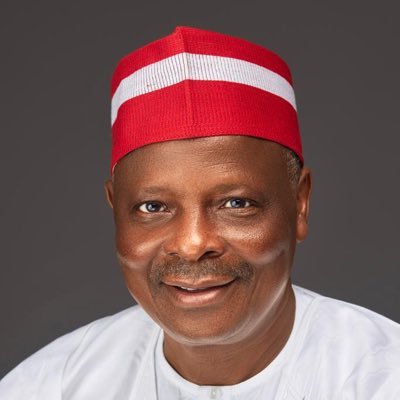
Former Kano State governor and Vice-Presidential Candidate of the National Democratic Congress (NDC) in the 2027 election, Senator Rabiu Musa Kwankwaso, has declared that former governors Ibrahim Shekarau and Abdullahi Umar Ganduje, as well as incumbent Governor Abba Kabir Yusuf, are “politically finished” in Kano State.
Kwankwaso made the declaration while reflecting on the political fortunes of former members of his political camp who later fell out with him.
He spoke on Sunday in Abuja while featuring on the News Agency of Nigeria (NAN) Personality Interview Series.
The former governor argued that political success built on what he described as “treachery” was unsustainable, saying his experience over more than two decades had shown him that politicians who betrayed their political allies eventually suffered political decline.
“You cannot succeed with treachery. I have not seen one. Now we have taken about two and a half decades,” Kwankwaso said.
He cited the political trajectories of former associates as evidence of his argument, saying some politicians who were once influential had gradually moved into what he described as political oblivion.
Kwankwaso particularly pointed to former governor Abdullahi Ganduje, who served as his deputy for eight years before succeeding him as governor in 2015.
According to him, Ganduje’s political fortunes began to decline after he fell out with the political structure they had jointly built.
“If you can even see the issue of Ganduje, who we came together and supported, and became governor free of charge. The day when he started fighting was the beginning of his problem. If I may ask: where is he now? It is difficult to see him,” he said.
Kwankwaso argued that Ganduje would have remained more politically influential in Kano and beyond had he maintained his relationship with the political structure.
He also extended his assessment to Governor Abba Yusuf, accusing the incumbent of abandoning the political group that worked to secure his emergence.
Kwankwaso said Yusuf was deliberately selected as his preferred candidate because the political camp wanted to avoid a repeat of what he described as Ganduje’s actions.
“Abba Yusuf: we went down, right down, to make sure that we picked the right person who would not go and repeat what Ganduje had done,” he said.
He recalled how members of his political group worked to field Yusuf in the 2019 governorship election, which Yusuf initially won before the result was overturned following litigation.
According to Kwankwaso, the same political structure regrouped and returned in 2023, eventually securing Yusuf’s election as governor.
He alleged, however, that Yusuf had subsequently distanced himself from the political camp that brought him to power.
“He left us, but he is not with Ganduje now. He is in-between because I don’t think he is happy for anybody to call him Dan Gandujiyya,” Kwankwaso said.
The former governor further alleged that Yusuf was attempting to establish himself as the dominant political figure in Kano despite Kwankwaso’s continued influence in the state.
Kwankwaso said the political struggle over succession and control was a recurring feature of Nigerian politics, although he described the Kano experience as particularly distinctive.
He also reflected on his relationship with former governor Ibrahim Shekarau, placing him among politicians whose political fortunes, in his assessment, had declined.
Kwankwaso’s comments come against the backdrop of intense political realignments in Kano ahead of the 2027 general elections, with major political camps positioning themselves for control of the state.
The former governor also recalled a conversation with President Bola Ahmed Tinubu, in which the President reportedly encouraged him to reconcile his differences with Ganduje.
Kwankwaso said he responded by drawing Tinubu’s attention to several politicians who had once been close to the President but were no longer prominent within his political circle.
He cited former Lagos State Deputy Governor Kofoworola Bucknor-Akerele and former Governor Akinwunmi Ambode as examples.
“I told him that when I come here, I don’t see Bucknor. When I come here, I don’t see Ambode. I started counting the people,” he said.
He said such experiences demonstrated the transient nature of political relationships, noting that politicians who once worked closely together could eventually become distant.
Kwankwaso, however, singled out former Osun State governor, Chief Bisi Akande, as one of the political associates he still considers a friend.
He likened political relationships to friendships formed in school, where former classmates could maintain relationships despite taking different political paths.
The former Kano governor maintained that the political developments in Kano should be understood within the broader context of Nigerian politics, while acknowledging that the state’s political experience has its own peculiarities.
“It’s not very peculiar to Kano, but I think the Kano experience is special out of the general lots,” he said.
Kwankwaso’s latest comments are likely to further intensify political debate in Kano, where his political movement has remained a major force and where the 2027 elections are expected to produce a fierce contest among competing political structures.
His assertion that Shekarau, Ganduje and Yusuf are “politically finished” is also expected to provoke responses from supporters of the three politicians, particularly as the state gradually moves into another cycle of political realignment.
The remarks have therefore added another layer to the increasingly competitive struggle for political influence in Kano ahead of 2027.