
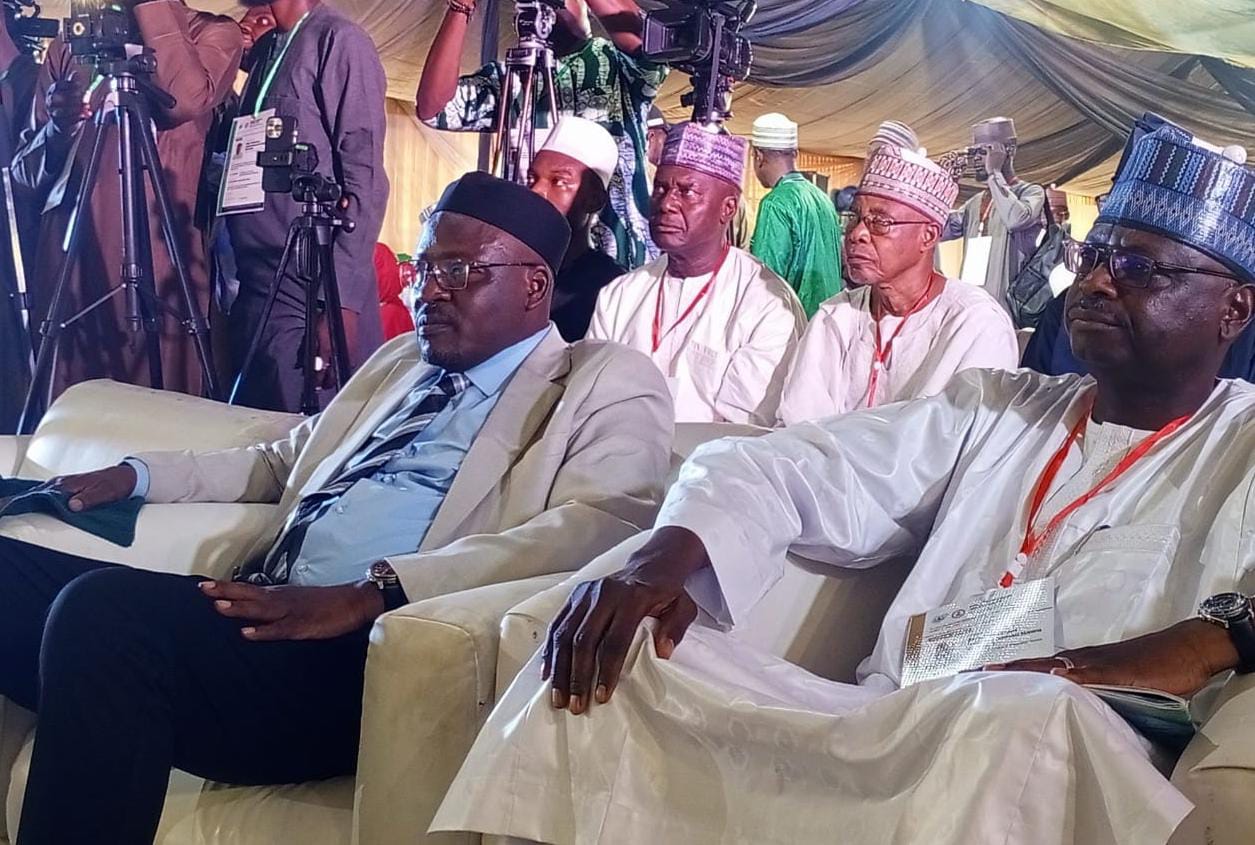
Senator Suleiman Abdulrahman Kawu Sumaila, representing Kano South Senatorial District, has challenged the people of the district to judge his first three years in the 10th National Assembly based on his legislative record, projects and interventions, as he unveiled a scorecard containing 102 projects and interventions implemented or initiated across the district’s 16 local government areas.
Kawu presented the record on Sunday at a public accountability session organised by the Nigeria Union of Journalists (NUJ), Kano State Council, Correspondents’ Chapel, in collaboration with his office.
The session was organised to review his 2023 campaign promises and examine his performance since his election into the Senate.
READ ALSO: Kawu Sumaila Faults US Senator Ted Cruz’s Remarks On Nigeria, Warns Against Religious Polarisation
Presenting a publication titled “The Record 2023–2026,” Kawu said the document provides information on the projects, locations and implementation status of interventions undertaken during his first three years in office.
The 102 projects and interventions, according to the senator, cover water supply, irrigation, education, healthcare, roads, solar street lighting, erosion and flood control, bridges, community empowerment and security.
He challenged constituents, journalists, academics and other stakeholders to scrutinise the record and determine whether his performance justified another mandate in the 2027 general elections.
“If they are satisfied, they are satisfied; that’s it. If they aren’t satisfied, they will look for someone better than me,” he said.
Kawu said his accountability initiative was intended to promote issue-based politics in which elected representatives are judged by their records rather than personal attacks, political propaganda or character assassination.
“I ask only that you do justice in your assessment, reporting and judgment, for the truth, when presented clearly, speaks for itself,” he said.
According to the senator, the 102 projects were distributed across Kano South’s 16 local government areas and 171 political wards.
In the water and agricultural sectors, Kawu said his record included 6,090 tube wells constructed to support farmers, particularly during the dry season, as well as water pumps distributed to facilitate irrigation.
He also reported the provision of more than 300 hand-pump boreholes aimed at improving access to clean water in communities across the senatorial district.
On irrigation, the document lists interventions involving Tiga Dam, Kafin Chiri Dam and Challawa Gorge, with efforts aimed at restoring irrigation facilities and bringing about 1,297 hectares of farmland back under irrigation.
In education, Kawu said 1,082 students benefited from a scholarship programme, with each beneficiary receiving a monthly stipend of ₦10,000.
The record also contains school construction and renovation projects, classroom blocks, desks, chairs, writing boards and other educational materials supplied to schools across Kano South.
In healthcare, the senator reported the provision of 1,200 hospital beds, mattresses and related equipment, while 437 medical and allied health students received sponsorship support.
He also highlighted more than 400 surgeries at Zarewa Standard Hospital in Rogo Local Government Area among the healthcare interventions recorded.
In the area of infrastructure, the document lists a 19-kilometre dual carriageway project, several rural roads, 16 erosion and flood-control sites, and 11 bridge and culvert projects.
One of the projects highlighted is the Asada Bridge in Doguwa, which Kawu said addressed a longstanding demand from a community that had waited about 40 years for a bridge.
The senator said the infrastructure interventions were aimed at improving transportation, access to markets and movement between communities.
On electricity and public infrastructure, Kawu reported the provision of 3,745 solar streetlights across streets, markets and other public spaces.
He also listed 10 empowerment programmes involving motorcycles, tricycles, sewing machines and other equipment designed to support livelihoods, small businesses and economic activities.
Kawu said the 102 projects and interventions were compiled in one document containing photographs, project locations and status descriptions to enable constituents and members of the public to examine the record.
The senator recalled that during his campaign on October 10, 2022, he presented an agenda centred on social justice, with particular emphasis on education, healthcare, water supply for domestic and irrigation purposes and agriculture.
He said his decision to subject his record to public scrutiny was driven by his belief that accountability and transparency were essential to democratic governance.
The event attracted the Chief Imam of Sahaba Juma’at Mosque, Muhammad Bin Usman; Professor of Political Science at Bayero University Kano, Professor Habu Fagge; former Director-General of the Kano State Hisbah Board, Dr Aliyu Kibiya; Kano South constituents, politicians, civil society representatives, journalists and other stakeholders.
Kawu attributed the projects and interventions to collaboration with government officials, elected representatives, traditional rulers, community leaders, political stakeholders, constituents and members of his team.
He acknowledged the support of President Bola Ahmed Tinubu, Kano State Governor Abba Kabir Yusuf, Deputy President of the Senate Senator Barau I. Jibrin, Chairman of the House Committee on Appropriation Abubakar Kabir Bichi, and other National Assembly members representing Kano South.
The senator also declared that he was not afraid of opposition ahead of 2027, saying political competition should not involve violence or thuggery.
He urged the media to concentrate on holding public officials accountable for their responsibilities rather than focusing on personal disputes.
“What you should expect from me is simply asking me to do the work,” he said.
The NUJ Correspondents’ Chapel said the accountability session was organised in line with the media’s constitutional responsibility to hold government accountable to the people, citing Section 22 of the 1999 Constitution, as amended.
The Chapel said it would examine the senator’s submissions against his campaign promises and determine the extent to which he had delivered on his mandate.
It also questioned whether his legislative experience, projects and interventions were sufficient grounds for Kano South voters to consider giving him another mandate in 2027.
The NUJ commended Kawu for accepting the invitation and urged other elected and appointed public officials to subject their records to similar public scrutiny.
Kawu concluded by challenging anyone who disputed his scorecard to come forward for further engagement, insisting that the ultimate verdict on his performance belonged to the people of Kano South.