
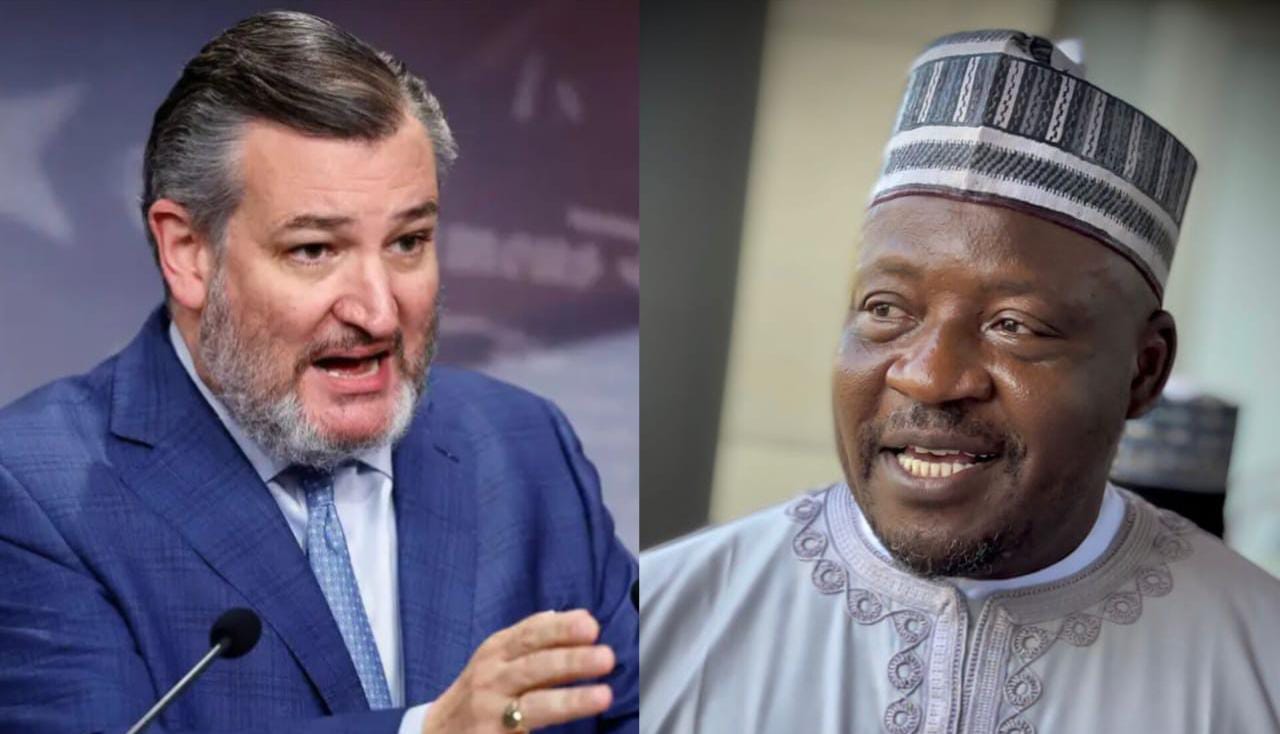
Senator Suleiman Abdulrahman Kawu Sumaila, representing Kano South Senatorial District, has criticised recent remarks by United States Senator Ted Cruz on Nigeria’s security situation, describing them as inflammatory and capable of deepening divisions in the country.
In a statement personally signed on Friday, the lawmaker warned that Cruz’s continued campaign for Nigeria to be redesignated as a Country of Particular Concern (CPC) under the United States International Religious Freedom Act could undermine ongoing peace efforts, distort the country’s security realities and endanger citizens irrespective of their religious affiliation.
The Kano South senator’s reaction followed repeated calls by Senator Ted Cruz, a Republican representing Texas in the United States Senate, for the U.S. government to return Nigeria to the CPC list, citing concerns over alleged religious persecution of Christians and violations of religious freedom.
READ ALSO: Kano Online Media Chapel Honours Gov Abba Yusuf with Excellence Award
Cruz has also supported legislative initiatives in the US Congress seeking increased diplomatic pressure on Nigeria over the issue.
Responding to the campaign, Kawu Sumaila argued that Nigeria’s security challenges are complex and should not be viewed solely through the prism of religion.
According to him, insecurity in the country affects Muslims, Christians and adherents of other faiths alike, making it inaccurate to portray the crisis as an exclusively religious conflict.
He noted that the administration of former U.S. President Donald Trump had removed Nigeria from the CPC designation following what he described as verified progress and diplomatic engagement, but alleged that Senator Cruz had continued to promote a narrative that undermines Nigeria’s sovereignty.
“Senator Ted Cruz’s continued campaign to re-label Nigeria appears to be driven not by an objective assessment of the facts, but by a narrative that oversimplifies Nigeria’s security challenges and portrays them primarily through a religious lens,” the statement read.
The senator maintained that reducing Nigeria’s multifaceted security crisis to a religious issue creates a distorted perception of the country before the international community and could fuel tensions instead of encouraging lasting solutions.
He warned that such narratives could also influence foreign policy decisions that fail to reflect the realities confronting communities affected by terrorism, insurgency, kidnapping and banditry.
Kawu Sumaila urged Christians in Nigeria and across the world to critically assess the facts and reject narratives capable of promoting division among Nigerians.
He called on Nigeria’s international partners to support initiatives that foster peace, reconciliation, sustainable development, interfaith cooperation and respect for the country’s sovereignty rather than narratives that could heighten religious polarisation.
The lawmaker also paid tribute to members of the nation’s security agencies, noting that personnel from different religious and ethnic backgrounds continue to serve together in the fight against criminal groups across the country.
“Nigeria’s security forces, comprising both Christians and Muslims, continue to serve together in the fight against terrorists, insurgents, kidnappers and bandits who indiscriminately attack churches, mosques, markets, schools and rural communities,” he said.
According to him, overlooking the shared sacrifices of security personnel and ordinary citizens in favour of divisive political narratives does a disservice to Nigerians who have borne the brunt of insecurity.
Reaffirming Nigeria’s sovereignty, the senator said the country’s greatest strength lies in the unity and resilience of its diverse population, adding that attempts by foreign political actors to exploit Nigeria’s internal challenges for ideological or political purposes should be rejected.
He further appealed to the international community, diplomatic partners, media organisations and well-meaning Nigerians to support policies and initiatives that promote peace, national unity, improved security and sustainable development rather than rhetoric capable of deepening existing divisions.