
BY: SANI MAGAJI GARKO, KANO
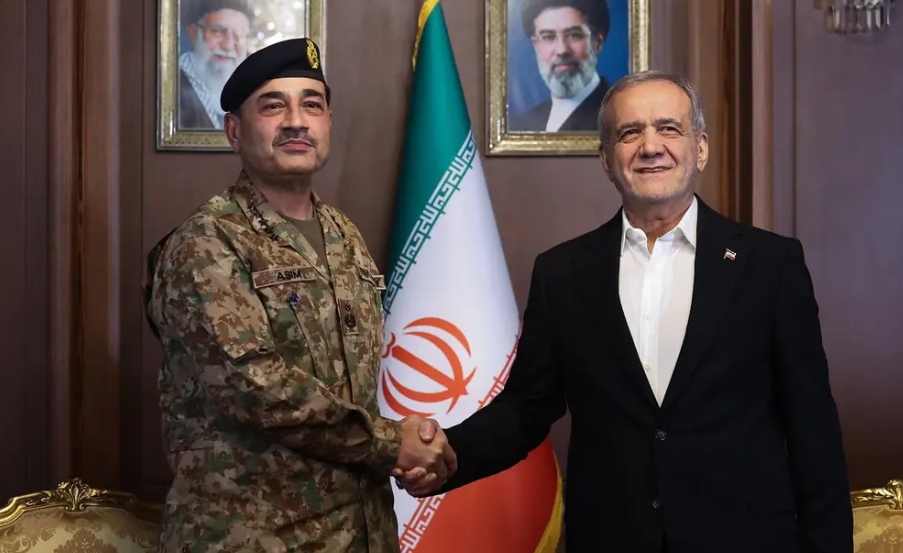
Pakistan’s Field Marshal and Army Chief, Asim Munir, has arrived in Tehran, the Capital of Islamic Republic of Iran on a high-stakes diplomatic mission aimed at promoting peace and security and helping revive stalled negotiations between Iran and the United States, as Washington prepares what it describes as an unprecedented new economic offensive against the Islamic Republic.
Munir’s visit to the Iranian capital on Monday, August 24, 2026, comes at a particularly sensitive moment, with tensions between Washington and Tehran escalating over sanctions, Iran’s nuclear programme, oil exports and control of the strategically vital Strait of Hormuz.
The Pakistani military confirmed that Munir travelled to Tehran accompanied by Interior Minister Mohsin Naqvi, describing the visit as part of Islamabad’s efforts to promote regional peace and stability.
Iranian authorities had earlier announced the visit as an effort to strengthen bilateral cooperation and continue Pakistan’s diplomatic efforts to improve regional security.
However, behind the official language lies a much wider diplomatic mission.
Three Pakistani sources cited by Reuters said US President Donald Trump spoke with Munir last week, shortly before the army chief’s Tehran trip, with one source saying Trump urged Pakistan to use its influence to persuade Iran to return to negotiations with Washington.
The call was reportedly initiated by Trump, although the White House had not publicly confirmed it at the time of the report.
The revelation has added considerable importance to Munir’s mission, effectively placing Pakistan at the centre of efforts to reopen a diplomatic channel between two countries whose confrontation has increasingly threatened regional and global economic stability.
US PREPARES NEW ECONOMIC OFFENSIVE
Munir’s arrival in Tehran coincides with Washington’s preparation of a sweeping new package of sanctions against Iran and entities that continue doing business with it.
US Treasury Secretary Scott Bessent has described the forthcoming measures in exceptionally severe terms, while President Trump has warned countries against providing Iran with what Washington considers an economic lifeline.
Iran, already facing years of sanctions and severe economic pressure, has rejected the US threats.
Foreign Minister Abbas Araqchi has described the threatened sanctions as a desperate move that will ultimately fail, while Iranian officials have warned that Tehran will respond to what it regards as Washington’s economic warfare.
The confrontation has moved beyond conventional economic pressure because Iran has threatened to disrupt oil exports from the Gulf, placing the Strait of Hormuz at the centre of the crisis.
The waterway is one of the world’s most important energy corridors, and any prolonged disruption could affect international oil and gas supplies, shipping costs, inflation and economies far beyond the Middle East.
On Monday, Iran also warned vessels using its arrangements for passage through the Strait of Hormuz that they could face restrictions including fines, detention or confiscation. The warning further heightened concerns about maritime security and the future of global energy shipments.
PAKISTAN’S MEDIATION ROLE
Pakistan has increasingly positioned itself as an intermediary between Tehran and Washington.
Islamabad maintains diplomatic and trade relations with Iran while also maintaining important strategic ties with the United States.
Earlier Pakistani mediation efforts produced an interim agreement between Iran and the US in June, but that understanding quickly faltered as fighting resumed and tensions intensified.
The latest mission is therefore an attempt to rebuild a diplomatic bridge before the current confrontation develops into an even wider regional crisis.
A Pakistani source cited by Reuters said the major problem confronting the mediation effort is the deep trust deficit between Iran and the United States.
Munir’s task is consequently not simply to carry messages between the two governments but to determine whether enough confidence can be rebuilt for both sides to return to negotiations.
TRUMP-MUNIR CONTACT RAISES STAKES
The reported conversation between Trump and Munir before the Tehran trip has become one of the most closely watched aspects of the mission.
According to Pakistani sources cited by Reuters, Trump wanted Islamabad to use its influence to persuade Tehran to return to negotiations.
The contact suggests Washington sees Pakistan as having a potentially useful channel to Iran at a time when direct US-Iran diplomacy has become increasingly difficult.
It also gives Munir an unusual diplomatic position: he is travelling to Tehran after communicating directly with the American president while representing a country that maintains relations with both Washington and Tehran.
The precise content of the Trump-Munir conversation has not been publicly disclosed.
WHAT MUNIT IS EXPECTED TO DISCUSS
Although the immediate focus is the US-Iran confrontation, Munir’s discussions are expected to cover a broader range of regional security issues.
According to Pakistani sources, he is expected to meet individuals close to Iran’s Supreme Leader, Ayatollah Mojtaba Khamenei.
Among the issues expected to feature are the stalled US-Iran negotiations, the consequences of Washington’s sanctions, regional security and Iran-aligned Houthi attacks affecting Saudi Arabia.
The recently signed mutual defence agreement involving Pakistan, Türkiye and Saudi Arabia is also expected to form part of the wider strategic discussion.
That element is particularly sensitive because Pakistan is simultaneously deepening security ties with Saudi Arabia and maintaining relations with Iran, two countries whose regional interests have sometimes diverged sharply.
STRAIT OF HORMUZ AT THE CENTER
The Strait of Hormuz has become one of the most critical issues surrounding the crisis.
Iran has threatened to halt Gulf oil exports if Washington continues what Tehran describes as economic warfare.
The threat has already generated concern among energy markets and shipping companies because the waterway is a crucial route for international oil and liquefied natural gas shipments.
Iran’s latest warning to vessels over transit arrangements has added another layer of uncertainty for shipping operators.
The stakes extend far beyond Iran and the United States.
Any prolonged disruption could affect oil prices, transportation costs and inflation across Asia, Europe, Africa and other energy-importing regions.
For Pakistan, which is geographically close to Iran and remains heavily dependent on regional stability, a prolonged closure or disruption of Hormuz would have serious economic and security implications.
IRAN UNDER SEVERE ECONOMIC PRESSURE
Munir’s visit also comes as Iran’s economy faces mounting difficulties.
Years of international sanctions have restricted Iran’s access to global markets, while the current conflict has damaged infrastructure and further disrupted trade.
Iranian officials insist the country can withstand additional sanctions, but the economic pressure is considerable.
Iran’s leadership is therefore facing a difficult choice: continue resisting Washington’s demands while absorbing increasing economic pressure, or return to negotiations under conditions that could require major concessions.
President Masoud Pezeshkian has indicated support for a diplomatic solution, while Foreign Minister Araqchi has continued to call for respectful dialogue.
UNITED STATES DEMANDS
Washington’s position remains centred on preventing Iran from developing or maintaining a nuclear weapons capability and on applying economic pressure to force Tehran to accept a broader settlement.
The Trump administration has also warned other countries against helping Iran evade sanctions.
Islamabad wants to maintain its economic relationship with neighboring Iran, but it must also avoid measures that could expose Pakistani institutions or businesses to secondary US sanctions.
Munir’s mission could therefore be aimed partly at finding a diplomatic solution that allows Iran to return to negotiations without requiring Pakistan to choose openly between Tehran and Washington.
WIDER REGIONAL CONSEQUENCES
The crisis is occurring against a broader transformation of Middle Eastern security arrangements.
Saudi Arabia, Türkiye and Pakistan have recently established a new mutual-defence framework, while Iran is simultaneously attempting to strengthen relationships with neighbouring states and resist what it sees as increasing Western pressure.
Oman is also preparing to engage Tehran over the Strait of Hormuz, creating another diplomatic channel at a time when several regional powers are trying to prevent the conflict from spreading.
Pakistan’s mediation therefore fits into a much wider regional effort to prevent the confrontation between Iran and the United States from becoming a prolonged regional war.
WHY MUNIR’s MISSION MATTERS
The choice of Pakistan’s military chief rather than simply a conventional diplomatic envoy is itself significant.
Munir has developed direct relationships with major regional and international actors, and his reported conversation with Trump gives him an unusual position in the current diplomatic landscape.
His presence in Tehran also allows Pakistan to communicate directly with Iranian decision-makers at a time when Washington and Tehran remain deeply suspicious of each other.
THE CHALLENGE, HOWEVER, IS ENORMOUS
Iran wants relief from sanctions and recognition of its security interests, while the United States wants Tehran to make substantial concessions.
Neither side appears prepared to make unilateral concessions without guarantees from the other.
That is why Pakistan’s role is potentially important: Islamabad is attempting to create a pathway in which negotiations can resume without either Washington or Tehran appearing to surrender.
A HIGH-STAKES DIPLOMATIC TEST
Munir’s Tehran mission therefore comes at the intersection of diplomacy, military security, energy politics and economic warfare.
Washington is preparing tougher sanctions.
Tehran is threatening retaliation and has raised the stakes around the Strait of Hormuz.
The United States is urging countries not to provide Iran with an economic lifeline.
Iran insists that sanctions will fail.
Meanwhile, Pakistan is attempting to persuade both sides to return to negotiations.
The outcome could have consequences far beyond the three countries.
A successful mediation effort could reopen the door to US-Iran diplomacy, reduce pressure on the Strait of Hormuz and calm global energy markets.
Failure, on the other hand, could lead to deeper sanctions, further disruption of oil shipments and a broader regional confrontation.