
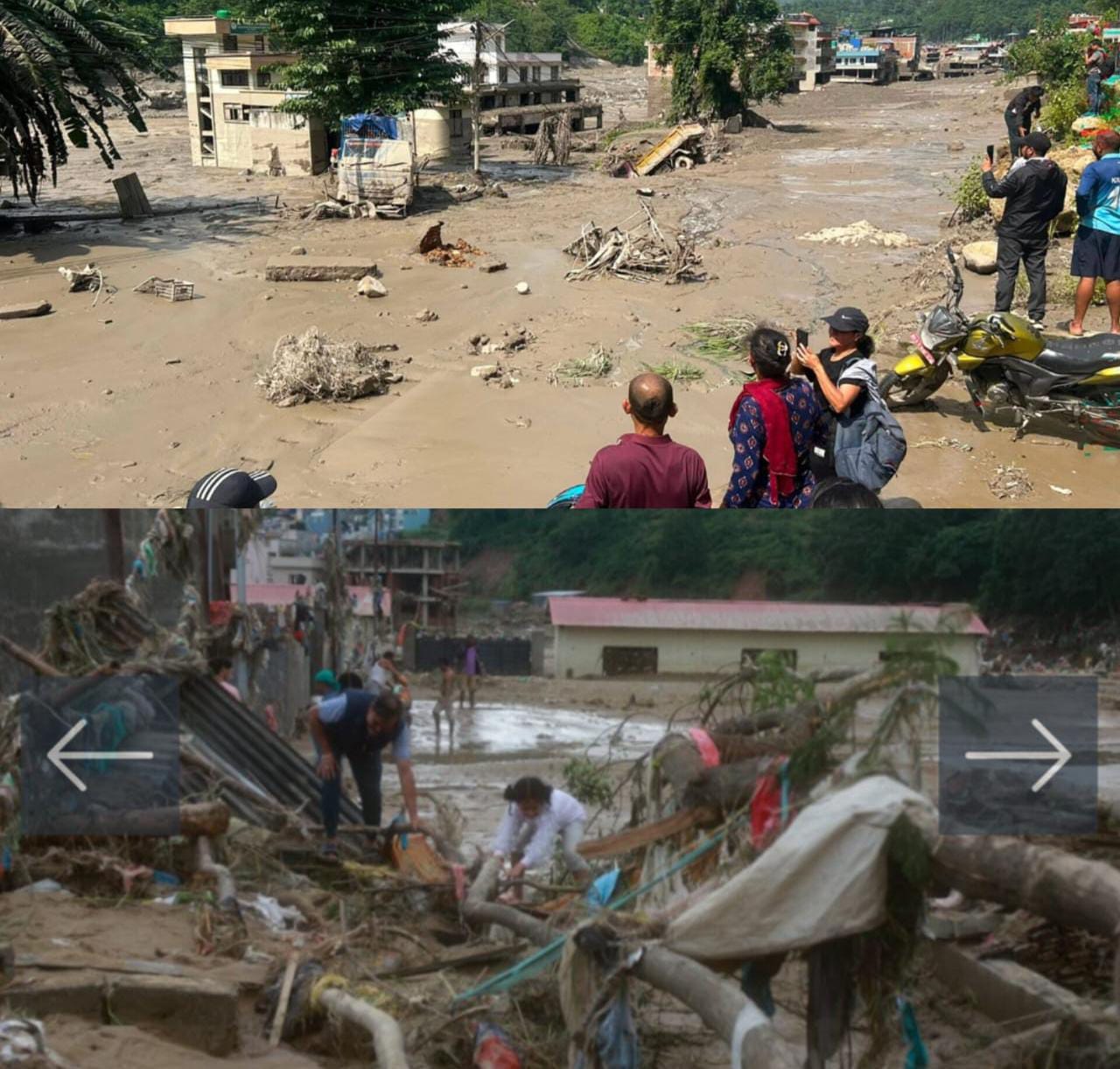
At least 157 people have been killed in Nepal and hundreds remain missing after devastating flash floods swept through communities along the Bhote Koshi and Trishuli river systems near the Nepal-China border, destroying homes, roads, bridges and critical infrastructure.
The disaster, which struck on Wednesday, August 26, has become one of the country’s most serious natural catastrophes in recent years, with rescue teams still struggling to reach isolated communities and locate missing residents, workers and tourists.
The death toll has risen sharply as rescuers gain access to areas initially cut off by floodwaters and landslides. Nepalese authorities reported 157 bodies recovered, while hundreds of people remain unaccounted for.
READ ALSO: Pakistan Seeks To Defuse US-Iran Crisis Amid New Sanctions Threat as Army Chief Visit Tehran
In neighbouring Tibet, Chinese authorities reported three additional deaths, bringing the combined toll across Nepal and China to at least 160.
More than 400 people are reportedly missing, including hundreds of foreign nationals. The Nepal Tourism Board has put the number of missing people at about 403, including 341 foreigners, among them citizens of India, the United States, Britain, Australia and Canada.
Glacier Avalanche Suspected
The catastrophic flooding occurred in the Himalayan border region of Rasuwa district, particularly around Rasuwagadhi, Timure and Syabrubesi, before floodwaters and debris moved downstream.
Scientists investigating the disaster believe an ice-rock avalanche from a glacier may have triggered the sudden flood.
A preliminary assessment by scientists and hydrological experts indicates that a large mass of ice and rock may have entered the Lhende River, a tributary of the Bhote Koshi, producing an enormous surge of water, sediment and boulders downstream.
Hydrological observations showed the extraordinary speed of the flood. Water levels in the Trishuli River reportedly rose by about nine metres within 30 minutes, demonstrating the enormous force and speed of the flood wave.
Although a magnitude 4.4 seismic event was initially reported in the region, scientists are still examining whether an earthquake triggered the avalanche or whether the seismic signal was actually generated by the avalanche itself.
Experts have also stressed that heavy rainfall does not appear to be the principal immediate cause, with growing evidence pointing towards a glacier-related event.
The disaster has renewed concerns over the effects of rising temperatures on Himalayan glaciers and the increasing threat posed by glacier collapses, glacial lakes and sudden outburst floods.
Villages Swept Away
The floodwaters carried huge quantities of mud, rocks and debris through settlements, sweeping away houses and destroying roads, bridges, electricity facilities and other infrastructure.
The strategically important Rasuwagadhi border area was severely damaged, disrupting trade and travel between Nepal and China.
Several hydroelectricity projects and other infrastructure along the river system were also affected.
The disaster struck along routes used by tourists and pilgrims travelling towards destinations including Gosaikunda Lake and Mount Kailash, leaving many visitors stranded or missing.
Government Declares Disaster Zones
The Nepalese government has declared the affected local administrative areas disaster-hit zones for three months, giving authorities greater powers to mobilise resources for rescue, relief and rehabilitation.
Prime Minister Balendra Shah said the government’s immediate priority was saving lives, finding missing people and providing relief to survivors.
The government has mobilised the Nepali Army, Nepal Police and Armed Police Force, while helicopters are being used to evacuate people trapped in inaccessible areas.
Authorities have also ordered the evacuation of people considered to be at risk from further flooding and landslides.
Free Treatment For Injured
The government has directed hospitals to provide free treatment for people injured in the disaster.
It has allocated 100 beds at Bir Hospital and the National Trauma Centre in Kathmandu for flood victims, while other medical facilities have been placed on standby.
Emergency medical teams are treating survivors, while the World Health Organisation has supplied emergency medicines and multipurpose tents and is supporting disease surveillance and continuity of health services.
The government has also instructed authorities to provide food, drinking water and accommodation to displaced families.
Families who lost relatives will receive financial assistance in accordance with existing government disaster-relief provisions.
Emergency Funds Released
The government has begun releasing emergency funds through local disaster-management mechanisms to support immediate relief operations.
Authorities have allocated 10 million Nepali rupees each to Rasuwa and Nuwakot, while 5 million rupees has been allocated to Dhading for emergency response and relief operations.
The Ministry of Infrastructure Development has been directed to restore damaged roads and drinking-water systems, while authorities are working to restore electricity and telecommunications services.
Rescue Operations Hampered
Rescue operations remain extremely difficult because several roads and bridges have been destroyed, while mountainous terrain and continuing adverse weather are restricting access to affected communities.
Helicopters have become crucial for evacuating survivors and delivering emergency supplies.
The Nepal Red Cross and international humanitarian organisations are also supporting the emergency response, while authorities continue compiling lists of missing people.
India, China Offer Assistance
The disaster has prompted assistance from neighbouring countries.
India has dispatched 10 tonnes of humanitarian assistance, disaster-relief supplies and essential medicines, with additional aircraft and helicopters prepared for further relief and evacuation operations.
China has also launched rescue operations on the Tibetan side of the border, where the flooding affected Gyirong County and the Gyirong Port area.
Chinese authorities have reported three deaths and hundreds missing in Tibet.
The United Nations and other international organisations are coordinating humanitarian support, while several countries are monitoring the situation because their nationals are among those missing.
Downstream Flood Threat
The disaster has also raised concerns beyond Nepal and Tibet.
Because the floodwaters entered major river systems flowing south towards India, authorities in India’s Uttar Pradesh and Bihar states have increased monitoring and preparedness for possible downstream flooding.
Indian authorities are coordinating with Nepal and local governments to monitor river levels and prepare for possible impacts.
Climate Change Raises Long-Term Concern
Beyond the immediate humanitarian crisis, the disaster has raised fresh questions about Nepal’s preparedness for increasingly dangerous glacier-related floods.
Scientists say warming temperatures are destabilising glaciers and increasing the likelihood of ice and rock avalanches, glacial lake outburst floods and other sudden high-altitude disasters.
The latest catastrophe therefore underscores the need for stronger glacier monitoring, river-level sensors, early-warning systems, satellite surveillance, hazard mapping and evacuation plans for vulnerable Himalayan communities.
Experts say early-warning systems could provide communities downstream with crucial minutes to evacuate when sudden changes in river levels are detected.
For now, however, the government’s priority remains the rescue of survivors, treatment of the injured and provision of food, shelter and other basic necessities.
With 157 people confirmed dead in Nepal, hundreds still missing and vast areas of infrastructure destroyed, officials warn that the final human and economic cost of the disaster may not be known until rescue teams reach communities that remain cut off.
The catastrophe has also become a stark reminder of the growing risks facing communities living in the Himalayan region, where climate change, unstable glaciers and difficult mountainous terrain can combine to produce disasters with little warning.