
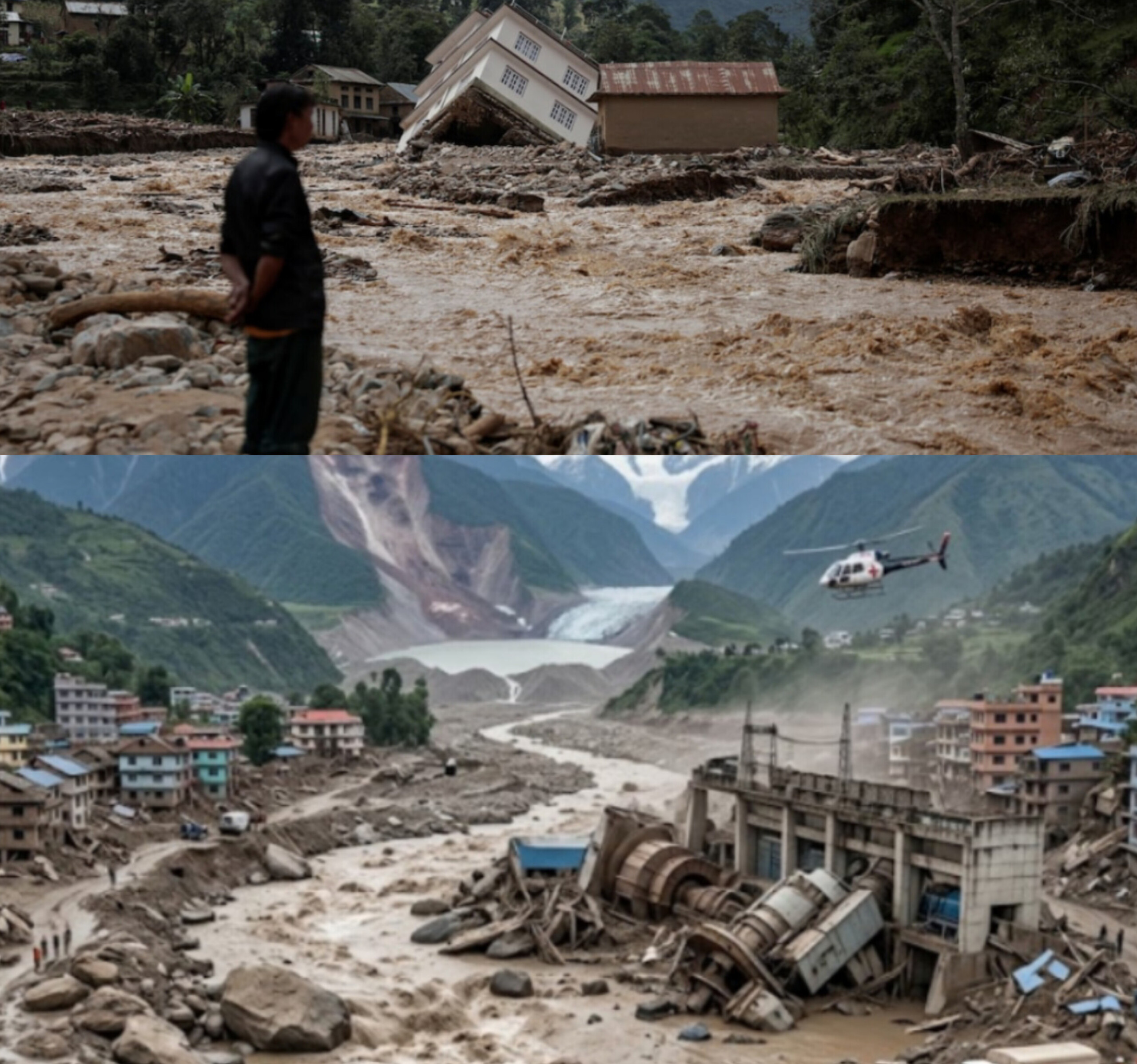
The death toll from Nepal’s devastating Bhote Koshi floods has risen to 1,114, with about 3,900 people still missing and 11,993 rescued, as the government intensifies a multinational search-and-rescue operation nearly a week after a catastrophic glacier collapse triggered torrents of water, ice, rock and mud across the Himalayan nation.
The latest figures were released by Nepal’s Ministry of Foreign Affairs on Wednesday as rescuers continued to search devastated communities and hydropower tunnels where hundreds of workers are feared trapped.
Reuters, however, reported separately on Wednesday that at least 1,204 people had been confirmed dead in Nepal, with more than 4,200 still missing, highlighting the rapidly changing nature of the casualty figures as bodies are recovered and identities verified.
The disaster, which began on August 26 after the collapse of a glacier near Nepal’s border with China, swept through valleys and settlements, destroying homes, bridges, roads and hydropower facilities.
The scale of the destruction has left Nepal facing one of its most serious humanitarian emergencies in recent history.
International Rescue Effort
Nepal is now receiving specialised assistance from a growing number of foreign countries as domestic security forces struggle to reach remote and heavily damaged areas.
The Nepalese Foreign Ministry said specialised tunnel-rescue teams from India, China and South Korea are working alongside Nepali rescuers, while forensic and disaster-victim-identification specialists from India, China and Singapore are helping authorities identify recovered bodies.
At the time of the latest government briefing, India had deployed tunnel-rescue personnel to Langtang and Chilime, while Chinese specialists were working at the Upper Trishuli 3A hydropower project. South Korean rescuers were assisting operations at Upper Trishuli 1.
The International Support Has Expanded Beyond Manpower.
India has provided a 19-member forensic team specialising in DNA analysis. China has sent a five-member specialist forensic team, while Singapore has deployed a six-member Disaster Victim Identification team, with additional personnel and DNA-testing equipment expected.
South Korea has also provided forensic assistance and equipment.
Nepal says it has requested or received specialised equipment including LiDAR systems, temporary “belly bridges”, freezers, DNA-testing kits, load carriers, bags for human remains, high-capacity drones and gene sequencers.
Countries Standing With Nepal
The humanitarian response has involved countries from Asia, Europe, North America, the Middle East and the wider international community.
Nepal has specifically acknowledged assistance from India, China, Japan, the United States, the United Arab Emirates, South Korea and other international partners.
Additional relief and humanitarian supplies are being provided or mobilised by the United States, UAE, Japan, Qatar, United Kingdom, Australia, South Korea, New Zealand, Malaysia, Singapore, Bangladesh, Pakistan and Myanmar, among others.
The assistance includes bridge units, generators, solar lamps, tents, blankets, sleeping bags, food packets, medicines and emergency relief equipment, as well as highly specialised rescue and forensic technology.
International organisations, including the United Nations, World Health Organization, World Food Programme and UNICEF, are also involved in the humanitarian response.
The Nepalese government has said it is receiving monetary assistance pledges from international partners while preparing a more comprehensive assessment of the disaster’s damage and reconstruction requirements.
India Steps Up Rescue And Forensic Support
India has emerged as one of the most prominent foreign contributors to the rescue operation.
Indian specialised tunnel-rescue teams are working with Nepalese forces at two hydropower locations, while its forensic specialists are helping process DNA samples from recovered bodies.
India has also supplied medicines, blankets, solar lamps and other relief materials.
Indian authorities have separately reported the rescue of hundreds of Indian nationals affected by the disaster, while continuing coordination with Nepal over citizens who remain missing.
China Opens Border Routes, Sends Rescue And Identification Teams
China is providing assistance on both sides of the Nepal-China border.
Chinese rescue personnel are working at hydropower facilities in Nepal, while Beijing is also supporting operations in Tibet, where the disaster caused major destruction around the Gyirong border region.
China’s latest reported toll in Tibet stands at 21 dead and 541 missing. Beijing has restored road access to the devastated border area, allowing heavy machinery and rescue teams to enter areas that were previously inaccessible.
Beijing has also said it will provide additional DNA-identification experts, emergency supplies, temporary Bailey bridges, mortuary refrigerators and communications equipment to support Nepal’s relief operations.
The Chinese government has additionally facilitated the return of Nepali and foreign nationals stranded in Tibet.
Nepal says about 2,500 of an estimated 3,000 people who had been travelling to or from Mount Kailash at the time of the disaster have already returned through border points, while further arrangements are being made for those still stranded.
Last Hope In Hydropower Tunnels
The most urgent rescue effort is now concentrated around hydropower tunnels.
Authorities believe hundreds of workers may have survived inside underground chambers after floodwaters and enormous quantities of mud and debris blocked tunnel entrances.
Reuters reported that about 900 workers were believed to be trapped in hydropower tunnels, with some chambers potentially containing breathable air, food and water.
At two locations, rescuers believe approximately 90 people may have the strongest chance of survival because air remains inside parts of the tunnels.
At Trishuli-3A, oxygen is being pumped into a potentially dry chamber as rescuers attempt to clear the passage. Specialised teams from India, China and the United States are participating in tunnel rescue efforts.
Nepalese officials acknowledge that the chances of finding survivors in many other locations are declining as the disaster enters its second week, but authorities insist that rescue operations will continue.
Thousands Still Missing
Despite the rescue of almost 12,000 people, thousands remain unaccounted for.
Nepal’s Foreign Ministry said about 3,900 people remain missing, including approximately 590 foreign nationals.
The foreign nationals include people from dozens of countries who were travelling, working or undertaking religious pilgrimages in the affected region.
Nepal has established an Emergency Control Room to coordinate with foreign governments, diplomatic missions and families of missing foreign nationals.
The government is also working on identification and repatriation of recovered bodies.
Because many bodies have been severely damaged or decomposed after prolonged exposure to water and debris, authorities have begun temporary burials after collecting forensic evidence and DNA samples.
The arrangement is intended to allow authorities to exhume and return remains to families once identities are confirmed.
Psychological Trauma Emerges
As the physical rescue operation continues, aid organisations are warning of a growing psychological crisis among survivors, particularly children.
Children in badly affected districts such as Nuwakot and Rasuwa have reportedly displayed fear and anxiety after witnessing homes, schools and vehicles swept away by floodwaters.
Save the Children said survivors had witnessed traumatic scenes, including school buses being carried away and entire communities destroyed.
Reuters reported that mental-health concerns are becoming an increasingly important part of the humanitarian response.
95 Per Cent Telecoms Restored
The Nepalese government is simultaneously working to restore essential infrastructure.
Prime Minister Balendra Shah said approximately 95 per cent of telecommunications services in affected areas had been restored.
However, the disaster has disrupted about 431 megawatts of electricity-generating capacity, while roads, bridges and hydropower infrastructure remain badly damaged.
Large quantities of debris continue to block access to some communities, although heavy machinery and temporary infrastructure are gradually allowing rescue teams to penetrate previously inaccessible areas.
Concern Over Climate Change And Early Warning
Beyond the immediate humanitarian emergency, the disaster has intensified concerns about Nepal’s vulnerability to climate-related hazards in the Himalayas.
The flood was triggered by a glacier collapse, while experts warn that rising temperatures are increasing instability in the Himalayan cryosphere.
Nepal faces the challenge of rebuilding infrastructure while simultaneously improving its ability to detect and respond to future glacier collapses, landslides, floods and other mountain hazards.
The disaster has exposed weaknesses in early-warning systems, communications and access to remote communities.
The Nepalese government is therefore expected to place greater emphasis on early-warning technology, stronger infrastructure, improved monitoring of glaciers and rivers, and closer information-sharing with China and other neighbouring countries.
Reconstruction Bill Could Run Into Billions
The emergency response is only the beginning of Nepal’s challenge.
The government has begun preliminary assessments of damage to houses, roads, bridges, hydropower projects and other critical infrastructure.
A more comprehensive Post-Disaster Needs Assessment is expected to determine the financial requirements for reconstruction.
Reuters has reported that rebuilding the devastated infrastructure could cost billions of dollars, placing considerable pressure on Nepal’s economy and making international financial assistance essential.
The government has already indicated that international support will be required not only for rescue and immediate relief but also for rehabilitation and reconstruction.
Nepal Appeals For Continued International Solidarity
The Nepalese Foreign Ministry has expressed gratitude to neighbouring countries, friendly governments, international organisations and other partners for their assistance.
The government’s message is increasingly shifting from an immediate rescue appeal to a broader call for specialised technology, humanitarian supplies, forensic capacity and long-term reconstruction assistance.
With more than 1,100 bodies recovered, thousands still missing and critical infrastructure destroyed, Nepal’s emergency has become an international humanitarian operation.
For families still waiting for relatives to emerge from collapsed communities and hydropower tunnels, however, the immediate priority remains finding survivors.
As Prime Minister Balendra Shah has pledged, Nepal’s search-and-rescue operations will continue for those still missing, even as the country begins confronting the enormous task of recovery and rebuilding after the Himalayan catastrophe.