
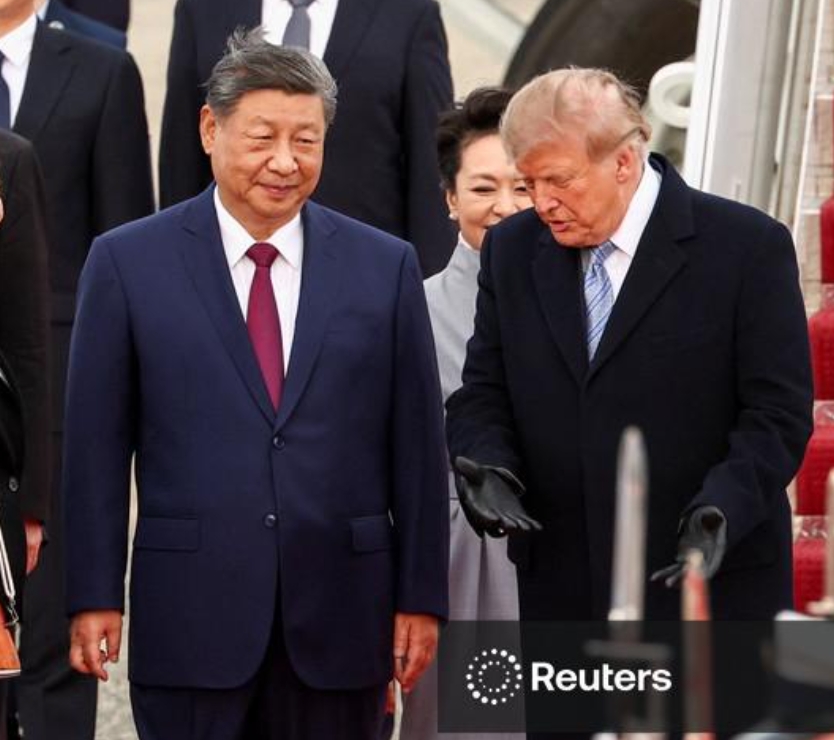
Chinese President Xi Jinping has arrived in the United States for a high-level state visit, opening a new chapter in the increasingly consequential relationship between Washington and Beijing as the two countries confront disputes over trade, artificial intelligence, rare-earth minerals, Taiwan and the ongoing war between the United States and Iran.
Xi’s visit, his first to Washington in more than a decade, comes four months after US President Donald Trump travelled to Beijing for talks with the Chinese leader.
Trump personally welcomed Xi and his wife, Peng Liyuan, at Joint Base Andrews on Wednesday, ahead of Thursday’s formal state reception and talks at the White House.
READ ALSO: China May Annex Taiwan Months After Trump’s Visit — Global Tracker Analysis Revealed
The White House has described the visit as a significant milestone in US-China relations, while Xi said upon arrival that Beijing and Washington should be “partners, not rivals”, stressing the importance of peaceful coexistence between the two countries.
The visit is taking place against the backdrop of profound strategic competition between the world’s two largest economies and amid several major international crises, including the Ukraine war, the Iran conflict and tensions surrounding Taiwan.
1. Trade Truce And Economic Rivalry
Trade is expected to dominate the Trump-Xi discussions, with Washington seeking concrete economic gains while Beijing attempts to prevent another escalation in tariffs and technology restrictions.
The two countries have extended their trade truce, providing additional time for negotiations on tariffs and other economic disputes.
US officials are also seeking greater Chinese purchases of American agricultural products, including soybeans and other farm commodities, while discussions are expected to cover Boeing aircraft and other American exports.
Trump is also under pressure to demonstrate that his engagement with Beijing can produce tangible economic benefits for American businesses and consumers.
For China, maintaining access to the American market remains important, although Beijing has simultaneously expanded trade with other parts of the world.
Reuters reported that the two leaders are expected to discuss agriculture and non-tariff barriers, while US Trade Representative Jamieson Greer said the countries could make announcements relating to agricultural purchases and other trade issues.
2. Rare Earths: China’s Strategic Advantage
One of the most important economic issues confronting the two leaders is China’s dominance of the global rare-earth supply chain.
Rare-earth elements are critical to the production of electric vehicles, electronics, advanced communications equipment, renewable-energy technology and military systems.
Reuters reported on Thursday that the United States is expected to remain dependent on China for rare-earth materials well into the 2030s, despite American efforts to expand domestic mining and processing.
China controls a dominant share of global rare-earth mining, refining and production, giving Beijing significant leverage in negotiations with Washington.
The issue became particularly contentious after China previously restricted rare-earth exports in response to American trade measures, causing concern across global supply chains.
3. Artificial Intelligence And Technology
Artificial intelligence is another major item on the Trump-Xi agenda.
Washington and Beijing are competing for technological leadership in AI, semiconductors and advanced computing, while both governments are increasingly concerned about the national-security implications of rapidly developing AI systems.
US officials have discussed creating an AI dialogue with China and even a communication mechanism designed to prevent dangerous incidents involving advanced technology from escalating into broader confrontation.
However, major differences remain over American restrictions on the export of advanced technologies to China and Beijing’s demand for greater access to sophisticated computing and semiconductor technology.
The presence of senior executives from major American technology companies at the White House state dinner illustrates the importance of technology and business ties to the summit.
4. Taiwan At The Centre Of Strategic Tension
Taiwan remains one of the most sensitive issues in the US-China relationship.
China regards Taiwan as part of its territory and opposes American arms sales and military support for the island.
Taiwan, however, maintains its own democratic government and rejects Beijing’s sovereignty claims.
The United States does not maintain formal diplomatic relations with Taiwan but remains its principal international arms supplier and security partner.
According to Reuters, Chinese officials are expected to press Trump to halt or reduce US arms sales to Taiwan and to adopt stronger language opposing Taiwanese independence.
Trump has previously described a proposed US arms package for Taiwan as a potential negotiating tool.
Any substantial change in American policy towards Taiwan would have implications for the wider Indo-Pacific security environment and for US relations with Japan and South Korea, both of which have expressed support for Taiwan’s security.
There is, however, no publicly verified evidence that Trump and Xi have reached a secret agreement for the United States to abandon Taiwan or permit China to annex the island.
5. Iran War Adds Another Dimension
The continuing US-Iran war has added another major geopolitical dimension to the Trump-Xi meeting.
China maintains close relations with Iran and is the world’s largest buyer of Iranian oil, giving Beijing considerable economic interests in the conflict and the wider Middle East.
Washington has sought Chinese influence over Tehran, particularly as the conflict continues to affect energy supplies, trade and regional security.
US Treasury Secretary Scott Bessent has said that Trump’s discussions with Xi will include China’s financial relationship with Iran.
Beijing, however, has shown limited willingness to use its relationship with Tehran in the manner Washington would prefer.
The Iran issue therefore represents another area in which the interests of Washington and Beijing overlap in some respects while diverging sharply in others.
6. Ukraine War And China’s Relationship With Russia
Although Ukraine is not expected to dominate the summit in the same way as trade or Taiwan, the Russia-Ukraine war remains part of the broader strategic context.
China maintains a close strategic relationship with Russia and has continued extensive economic engagement with Moscow despite Western pressure.
Washington and its allies have accused Beijing of providing economic and industrial support that helps sustain Russia’s war capacity, while China rejects the characterisation that it is a party to the conflict.
The issue is particularly significant because China’s relationship with Russia forms an important part of the emerging international balance.
While Washington remains focused on the war in Ukraine, Beijing continues to describe itself as a country seeking dialogue and political resolution.
From Washington-Beijing Rivalry To A Multipolar World
Xi’s visit also carries significance beyond bilateral US-China relations.
His journey to Washington follows Trump’s May visit to Beijing and comes after Russian President Vladimir Putin’s engagement with Xi in China.
The sequence of meetings has highlighted China’s growing position at the centre of major diplomatic and economic relationships.
China is simultaneously negotiating with the United States, maintaining its strategic partnership with Russia and preserving close economic relations with Iran.
This does not mean that China, Russia and Iran constitute a single military or political bloc. Their interests differ on numerous issues.
But their expanding economic and diplomatic relationships are contributing to a world in which power is increasingly distributed among several major centres.
Russia and China have repeatedly promoted the concept of a multipolar world, arguing that international affairs should not be dominated by one power.
The United States, meanwhile, remains a major military, financial and technological power and continues to exercise substantial influence across Europe, Asia and the Middle East.